Lose vs Loose: Meaning, Difference, Pronunciation, and How to Use Each Correctly

If you often wonder whether to write lose or loose, you are not alone. These two words look and sound similar, but they have different meanings, pronunciations, and grammatical roles.

The simplest rule is this:

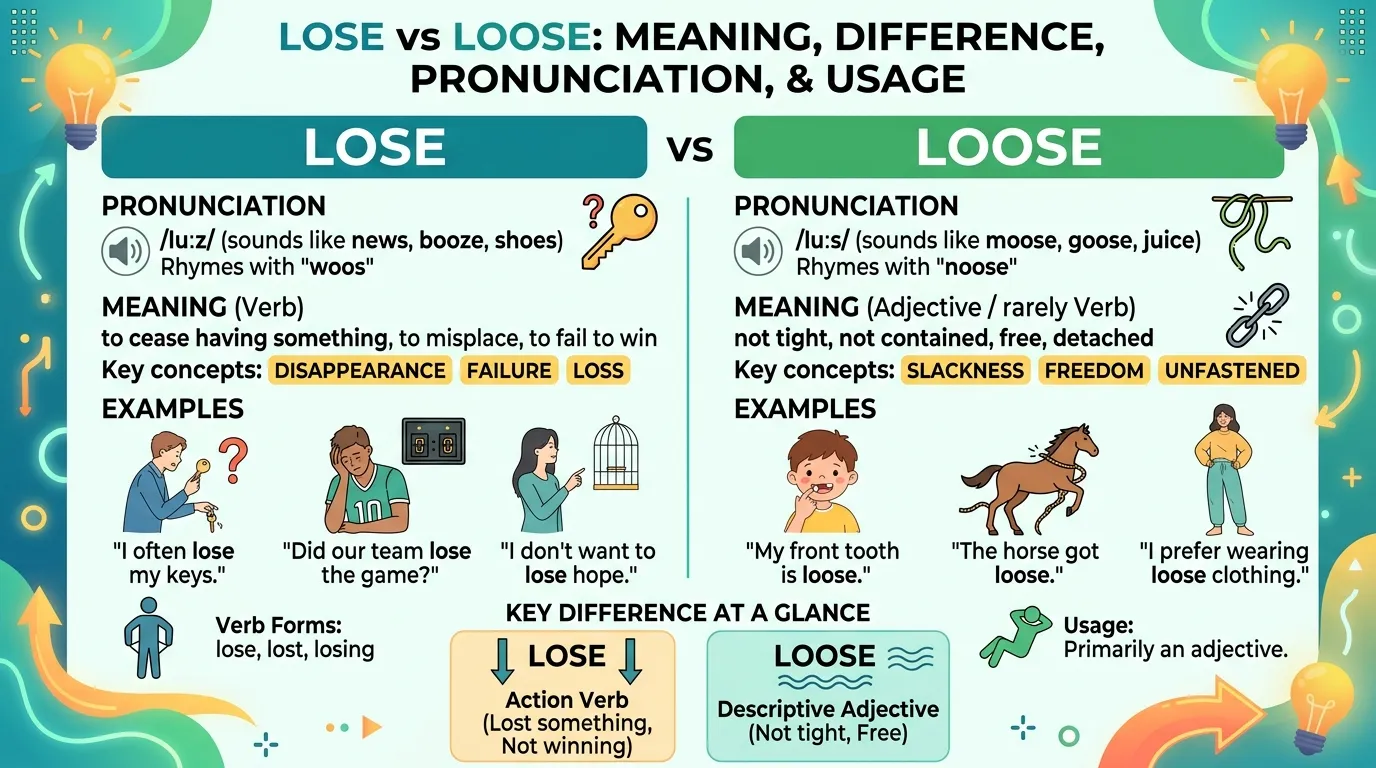
Lose means to misplace something, fail to win, or no longer have something.
Loose means not tight, not firmly attached, or free from restraint.

For example:

  • I don’t want to lose my phone.
  • My phone case is loose.
  • Our team could lose the game.
  • This screw is loose.

The confusion usually happens because both words contain the same letters—los-—and because English pronunciation does not always match spelling in an obvious way.

This guide explains lose vs loose in detail, including their definitions, pronunciation, grammar, word history, common expressions, examples, mistakes, memory tricks, and usage in American and British English.


Quick Answer: Lose vs Loose

Lose and loose are both correct English words, but they are not interchangeable.

WordBasic meaningPronunciationExample
LoseMisplace, fail to win, or no longer have/luːz/Don’t lose your keys.
LooseNot tight, not firmly fixed, or free/luːs/The knot is loose.

The easiest way to remember

Lose has one O and usually refers to losing something.

Loose has two O’s and usually describes something that is not tight.

Think:

Lose = no longer have
Loose = not tight


What Is the Difference Between Lose and Loose?

The main difference between lose and loose is their meaning and grammatical function.

Lose

Lose is primarily a verb.

It can mean:

  • to misplace something
  • to fail to win
  • to no longer have something
  • to experience a reduction
  • to become unable to find or follow something
  • to be deprived of someone or something

Examples:

  • I might lose my wallet.
  • They could lose the match.
  • She doesn’t want to lose her job.
  • We may lose power during the storm.
  • He began to lose interest in the project.

Loose

Loose is most commonly an adjective.

It describes something that:

  • is not tight
  • is not securely attached
  • is not closely controlled
  • is free or unrestricted
  • is not compact or firmly held together

Examples:

  • My shoes are loose.
  • The dog got loose.
  • There is a loose connection.
  • She wore a loose shirt.
  • The papers were loose on the desk.

Loose can also function as a verb, although this use is less common. As a verb, it can mean to release or set free.

Example:

  • The soldiers were ordered to loose the prisoners.

In everyday American English, however, loose is far more commonly used as an adjective.


Lose Meaning and Definition

Lose is a verb with several related meanings.

Dictionary-style definition of lose

Lose means to:

  1. Fail to keep or retain something.
  2. Misplace something and be unable to find it.
  3. Fail to win a competition or contest.
  4. Experience the death or departure of someone.
  5. Decrease in amount, value, weight, or quality.
  6. Stop understanding, remembering, or following something.
  7. Waste or miss an opportunity.

Examples

Misplace:

I always worry that I will lose my keys.

Fail to win:

Our team may lose the championship.

No longer possess:

He could lose his job if he ignores the warning.

Decrease:

The company may lose money this quarter.

Stop understanding:

I lost the speaker halfway through the presentation.

Miss an opportunity:

Don’t lose your chance to apply.


Loose Meaning and Definition

Loose is primarily an adjective describing something that is not tight, firmly attached, controlled, or contained.

Dictionary-style definition of loose

Loose can mean:

  • not firmly fixed
  • not tightly fastened
  • not close-fitting
  • free from restraint
  • not tightly packed
  • lacking strict control
  • approximate rather than exact

Examples

This belt is too loose.

The tooth feels loose.

There is a loose wire behind the computer.

The company has a loose structure.

The dog broke loose from its leash.

The word can describe both physical and figurative situations.


Lose vs Loose Pronunciation

Pronunciation is one of the clearest ways to distinguish the two words.

How to pronounce lose

Lose is pronounced approximately:

looz

The final sound is a /z/ sound.

lose → /luːz/

It rhymes with words such as:

  • choose
  • shoes
  • news
  • blues

Example:

Don’t lose your shoes.

How to pronounce loose

Loose is pronounced approximately:

loos

The final sound is an /s/ sound.

loose → /luːs/

It rhymes with:

  • goose
  • moose
  • juice
  • noose

Example:

These shoes are too loose.

Pronunciation trick

Say these aloud:

lose — choose

loose — goose

The final consonant changes:

  • lose → /z/
  • loose → /s/

This difference is important because spelling alone can make the words look almost identical.


Is Lose a Verb or an Adjective?

Lose is primarily a verb.

It describes an action, condition, or change.

Examples:

  • I lose things easily.
  • We lost the game.
  • She has lost her wallet.
  • They might lose money.
  • Don’t lose hope.

Forms of lose

FormWord
Base formlose
Third-person singularloses
Past tenselost
Past participlelost
Present participlelosing

Notice that the past tense is lost, not “loosed.”

Correct:

She lost her phone.

Incorrect:

She loosed her phone.


Is Loose a Verb or an Adjective?

Loose is most commonly an adjective.

Examples:

  • a loose shirt
  • a loose tooth
  • a loose screw
  • loose clothing
  • loose papers

It can also appear in expressions where it functions differently.

Loose as a verb

As a verb, loose means to release or set free.

Example:

The hunter loosed the arrow.

This usage is grammatically correct but relatively uncommon in modern everyday conversation.

Loose as an adverb

The phrase on the loose describes someone or something that has escaped or is free.

The escaped animal is on the loose.


Why Do People Confuse Lose and Loose?

There are several reasons.

They look almost identical

Both words begin with:

los-

Only the number of O’s and final consonant differ.

That makes them easy to mix up when writing quickly.

Their pronunciations are similar

Both begin with the long oo sound.

The important distinction comes at the end:

  • lose → z
  • loose → s

English spelling is complicated

English contains many words whose spelling does not perfectly predict pronunciation.

Writers may therefore remember the meaning but still select the wrong spelling.

Online writing makes the mistake common

Typos and spelling errors involving lose and loose frequently appear in:

  • social media posts
  • comments
  • text messages
  • forums
  • blogs
  • advertisements
  • casual emails

The mistake is especially noticeable in phrases such as:

Don’t loose hope.

The correct expression is:

Don’t lose hope.


Lose vs Loose: Side-by-Side Comparison

FeatureLoseLoose
Part of speechMainly verbMainly adjective
Main ideaNo longer have or failNot tight or not firmly fixed
Final sound/z//s/
ExampleDon’t lose your phone.The lid is loose.
Past tenselostloosed, only for the verb
Oppositegain, win, keep, findtight, secure, restrained
Common phraselose weightloose clothing
Typical useAction or lossDescription

A useful question is:

Am I talking about losing something, or describing something that isn’t tight?

If you are describing something that isn’t tight, choose loose.

If you mean to misplace, fail, or no longer have something, choose lose.


Common Meanings of Lose

The verb lose appears in many everyday contexts.

Lose something

This means you cannot find or keep something.

I lost my wallet yesterday.

Don’t lose your passport while traveling.

Lose a game

This means you fail to win.

We lost the basketball game.

Nobody wants to lose the final.

Lose weight

This means to reduce body weight.

He wants to lose weight.

The phrase is lose weight, never “loose weight.”

Lose money

This means to experience a financial loss.

The business could lose money this year.

Lose interest

This means to stop being interested.

She lost interest in the project.

Lose control

This means to stop controlling a situation or yourself.

The driver lost control of the vehicle.

Lose time

This means to waste or no longer have available time.

We can’t afford to lose time.


Common Meanings of Loose

Not tight

My jeans are loose.

Not securely attached

The handle is loose.

Not closely packed

Her hair was loose around her shoulders.

Free from restraint

The horse broke loose.

Not strict

The organization has a loose structure.

Approximate

A loose interpretation is one that is not exact or strict.

That’s a loose translation of the original phrase.


Lose vs Loose in Everyday Sentences

Here are practical examples that show the difference clearly.

Correct use of lose

  • Don’t lose your keys.
  • I don’t want to lose this opportunity.
  • They might lose the game.
  • She lost her phone.
  • He is trying to lose weight.
  • We could lose power tonight.
  • Don’t lose confidence.
  • I lost track of time.
  • The company may lose customers.
  • She doesn’t want to lose her job.

Correct use of loose

  • My shirt is loose.
  • This screw is loose.
  • The dog is loose.
  • The knot is loose.
  • He prefers loose clothing.
  • A loose wire can cause problems.
  • The horse broke loose.
  • She wore her hair loose.
  • The group followed a loose plan.
  • The connection is loose.

Common Lose vs Loose Mistakes

These errors are extremely common.

IncorrectCorrectWhy
Don’t loose hope.Don’t lose hope.You mean “do not give up hope.”
I don’t want to loose the game.I don’t want to lose the game.Losing a game means failing to win.
I need to loose weight.I need to lose weight.Weight decreases; it isn’t “loose.”
My pants are lose.My pants are loose.The pants are not tight.
The screw is lose.The screw is loose.The screw isn’t firmly attached.
Don’t loose your keys.Don’t lose your keys.You could misplace them.
The dog got lose.The dog got loose.The dog escaped restraint.

Awkward vs Natural Examples

Sometimes both words appear close together, making the difference easier to understand.

Awkward

I don’t want to loose my loose change.

Natural and correct

I don’t want to lose my loose change.

Here, lose is the verb. Loose describes the change because it is not contained in a wallet, purse, or container.

Another example:

Don’t lose your loose papers.

The papers are loose, but you could lose them.

This is a useful sentence for remembering the distinction.


Lose vs Loose in Formal Writing

The distinction matters in professional and academic writing.

Business writing

Correct:

The company could lose several clients.

Correct:

The connection appears loose.

Incorrect:

The company could loose several clients.

Academic writing

Correct:

The study may lose participants over time.

Correct:

The researchers used a loose definition of the term.

Journalism

Correct:

The team could lose its leading position.

Correct:

Police reported that a dangerous animal was on the loose.

Technical writing

Correct:

A loose cable may cause intermittent failure.

Correct:

The device may lose power if the connection fails.


Lose vs Loose in Sports

Sports writing frequently uses lose.

Examples:

The team could lose the championship.

They lost their last three games.

The player does not want to lose his starting position.

Loose appears when describing physical conditions or playing style.

He wore a loose jersey.

The defense looked loose in the second half.

The team’s defensive structure became loose.

A common phrase is:

Let loose

This means to release energy, emotion, or restraint.

Example:

The players let loose after the victory.


Lose vs Loose in Business and Professional English

In professional settings, choosing the correct word is especially important because spelling errors can affect credibility.

Lose

Common business collocations include:

  • lose money
  • lose customers
  • lose revenue
  • lose market share
  • lose a client
  • lose a contract
  • lose an opportunity
  • lose productivity
  • lose credibility
  • lose control
  • lose focus
  • lose time

Example:

A company can lose customers if its service quality declines.

Loose

Common professional collocations include:

  • loose connection
  • loose structure
  • loose definition
  • loose agreement
  • loose framework
  • loose interpretation
  • loose guidelines
  • loose association

Example:

The two organizations have a loose association rather than a formal partnership.


Lose vs Loose in Technical Contexts

Both words appear in technical English, but they describe different things.

Loose often describes a physical component that is not securely attached.

The technician found a loose cable.

Check for loose screws.

The battery connection is loose.

Lose describes a failure to retain something.

The system may lose data.

The device can lose its network connection.

The sensor may lose power.

A useful distinction is:

Loose connection = the connection is not secure.

Lose connection = the connection disappears.

Compare:

The cable is loose, so the computer may lose its connection.

Both words are correct because they describe different ideas.


Common Collocations With Lose

A collocation is a group of words that naturally occur together.

Common expressions with lose include:

  • lose weight
  • lose money
  • lose time
  • lose sleep
  • lose interest
  • lose control
  • lose hope
  • lose patience
  • lose focus
  • lose confidence
  • lose a game
  • lose a job
  • lose a friend
  • lose an opportunity
  • lose track
  • lose touch
  • lose sight
  • lose your temper
  • lose your mind
  • lose your way

Examples

I lost track of time.

Don’t lose hope.

She lost touch with her old classmates.

He lost his temper during the argument.


Common Collocations With Loose

Common combinations include:

  • loose clothing
  • loose hair
  • loose change
  • loose tooth
  • loose screw
  • loose wire
  • loose connection
  • loose knot
  • loose fitting
  • loose structure
  • loose definition
  • loose translation
  • loose interpretation
  • loose agreement

Examples

I found some loose change in my pocket.

The dentist examined my loose tooth.

There is a loose wire behind the desk.


Common Phrases and Idioms With Lose

Lose your temper

To become angry.

He lost his temper during the meeting.

Lose your mind

To become extremely upset, confused, or irrational; often used informally.

I thought I was going to lose my mind waiting for the results.

Lose track of time

To stop noticing how much time has passed.

I lost track of time while reading.

Lose touch

To stop communicating with someone.

We lost touch after college.

Lose sight of

To stop seeing something or forget an important goal.

Don’t lose sight of your long-term goal.


Common Phrases and Idioms With Loose

On the loose

Free after escaping confinement or control.

The escaped prisoner was still on the loose.

The phrase can also be used humorously.

My children are on the loose in the backyard.

Let loose

To release or allow someone to behave freely.

The coach told the players to let loose after the game.

Loose ends

Unfinished matters that need attention.

We still have a few loose ends to resolve.

Cut loose

To become independent or behave freely.

She decided to cut loose and enjoy the weekend.

Loose cannon

A person who behaves unpredictably and may cause problems.

The politician was considered a loose cannon by some members of the party.


Lose vs Loose: Synonyms and Antonyms

Understanding related words can make the distinction easier.

Synonyms for lose

Depending on context:

  • misplace
  • forfeit
  • surrender
  • fail
  • miss
  • waste
  • decrease
  • decline
  • drop
  • abandon

Example:

I lost my keys.

Possible synonym:

I misplaced my keys.

Antonyms for lose

Depending on meaning:

  • find
  • gain
  • win
  • keep
  • retain
  • acquire
  • preserve

Synonyms for loose

Depending on context:

  • slack
  • free
  • relaxed
  • unsecured
  • detached
  • unfastened
  • unrestricted
  • spacious
  • approximate

Antonyms for loose

  • tight
  • secure
  • fixed
  • fastened
  • restrained
  • strict
  • compact

Lose vs Loose Word History

The two words are historically related in appearance but developed into distinct modern words.

Lose comes from Old English forms related to the idea of being deprived of something, perishing, or failing to retain something. Over time, its meanings expanded into the modern senses of misplacing, failing to win, and experiencing a reduction.

Loose comes from Old Norse and Old English forms associated with being free, released, or not firmly fastened. Its modern meanings developed around the idea of something being unrestricted, unattached, or not tight.

Their similar spelling does not mean they have the same meaning.

Modern English treats them as two separate words.


Regional Differences: American vs British English

There is no major American-versus-British spelling difference between lose and loose.

Both American English and British English use:

  • lose
  • loose

The meanings and basic pronunciations are also essentially the same.

You should therefore write:

I don’t want to lose the game.

in both American and British English.

Likewise:

These shoes are too loose.

is correct in both varieties.

The important issue is not regional preference but choosing the word that matches the intended meaning.


Lose vs Loose in Casual Texting and Social Media

In casual communication, people sometimes type loose when they mean lose.

For example:

I don’t wanna loose this game.

This is a spelling mistake, even though readers may understand the intended meaning.

Correct:

I don’t wanna lose this game.

Similarly:

Don’t loose hope!

should be:

Don’t lose hope!

Casual writing allows abbreviations, slang, and informal grammar, but lose vs loose remains an important spelling distinction when you want your writing to look polished.


How to Remember Lose vs Loose

Here are several effective memory tricks.

Trick 1: One O means lose

Remember:

Lose = one O

Think of losing one O.

This is not a linguistic rule, but it is a useful spelling memory aid.

Trick 2: Loose has extra space

Loose has an extra O.

Imagine the extra O creates extra space.

Something with extra space can be loose.

Trick 3: Loose has more letters

Loose has five letters.

Lose has four.

The longer word can remind you of something that is not tight.

Trick 4: Listen to the final sound

Lose ends with a Z sound.

Loose ends with an S sound.

Say:

lose → /z/

loose → /s/


A Simple Memory Sentence

This sentence contains both words correctly:

Don’t lose your loose change.

Why?

You might lose the change because you cannot find it.

The change is loose because it is not secured in a wallet or container.

Another useful sentence:

Don’t lose your loose shoelace.

The shoelace is loose, and you could lose it.


Lose vs Loose vs Loosen

A third word often causes confusion: loosen.

These three words are different.

WordMeaningExample
LoseMisplace, fail, or no longer haveDon’t lose your keys.
LooseNot tight or secureThe knot is loose.
LoosenMake something less tightLoosen the knot.

Notice the relationship:

tight → loosen → loose

For example:

Loosen the belt because it is too tight.

After you loosen it:

The belt is loose.

But:

Don’t lose the belt.

That means don’t misplace it.


Lose vs Loose vs Looser vs Loser

These words are also easy to confuse.

Lose

Verb:

Don’t lose the game.

Loose

Adjective:

The shirt is loose.

Looser

Comparative adjective:

This shirt is looser than the other one.

Loser

Noun:

The loser leaves the competition.

Notice that loser comes from lose, not loose.

Correct:

The losing team became the loser.

Incorrect:

The losing team became the looser.

Looser means “more loose.”

Example:

This jacket is looser than mine.


Practical Recommendations for Better Writing

When proofreading, stop whenever you see lose or loose and ask what you mean.

Use lose when you mean:

  • misplace
  • fail to win
  • no longer have
  • decrease
  • miss
  • waste
  • surrender
  • stop understanding
  • stop communicating

Use loose when you mean:

  • not tight
  • unsecured
  • free
  • relaxed
  • not firmly controlled
  • approximately defined
  • not closely packed

Use loosen when you mean:

  • make less tight
  • release slightly
  • relax a restriction

This simple three-way distinction eliminates most errors.


Frequently Asked Questions

Is it lose or loose?

Both lose and loose are correct English words, but they have different meanings. Lose is mainly a verb meaning to misplace, fail to win, or no longer have something. Loose is mainly an adjective meaning not tight, not secure, or free from restraint.

What is the difference between lose and loose?

Lose means to misplace something, fail to win, or no longer possess something. Loose means not tight, not firmly attached, or free. For example, “I don’t want to lose my keys” and “The screw is loose.”

Is loose the past tense of lose?

No. The past tense of lose is lost.

Correct:

I lost my phone.

Incorrect:

I loose my phone.

Loose is a separate word.

Is it lose weight or loose weight?

The correct phrase is lose weight.

You lose weight because your weight decreases. Loose weight is incorrect in standard English.

Is it lose hope or loose hope?

The correct expression is lose hope.

Example:

Don’t lose hope.

Here, lose means to stop having or maintaining hope.

Is it loose change or lose change?

The correct phrase is loose change when you mean coins that are not secured in a wallet, purse, or container.

Example:

I found some loose change in my car.

However, lose change could theoretically appear in a sentence where lose is a verb:

You might lose change if you leave it on the table.

Is loose a verb?

Yes, loose can be a verb meaning to release or set free, but this use is relatively uncommon in everyday modern English.

Example:

The archer loosed an arrow.

In ordinary writing, loose is much more commonly an adjective.

How do you pronounce lose and loose?

Lose ends with a /z/ sound and sounds like “looz.” Loose ends with an /s/ sound and sounds like “loos.” A useful comparison is lose/choose versus loose/goose.

Is “looser” related to “lose”?

No. Looser means “more loose.”

Example:

These pants are looser than those pants.

The person who loses is a loser, which comes from lose.

How can I remember lose vs loose?

Use the memory sentence:

Don’t lose your loose change.

Lose means misplace it. Loose describes the change as being unsecured. You can also remember that loose has an extra O, which can represent extra space.


Conclusion

The difference between lose vs loose becomes easy once you focus on meaning rather than spelling.

Lose is mainly a verb. It means to misplace something, fail to win, no longer have something, decrease, or miss an opportunity.

I don’t want to lose my keys.

Loose is mainly an adjective. It means not tight, not firmly attached, unrestricted, or not closely controlled.

My shoelaces are loose.

Remember the most useful distinction:

Lose = misplace, fail, or no longer have.
Loose = not tight or not secure.

Also remember the pronunciation:

lose → /z/
loose → /s/

And don’t forget loosen, which means to make something less tight.

Whether you are writing an email, school assignment, business report, blog post, social media caption, technical document, or everyday message, choosing lose and loose correctly will make your writing clearer and more professional.

The quickest memory trick is simple:

Don’t lose your loose change.

Once that sentence sticks, this common spelling problem is much easier to avoid.

Leave a Comment