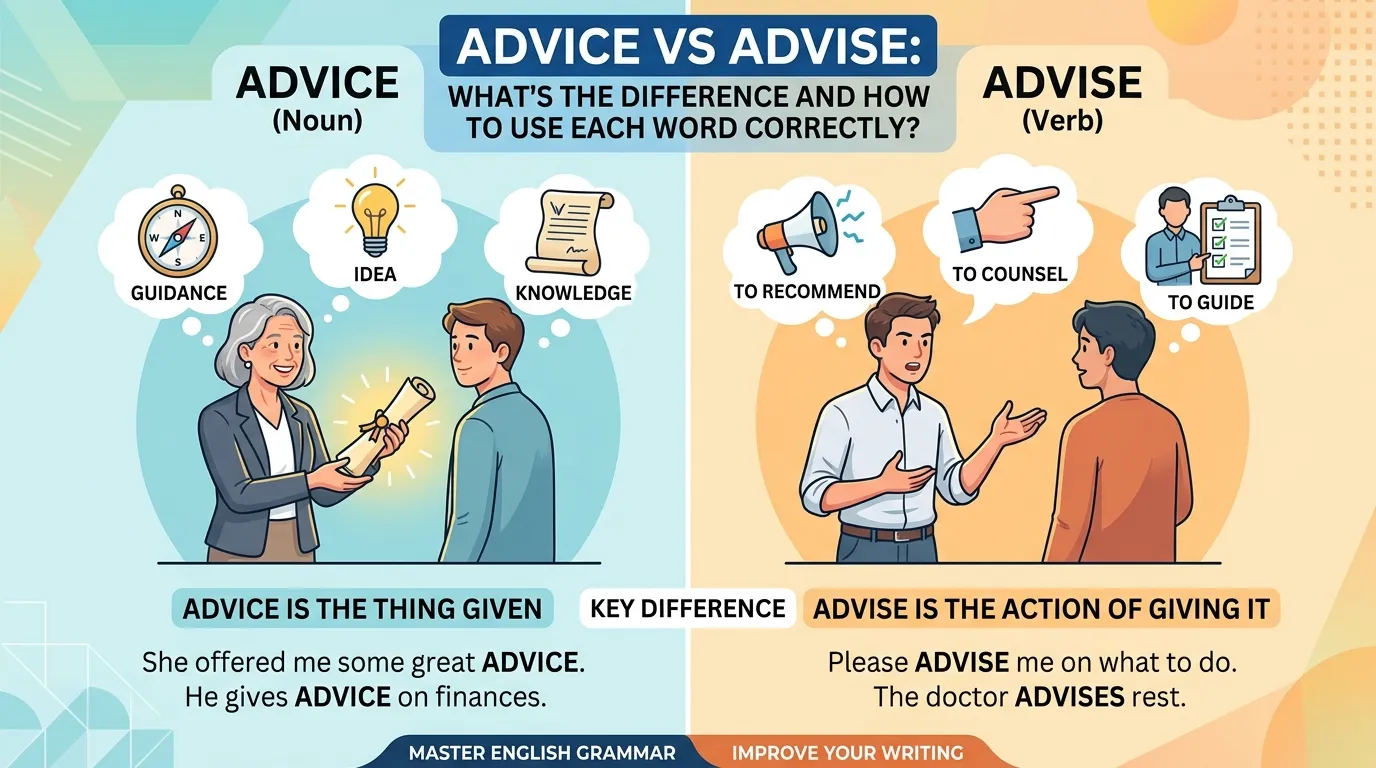
If you have ever wondered whether to write advice or advise, you are not alone. These two words look almost identical, sound similar, and are closely related in meaning. However, they have different grammatical roles and pronunciations, so they cannot always be used interchangeably.
The simplest rule is this: advice is a noun, while advise is a verb. You give advice, but you advise someone. For example, “She gave me good advice” is correct, while “She advised me to wait” is also correct.
Understanding the difference between advice vs advise can help you avoid common spelling and grammar mistakes in emails, essays, business writing, social media posts, academic work, and everyday conversations.
In this guide, you will learn the meanings, pronunciations, grammatical differences, usage rules, examples, common expressions, regional differences, word history, synonyms, memory tricks, and frequent mistakes involving advice and advise.
Quick Answer: Advice vs Advise
The difference between advice and advise is mainly grammatical:
| Word | Part of speech | Meaning | Example |
|---|---|---|---|
| Advice | Noun | A suggestion or recommendation | “Thanks for your advice.” |
| Advise | Verb | To give advice or recommend something | “I advise you to wait.” |
Easy rule to remember
Advice = something you give.
Advise = something you do.
You can:
- give advice
- offer advice
- receive advice
- ask for advice
- follow advice
- take advice
- advise someone
- advise someone to do something
- advise against something
A useful sentence to remember is:
“My friend gave me good advice, so I advised my brother to follow it.”
What Does Advice Mean?
Advice is a noun meaning a suggestion, recommendation, opinion, or guidance about what someone should do.
When someone gives you advice, they are offering their thoughts about a situation and suggesting a possible course of action.
Dictionary-style definition of advice
Advice: A recommendation or opinion offered to help someone decide what to do.
Examples of advice
- “My teacher gave me useful advice.”
- “Can I ask you for some advice?”
- “She offered me excellent career advice.”
- “His advice helped me make a better decision.”
- “I appreciate your advice.”
- “You should take her advice seriously.”
In each example, advice names the information or recommendation being given.
Advice is a noun
This is the most important grammar point.
You can use advice as the object of a verb:
- “She gave me advice.”
- “I need advice.”
- “He offered advice.”
- “We received advice.”
You can also describe advice with adjectives:
- good advice
- useful advice
- practical advice
- helpful advice
- professional advice
- valuable advice
- honest advice
- sound advice
- expert advice
- financial advice
- legal advice
- career advice
What Does Advise Mean?
Advise is a verb. It means to give someone advice, recommend an action, or tell someone what you think they should do.
Dictionary-style definition of advise
Advise: To give someone a recommendation, suggestion, or opinion about what they should do.
Examples of advise
- “I advise you to leave early.”
- “The doctor advised him to rest.”
- “She advised me against buying the car.”
- “Our manager advised us to check the report.”
- “I would advise caution.”
- “They advised customers to arrive early.”
Because advise is a verb, it describes an action.
Compare:
- “She gave me advice.”
- “She advised me.”
The first sentence uses a noun. The second uses a verb.
Advice vs Advise: The Main Difference
The easiest way to understand these words is to look at what each one does in a sentence.
Advice is a thing
Advice refers to the recommendation itself.
“His advice was helpful.”
The advice is the information or recommendation.
Advise is an action
Advise refers to the act of giving that recommendation.
“He advised me to study harder.”
Here, advised describes what he did.
Think of it this way:
Advice = recommendation
Advise = recommend
That simple comparison will solve most usage questions.
Advice vs Advise Pronunciation
Another important difference is pronunciation.
Although the spelling is very similar, the final sound changes.
Advice pronunciation
Advice is pronounced with an /s/ sound at the end.
It sounds roughly like:
ad-VICE
The ending sounds like the s in “ice.”
Advise pronunciation
Advise is pronounced with a /z/ sound at the end.
It sounds roughly like:
ad-VIZE
The ending sounds like the z in “size.”
Why pronunciation matters
The pronunciation difference can help you remember the spelling and grammatical role.
- advice → noun → final s sound
- advise → verb → final z sound
This distinction is especially useful in spoken English.
Is Advice or Advise Correct?
Both are correct words. The correct choice depends on how you use the word.
Use advice when you need a noun
Correct:
“Thank you for your advice.”
Incorrect:
“Thank you for your advise.”
The second sentence is wrong because the sentence needs a noun.
Use advise when you need a verb
Correct:
“I advise you to be careful.”
Incorrect:
“I advice you to be careful.”
The second version incorrectly uses the noun where a verb is required.
Compare these sentences
- “I need your advice.”
- “Please advise me.”
- “She gave me advice.”
- “She advised me.”
- “His advice was useful.”
- “He advised caution.”
Why Do People Confuse Advice and Advise?
The confusion is understandable because the two words are closely related.
They:
- Look almost identical.
- Have related meanings.
- Come from the same word family.
- Are pronounced similarly.
- Both involve recommendations or guidance.
The main difference is easy to overlook because only one letter changes:
advice
advise
That final c versus s distinction carries an important grammatical difference.
English has many word pairs that cause similar problems because spelling, pronunciation, and grammar do not always line up in obvious ways.
Advice vs Advise Grammar Rules
Understanding sentence structure makes the difference much easier.
Advice as a noun
Common structures include:
give + advice
“She gave me some advice.”
ask for + advice
“I asked my father for advice.”
need + advice
“I need some advice.”
take + advice
“You should take his advice.”
follow + advice
“She followed her lawyer’s advice.”
Advise as a verb
Common structures include:
advise + someone
“The teacher advised the student.”
advise + someone + to + verb
“The teacher advised the student to study.”
advise + against + noun or -ing form
“The doctor advised against driving.”
“She advised against making a quick decision.”
advise + noun
“The lawyer advised caution.”
Is “Advise Me” Correct?
Yes.
“Please advise me” is grammatically correct because advise is a verb.
For example:
“Please advise me on what to do next.”
This expression is especially common in professional and business communication.
However, in everyday American English, alternatives can sometimes sound more natural:
- “Please let me know what you recommend.”
- “What would you suggest?”
- “Could you give me some advice?”
- “What do you think I should do?”
Is “Please Advice” Correct?
No, “please advice” is generally incorrect when you mean “please give me advice.”
Use:
“Please advise.”
Or:
“Please give me some advice.”
Why?
Because the sentence needs a verb after “please.” Advise is the verb.
Incorrect
“Please advice me.”
Correct
“Please advise me.”
Also correct
“Please give me your advice.”
Is “A Piece of Advice” Correct?
Yes.
Because advice is normally an uncountable noun in standard English, we generally do not say:
“an advice”
or
“two advices”
Instead, use:
- a piece of advice
- some advice
- a bit of advice
- words of advice
Examples
“Can I give you a piece of advice?”
“She gave me some useful advice.”
“He offered me a few words of advice.”
Why “an advice” is usually wrong
Advice does not normally take the indefinite article a/an in standard American English.
Incorrect:
“She gave me an advice.”
Correct:
“She gave me some advice.”
Correct:
“She gave me a piece of advice.”
Can You Say “Advices”?
Usually, no.
In standard English, advice is generally uncountable, so advices is not normally used when referring to recommendations.
Instead of:
“He gave me several advices.”
Use:
“He gave me several pieces of advice.”
Or:
“He gave me several recommendations.”
Natural alternatives
- several pieces of advice
- some helpful advice
- several recommendations
- a few suggestions
- useful guidance
Advice vs Advise in American English
In American English, the basic distinction is the same:
- advice = noun
- advise = verb
Examples:
“I appreciate your advice.”
“I advise you to reconsider.”
American English does not use a different basic grammar rule for these words.
The distinction is therefore important in:
- American school writing
- college essays
- workplace emails
- business documents
- websites
- blogs
- text messages
- professional communication
Advice vs Advise in British English
British English also distinguishes between advice and advise.
The noun remains:
“advice”
The verb remains:
“advise”
The pronunciation difference also exists in British English.
So this is one area where American and British English are essentially the same.
International English
Learners of English should use the same distinction in international, academic, and professional writing.
Whether you are writing for an American, British, Canadian, Australian, or international audience, the safest rule remains:
Advice is the noun. Advise is the verb.
Formal vs Informal Usage
Both words work in formal and informal English.
Informal examples
“Can I get your advice?”
“What would you advise me to do?”
“Thanks for the advice!”
Formal examples
“We advise all applicants to review the requirements carefully.”
“The committee provided advice regarding the proposed changes.”
“Professional advice should be obtained before making a major decision.”
Neither word is inherently formal or informal.
The surrounding expression determines the overall tone.
Advice vs Advise in Business Writing
Both words are extremely common in professional communication.
Business examples with advice
“Thank you for your advice regarding the project.”
“We value your advice on this matter.”
“The company sought financial advice before making the investment.”
Business examples with advise
“We advise customers to review the terms carefully.”
“Please advise us of any changes.”
“The team advised management of the potential problem.”
A common professional phrase is:
“Please advise.”
It means something like:
“Please let me know what you recommend or what action I should take.”
Advice vs Advise in Academic Writing
Academic writing often uses both words.
Examples with advice
“Students may benefit from academic advice before selecting their courses.”
“The researcher received advice from several experts.”
Examples with advise
“The authors advise readers to interpret the findings carefully.”
“The report advises organizations to review their procedures.”
In academic writing, choose the word based on grammar rather than formality.
Advice vs Advise in Journalism
Journalists may use both words depending on sentence structure.
Advice
“The agency issued advice to travelers.”
Advise
“Officials advised travelers to check for delays.”
A useful editing trick is to replace the word mentally with recommendation or recommend.
If recommendation works, use advice.
If recommend works, use advise.
For example:
“She gave me a recommendation.”
Therefore:
“She gave me advice.”
And:
“She recommended that I wait.”
Therefore:
“She advised me to wait.”
Advice vs Advise in Technical and Professional Writing
The same distinction applies in technical fields.
Medical context
“The doctor gave me medical advice.”
“The doctor advised me to rest.”
Legal context
“You should seek legal advice.”
“The attorney advised the client to review the contract.”
Financial context
“He received financial advice.”
“The consultant advised the company to reduce expenses.”
Safety context
“The company issued safety advice.”
“The company advised workers to wear protective equipment.”
The subject may change, but the grammar does not.
Common Collocations With Advice
A collocation is a group of words that naturally appear together.
Common combinations with advice include:
- good advice
- sound advice
- useful advice
- helpful advice
- practical advice
- valuable advice
- expert advice
- professional advice
- honest advice
- career advice
- financial advice
- legal advice
- medical advice
- relationship advice
- parenting advice
- travel advice
- safety advice
- seek advice
- ask for advice
- give advice
- offer advice
- receive advice
- take advice
- follow advice
Examples
“She gave me some practical advice.”
“You should seek professional advice.”
“His advice was honest but helpful.”
Common Collocations With Advise
Common patterns with advise include:
- advise someone
- advise someone to do something
- advise against something
- advise caution
- advise customers
- advise clients
- advise readers
- advise users
- advise students
- advise people
- strongly advise
- highly advise
Examples:
“I strongly advise you to check the details.”
“The doctor advised against strenuous activity.”
“The company advised customers to update their information.”
One note: “strongly advise” is natural, but “highly advise” is less natural in many contexts. “Strongly advise” is usually the better choice.
Common Expressions With Advice
Here are several natural phrases:
“A piece of advice”
“Let me give you a piece of advice.”
“Take my advice”
“Take my advice and check the contract first.”
“Follow someone’s advice”
“She followed her teacher’s advice.”
“Ask for advice”
“I asked my friend for advice.”
“Seek advice”
“You should seek professional advice.”
“Words of advice”
“He offered a few words of advice.”
Common Expressions With Advise
“Please advise”
“Please advise when the report is ready.”
“I advise you to…”
“I advise you to wait.”
“I would advise…”
“I would advise checking the information again.”
“Advise against…”
“Experts advise against making a decision too quickly.”
“Advise someone of something”
This means to inform someone about something, especially in formal or professional language.
“Please advise us of any changes to your address.”
Advice vs Advise: Comparison Table
| Feature | Advice | Advise |
|---|---|---|
| Part of speech | Noun | Verb |
| Basic meaning | Recommendation or guidance | To recommend or guide |
| Pronunciation ending | /s/ | /z/ |
| Can follow “give”? | Yes | No |
| Can follow “please” as a command? | No | Yes |
| Can be pluralized normally? | Usually no | Not applicable |
| Example | “Thanks for the advice.” | “I advise you to wait.” |
| Related word | recommendation | recommend |
Advice vs Advise Memory Tricks
Here are several easy ways to remember the difference.
Trick 1: Advice is a thing
Think:
Advice = information
You can give advice, receive advice, or ask for advice.
Trick 2: Advise is an action
Think:
Advise = recommend
If you can replace the word with recommend, you probably need advise.
“I advise you to leave.”
Becomes:
“I recommend that you leave.”
Trick 3: C for advice
Remember:
adviCe = noun
The c can remind you that advice is a concept or thing.
Trick 4: S sounds like advice
Advice ends with an s sound.
Advise ends with a z sound.
Common Advice vs Advise Mistakes
Mistake 1: “Thanks for your advise.”
Incorrect:
“Thanks for your advise.”
Correct:
“Thanks for your advice.”
Why? Because advice is the noun being received.
Mistake 2: “I advice you to wait.”
Incorrect:
“I advice you to wait.”
Correct:
“I advise you to wait.”
Why? The word describes an action, so you need the verb advise.
Mistake 3: “Please advice.”
Incorrect:
“Please advice.”
Correct:
“Please advise.”
Why? Please is followed by the base-form verb.
Mistake 4: “She gave me an advice.”
Incorrect:
“She gave me an advice.”
Correct:
“She gave me some advice.”
Correct:
“She gave me a piece of advice.”
Mistake 5: “He gave me many advices.”
Incorrect:
“He gave me many advices.”
Correct:
“He gave me several pieces of advice.”
Awkward vs Natural Examples
| Awkward or Incorrect | Natural and Correct |
|---|---|
| “Thanks for your advise.” | “Thanks for your advice.” |
| “I advice you to wait.” | “I advise you to wait.” |
| “Please advice.” | “Please advise.” |
| “She gave me an advice.” | “She gave me some advice.” |
| “He gave me three advices.” | “He gave me three pieces of advice.” |
| “I need your advise.” | “I need your advice.” |
| “Can you advice me?” | “Can you advise me?” |
| “His advise was helpful.” | “His advice was helpful.” |
| “She advised me some advice.” | “She gave me some advice.” |
| “He advised a good advice.” | “He gave good advice.” |
How to Choose Between Advice and Advise
When you are unsure, ask yourself one question:
Am I talking about the recommendation, or am I talking about giving the recommendation?
If you mean the recommendation, use advice.
“Her advice was helpful.”
If you mean the act of recommending, use advise.
“She advised me to wait.”
A three-second test
Replace the word with one of these:
advice → recommendation
advise → recommend
If the sentence still makes sense, you have your answer.
Example:
“I need your recommendation.”
Therefore:
“I need your advice.”
But:
“I recommend you wait.”
Therefore:
“I advise you to wait.”
Synonyms for Advice
Depending on context, synonyms for advice include:
- recommendation
- suggestion
- guidance
- counsel
- direction
- opinion
- input
- information
- instruction
- tip
- warning
- consultation
These words are not always exact replacements.
For example, guidance can suggest broader or ongoing help, while a tip is often a short and practical suggestion.
Examples
“She gave me some helpful guidance.”
“He offered a useful suggestion.”
“The consultant provided a recommendation.”
Synonyms for Advise
Depending on context, synonyms for advise include:
- recommend
- suggest
- counsel
- encourage
- urge
- guide
- caution
- warn
- inform
Again, context matters.
For example:
“I advise you to wait.”
can become:
“I recommend that you wait.”
Or:
“I urge you to wait.”
But urge is stronger than advise, while suggest can sound less forceful.
Antonyms and Contrasting Ideas
There is no single perfect antonym for advice, because advice can be positive, negative, cautious, or neutral.
Depending on context, contrasting ideas include:
- misinformation
- discouragement
- dissuasion
- refusal to recommend
- silence
- neglect
For advise, contrasting actions might include:
- mislead
- discourage
- conceal
- withhold information
- ignore
These are contextual opposites rather than exact dictionary antonyms.
Advice and Advise: Word History
The two words are historically connected.
Both ultimately developed from forms associated with the idea of considering, observing, or giving guidance. Their shared history explains why their meanings remain closely related.
Over time, English developed a useful distinction between the noun advice and the verb advise.
This noun-and-verb relationship appears in other English word families too. English often changes spelling or pronunciation slightly to distinguish related grammatical functions.
The historical connection is therefore one reason the words look so similar today.
Is There a Slang Meaning of Advice or Advise?
Neither advice nor advise has a major separate slang meaning in standard contemporary American English.
However, informal speech may use related expressions such as:
- “Here’s a tip.”
- “Take it from me.”
- “You should probably…”
- “My advice is…”
- “I’d recommend…”
- “Trust me on this.”
These expressions can communicate advice without using the exact word advice.
Social media and casual conversations may also use phrases such as “free advice” or “unsolicited advice.”
Unsolicited advice
Unsolicited advice means advice that someone gives without being asked for it.
Example:
“I appreciate your concern, but I didn’t ask for advice.”
This phrase is common in everyday conversations and online discussions.
Figurative and Broader Uses of Advice
Advice is usually literal: it refers to guidance or recommendations.
However, it can be used broadly or figuratively in expressions.
For example:
“The old saying offers good advice for difficult times.”
Here, advice can refer to a lesson or principle rather than a direct personal recommendation.
Similarly:
“The experience taught me a valuable lesson.”
Although “lesson” and “advice” are not identical, both can provide guidance.
Advice vs Advise in Sports
Sports writing uses both words naturally.
Advice
“The coach gave the players advice before the game.”
Advise
“The coach advised the players to stay focused.”
Sports commentators and journalists may also write:
“The coach advised against changing the strategy too quickly.”
The grammar remains exactly the same.
Advice vs Advise in Blogging and Online Content
Bloggers frequently use advice because many articles provide recommendations.
Examples include:
- relationship advice
- writing advice
- travel advice
- study advice
- career advice
- blogging advice
- parenting advice
- financial advice
Use advise when describing what a person, company, expert, or organization recommends.
“We advise readers to compare several options before deciding.”
For online writing, clarity matters more than trying to make one word sound more formal.
Formal Alternatives to Advice and Advise
Sometimes another word is more precise.
Instead of advice, you might use:
- recommendation
- guidance
- counsel
- suggestion
- professional opinion
Instead of advise, you might use:
- recommend
- suggest
- urge
- encourage
- caution
- inform
Compare tone
Advice:
“My advice is to wait.”
Recommendation:
“My recommendation is to wait.”
Suggestion:
“My suggestion is to wait.”
Advise:
“I advise you to wait.”
Recommend:
“I recommend that you wait.”
Each can be correct, but the tone and strength can differ.
Real-World Examples of Advice vs Advise
At school
“My teacher gave me good advice.”
“My teacher advised me to practice more.”
At work
“The manager gave us advice about the presentation.”
“The manager advised us to simplify the slides.”
With friends
“Can I ask you for some advice?”
“What would you advise me to do?”
In healthcare
“The patient received medical advice.”
“The doctor advised the patient to rest.”
In business
“The company sought professional advice.”
“The consultant advised the company to review its strategy.”
In everyday conversation
“Thanks for the advice.”
“I’d advise you to think about it first.”
Which Is More Formal: Advice or Advise?
Neither word is automatically more formal.
Advice is a noun, and advise is a verb. Their grammatical roles determine which one you use.
For example, both are perfectly appropriate in a formal business email:
“Thank you for your advice.”
and:
“We advise customers to review the policy.”
Trying to choose between them based on formality is the wrong approach. Choose based on grammar and meaning.
Advice vs Advise vs Recommend
Another useful comparison is advice vs advise vs recommend.
| Word | Role | Example |
|---|---|---|
| Advice | Noun | “She gave me advice.” |
| Advise | Verb | “She advised me to wait.” |
| Recommend | Verb | “She recommended that I wait.” |
| Recommendation | Noun | “She made a recommendation.” |
This word family can make the distinction easier to remember.
Advice and recommendation are nouns.
Advise and recommend are verbs.
Practical Editing Checklist
Before publishing an email, essay, article, or business document, check each use of advice and advise.
Ask:
- Is the word functioning as a noun?
- Am I talking about a recommendation itself?
- Could I replace it with recommendation?
- If so, use advice.
Or ask:
- Is the word functioning as a verb?
- Am I describing someone giving a recommendation?
- Could I replace it with recommend?
- If so, use advise.
Quick editing examples
“I need your ___.”
Replace with “recommendation.”
“I need your recommendation.”
Therefore:
“I need your advice.”
“I ___ you to wait.”
Replace with “recommend.”
“I recommend you wait.”
Therefore:
“I advise you to wait.”
The Most Important Rules to Remember
If you remember nothing else, remember these rules:
- Advice is a noun.
- Advise is a verb.
- Advice means a recommendation or guidance.
- Advise means to recommend or give guidance.
- Advice ends with an /s/ sound.
- Advise ends with a /z/ sound.
- Say some advice, not usually an advice.
- Say a piece of advice when you need a countable expression.
- Say advise me, not advice me.
- Say please advise, not please advice.
- Use advice after verbs such as “give,” “get,” “ask for,” and “receive.”
- Use advise when describing the action of recommending.
Advice vs Advise FAQs
1. What is the difference between advice and advise?
Advice is a noun meaning a recommendation or guidance. Advise is a verb meaning to recommend or give guidance. For example, “She gave me advice” and “She advised me to wait.”
2. Is it “advice” or “advise” someone?
Use advise when the word comes directly before “someone” as a verb.
Correct:
“I advise you to wait.”
You can also say:
“I gave you some advice.”
3. Is “Please advice” correct?
No. The correct phrase is “Please advise.” Here, advise is the verb meaning “please tell me what you recommend” or “please provide the requested information.”
4. Is “Thanks for your advise” correct?
No. The correct sentence is “Thanks for your advice.” The word refers to the recommendation you received, so the noun advice is required.
5. Can you say “an advice”?
In standard American English, advice is generally an uncountable noun. Say “some advice” or “a piece of advice” rather than “an advice.”
6. Can “advice” be plural?
Usually, no. Standard English normally uses advice as an uncountable noun. Instead of “advices,” use “pieces of advice,” “suggestions,” or “recommendations.”
7. How do you pronounce advice and advise?
Advice ends with an /s/ sound, while advise ends with a /z/ sound. They are pronounced similarly otherwise.
8. Is “I advise you” correct?
Yes. Advise is a verb, so “I advise you to…” is a standard grammatical construction.
Example:
“I advise you to check the information first.”
9. Which is correct: “good advice” or “good advise”?
The correct phrase is “good advice.” Since “good” describes the recommendation, the noun advice is needed.
10. How can I easily remember advice vs advise?
Remember:
Advice = a thing you give.
Advise = an action you do.
You give advice, but you advise someone. You can also remember that advice ends with an /s/ sound, while advise ends with a /z/ sound.
Conclusion: Advice vs Advise Made Simple
The difference between advice vs advise becomes easy once you focus on grammar.
Advice is a noun. It means a recommendation, suggestion, or guidance.
“Thank you for your advice.”
Advise is a verb. It means to recommend, guide, or tell someone what you think they should do.
“I advise you to be careful.”
The words are closely related, which explains why they are so often confused. However, they are not interchangeable.
Use advice when you are talking about the recommendation itself:
- give advice
- ask for advice
- receive advice
- follow advice
- take advice
- a piece of advice
Use advise when you are describing the act of recommending:
- advise someone
- advise someone to do something
- advise against something
- advise caution
- please advise
For American English, British English, academic writing, business communication, journalism, blogging, technical writing, and everyday conversation, the same core rule applies.
When in doubt, use the substitution test:
Advice = recommendation.
Advise = recommend.
Once you remember that advice is the noun and advise is the verb, this commonly confused word pair becomes much easier to use correctly.