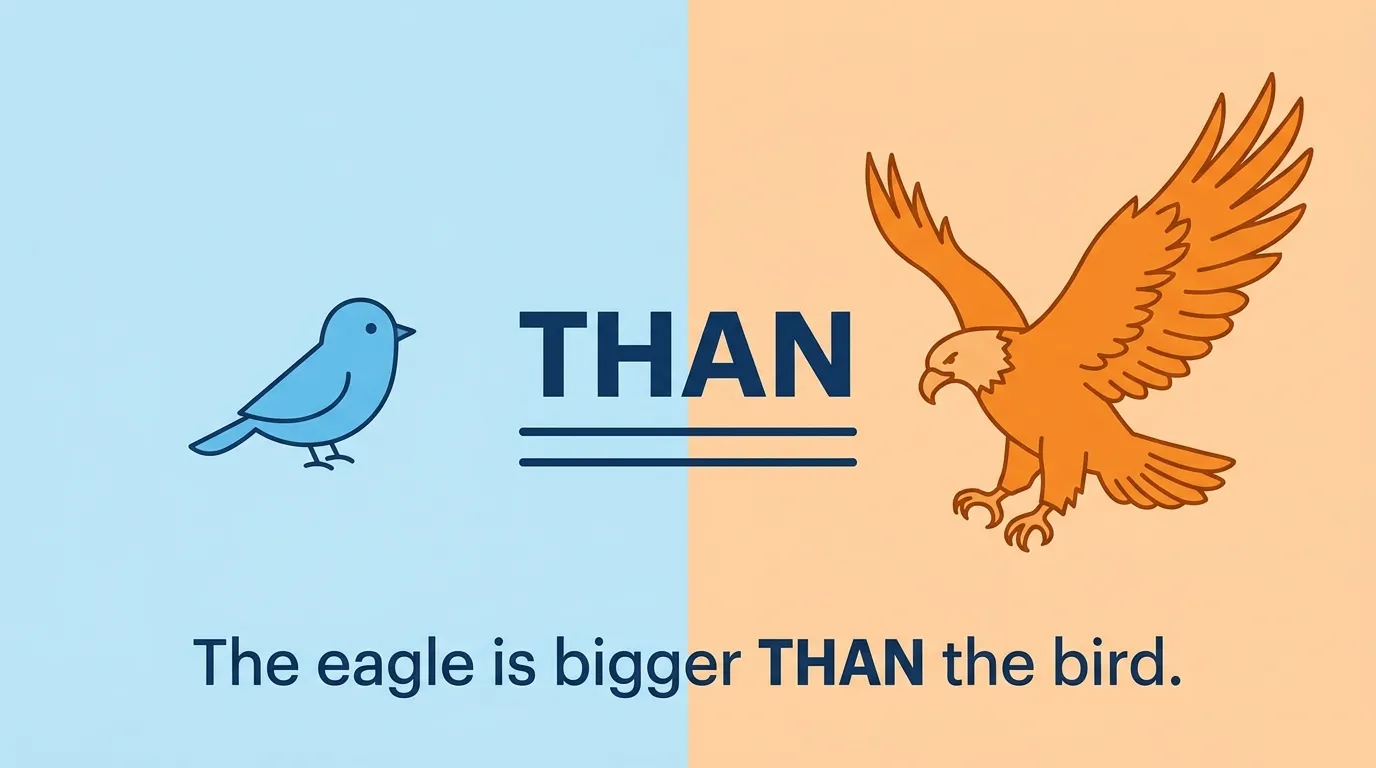
If you often pause over than vs then, you are not alone. These two words look and sound similar, but they have different meanings and grammatical jobs.
The simplest rule is:
Than is mainly used for comparisons.
Then is mainly used for time, sequence, or consequence.
For example:
- My car is faster than yours.
- We ate dinner, then watched a movie.
- If you finish your work, then you can leave.
The confusion happens because than and then are only one letter apart, and their pronunciation can be similar in some varieties of English. However, choosing the correct word becomes much easier once you understand what each one does.
This guide explains than vs then, including their meanings, grammar, pronunciation, history, common expressions, mistakes, formal and informal usage, and practical examples for everyday, academic, business, technical, and professional writing.
Quick Answer: Than vs Then
| Word | Main Function | Basic Meaning | Example |
|---|---|---|---|
| Than | Comparison | Used to compare people, things, or amounts | She is taller than me. |
| Then | Time or sequence | At that time; next; afterward | We went home then went to bed. |
| Then | Consequence | In that case; therefore | If you’re ready, then let’s begin. |
Easy memory trick
Think:
Than = comparison
Then = time or next
If you are comparing two things, choose than.
If you are describing what happens next, choose then.
What Does “Than” Mean?
Than is primarily a conjunction or preposition used to introduce the second element of a comparison.
It commonly appears after comparative words such as:
- better
- bigger
- smaller
- faster
- slower
- older
- younger
- more
- less
- fewer
- rather
- sooner
Examples
- This book is better than the other one.
- Sarah is older than her brother.
- The blue shirt costs more than the red shirt.
- I would rather walk than drive.
- There were fewer people than I expected.
In each sentence, than connects two things being compared.
Dictionary-style definition of “than”
Than: A word used to introduce the second person, thing, or amount in a comparison.
For example:
This laptop is lighter than my old one.
The comparison is between this laptop and my old one.
What Does “Then” Mean?
Then has several meanings, but its most common uses involve time, sequence, or consequence.
It can mean:
- At that time
- After that
- Next
- In that case
- As a consequence
Examples
At that time:
I lived in Chicago then.
After that:
We finished lunch and then went shopping.
Next:
First, mix the ingredients. Then, add the eggs.
In that case:
If you don’t want to go, then I’ll go alone.
As a consequence:
The road was closed, then we had to take another route.
The exact meaning depends on the sentence.
Than vs Then: The Key Difference
The easiest way to understand than vs then is to look at their purpose.
Use “than” for comparison
My new phone is cheaper than my old phone.
You are comparing two phones.
Use “then” for sequence
I bought a new phone and then transferred my data.
You are describing what happened next.
Use “then” for a condition or result
If you have finished, then you can leave.
Here, then means something like in that case.
Than vs Then Comparison Table
| Feature | Than | Then |
|---|---|---|
| Main idea | Comparison | Time, sequence, or result |
| Common question | “Compared with what?” | “What happened next?” |
| Common position | After comparative words | Before or after an action |
| Meaning | Compared with | At that time, next, afterward, in that case |
| Example | Better than expected | Finish this then call me |
| Comparative adjective | Yes | No |
| Time reference | Usually no | Yes |
| Conditional statements | No | Yes |
A useful test is to replace the word mentally.
If you can replace it with compared with, use than.
If you can replace it with next, afterward, at that time, or in that case, use then.
When Should You Use “Than”?
Use than when one person, object, action, or amount is being compared with another.
Comparisons With Adjectives
- My house is larger than yours.
- This test was easier than I expected.
- Winter is colder than autumn.
- Her explanation was clearer than mine.
Comparisons With Adverbs
- He runs faster than I do.
- She works harder than her coworkers.
- The car accelerated more quickly than expected.
Comparisons With Amounts
- I have more books than you.
- We need less water than before.
- The company earned more money than last year.
Comparisons With Preferences
Than also appears in expressions involving preference.
- I would rather stay home than go out.
- She would sooner apologize than argue.
- I’d rather read than watch television.
When Should You Use “Then”?
Use then when talking about time, order, or a result.
“Then” Means “Next”
First, read the instructions. Then, answer the questions.
Here, then tells the reader what happens next.
More examples:
- Take a shower and then get dressed.
- We had breakfast and then left.
- Open the file, then select the correct option.
- Finish your homework then you can play.
“Then” Means “At That Time”
I was living in New York then.
Here, then refers to a particular time in the past.
Other examples:
- Things were different then.
- She was a student then.
- I didn’t understand it then.
- We didn’t know each other then.
“Then” Means “In That Case”
This use is especially common in conditional statements.
If you’re tired, then you should rest.
The meaning is:
If you’re tired, in that case, you should rest.
More examples:
- If you don’t need it, then give it away.
- If that’s your decision, then I respect it.
- If you know the answer, then tell us.
Why Do People Confuse Than and Then?
The confusion between than and then has several causes.
They look almost identical
The only spelling difference is the letter a versus e.
- than
- then
That small difference is easy to miss when typing quickly.
They can sound similar
In some accents, unstressed vowels may become less distinct. This can make the words harder to distinguish in casual speech.
However, in careful standard American pronunciation, they are generally distinguished:
- than: /ðæn/
- then: /ðɛn/
The th sound is the voiced sound heard in words such as this and that.
Autocorrect does not always help
Both than and then are correctly spelled English words. A spell checker may therefore accept the wrong one.
For example:
This one is better then that one.
Every individual word is spelled correctly, but then is grammatically wrong. It should be than.
This is an example of a contextual spelling error, not a simple spelling mistake.
Than vs Then Pronunciation
In standard American English, the two words are commonly pronounced differently.
Than
Than usually sounds like:
“than”
Its vowel is similar to the vowel in cat for many American English speakers.
Then
Then usually has a vowel similar to the vowel in bed.
The distinction can become less noticeable in fast or casual speech, especially when than is unstressed.
For writers, however, pronunciation should never determine which spelling you use.
Meaning and grammatical function determine the correct word.
Is “Than” a Preposition or a Conjunction?
This is a more advanced grammar question.
Than can function in different ways depending on the sentence structure.
As a conjunction
She is taller than I am.
Here, than introduces a clause.
As a preposition
She is taller than me.
In modern English, this construction is extremely common, especially in everyday American English.
There has been long-standing debate about whether expressions such as than me or than I are more grammatically appropriate. The answer often depends on the sentence structure, style, and level of formality.
For formal writing, you may choose a complete clause when clarity matters:
She is taller than I am.
In casual conversation:
She’s taller than me.
Both are widely understood.
Is “Then” an Adverb?
Yes. Then is most commonly used as an adverb.
It can modify an action by showing when or in what order something happens.
We ate then.
Then we left.
It can also indicate a logical consequence:
If that’s true, then we need to reconsider the plan.
Because then has several related meanings, context determines its exact function.
Common Expressions With “Than”
Many familiar English phrases use than because they involve comparison.
Common expressions
- better than
- more than
- less than
- rather than
- other than
- sooner than
- later than
- bigger than
- easier than
- harder than
- different than
Examples
This is more than enough.
She chose tea rather than coffee.
The answer was different than I expected.
He arrived later than usual.
Common Expressions With “Then”
Then appears frequently in expressions related to time and sequence.
Common expressions
- back then
- since then
- until then
- by then
- from then on
- just then
- now and then
- every now and then
- and then
- then again
- if-then
Examples
Back then, we didn’t have smartphones.
I haven’t seen her since then.
By then, the store had closed.
We decided to move from then on.
I still visit every now and then.
“Rather Than” vs “Rather Then”
The correct expression is:
rather than
Not:
rather then
Rather than introduces a preference or alternative.
Examples:
- I stayed home rather than go out.
- She chose tea rather than coffee.
- We should repair the machine rather than replace it.
- He listened rather than argue.
This is one of the most common than vs then spelling mistakes.
“Better Than” vs “Better Then”
The correct expression is:
better than
Not:
better then
Why?
Because better is a comparative adjective. It requires than when introducing the thing being compared.
Correct
This option is better than the first one.
Incorrect
This option is better then the first one.
A useful rule is:
Comparative word + than
Examples:
- faster than
- cheaper than
- stronger than
- more useful than
- less expensive than
“If Then” vs “If Than”
The correct combination is:
if…then
Not:
if…than
Example:
If it rains, then we will stay inside.
Why?
Because then introduces the result or consequence of the condition.
This structure is common in:
- everyday conversation
- academic writing
- programming logic
- mathematics
- business analysis
- technical instructions
Technical example
If the value is zero, then the function returns an error.
In programming and formal logic, if-then describes a conditional relationship.
Than vs Then in Academic Writing
Academic writing requires careful distinction between the two words.
Correct
The second method was more effective than the first.
The researchers collected the data and then analyzed the results.
The sample was smaller than expected.
The experiment was repeated, and then the results were recorded.
A useful editing technique is to check every occurrence of than and then separately.
Ask:
Is this word comparing two things?
If yes, choose than.
Is it describing time, sequence, or a consequence?
If yes, choose then.
Than vs Then in Business Writing
Business communication often uses both words.
Than for comparisons
Our costs were lower than last quarter.
The new system is more efficient than the old one.
Sales were higher than projected.
Then for sequence
Review the proposal and then send it to the client.
First, approve the budget. Then, contact the supplier.
Using the wrong word can make professional writing look careless even when the meaning remains obvious.
Than vs Then in Technical Writing
Technical instructions frequently use then because procedures involve sequences.
For example:
Connect the cable. Then restart the device.
Comparisons, however, require than:
The new processor is faster than the previous model.
Technical writers should be especially careful because than and then can appear close together in complex explanations.
Than vs Then in Sports Writing
Sports reporting commonly uses than for statistics and comparisons.
The team scored more points than its opponent.
The player ran faster than expected.
Then is used to describe game sequence:
The team scored first and then defended its lead.
Formal vs Informal Usage
There is no major regional difference in the basic distinction between than and then.
American and British English both use:
- than for comparison
- then for time, sequence, and consequence
The larger differences involve surrounding constructions.
For example, American English commonly accepts:
Different than what I expected.
British English traditionally favors:
Different from what I expected.
However, different than is well established in American usage.
This does not change the central rule:
than and then are not interchangeable.
Common Than vs Then Mistakes
Here are some of the mistakes you are most likely to encounter.
Mistake: “Better then”
Incorrect:
My new job is better then my old one.
Correct:
My new job is better than my old one.
Mistake: “First than”
Incorrect:
First finish your work, than call me.
Correct:
First finish your work, then call me.
Here, then means after that.
Mistake: “Rather then”
Incorrect:
I’d rather walk then drive.
Correct:
I’d rather walk than drive.
Mistake: “If than”
Incorrect:
If you’re ready, than we can start.
Correct:
If you’re ready, then we can start.
Mistake: “More then”
Incorrect:
The repair cost more then expected.
Correct:
The repair cost more than expected.
Awkward vs Natural Examples
Sometimes a sentence is technically understandable but can be improved.
Awkward
I was younger than then.
More natural
I was younger back then.
Here, back then clearly refers to a past period.
Awkward
First we went to the store than we went home.
Natural
First we went to the store, then we went home.
Awkward
This method works better then the old method.
Natural
This method works better than the old method.
How to Remember Than vs Then
Here are several simple memory tricks.
Remember “A” for comparison
The word than contains an A.
Think:
A = compare
For example:
Bigger than
Better than
Faster than
This is not a grammatical rule, but it is a useful memory device.
Remember “E” for event
Then contains an E.
Think:
E = event or sequence
For example:
First this happens, then that happens.
Again, it is simply a mnemonic.
Ask one question
When unsure, ask:
Am I comparing?
If yes → than
If not, ask:
Am I talking about what happens next, when something happened, or what follows from a condition?
If yes → then
Than and Then: Synonyms and Related Words
Because the two words have different meanings, their related words are also different.
Words related to “than”
Depending on context:
- compared with
- compared to
- versus
- relative to
- rather than
- instead of
Example:
This model is cheaper than the other.
Similar idea:
This model is cheaper compared with the other.
These substitutions are not always grammatically interchangeable, but they can help you identify the comparison.
Words related to “then”
Depending on context:
- next
- afterward
- later
- subsequently
- at that time
- in that case
- therefore
- consequently
Example:
Finish the report and then call me.
You could think:
Finish the report and afterward call me.
Antonyms of Than and Then
Strictly speaking, than and then do not have direct antonyms because they are function words rather than ordinary descriptive words.
However, their meanings can be contrasted with related concepts.
For than, comparison may involve:
- more vs less
- greater vs smaller
- better vs worse
- higher vs lower
For then, time can contrast with:
- now
- before
- earlier
- currently
For example:
I lived there then, but I live here now.
The History of Than and Then
The history of these words helps explain why they look so similar.
Both than and then are historically related to old Germanic words expressing ideas involving time, comparison, and sequence. Their forms developed over centuries as English changed.
In Old and Middle English, spellings were far less standardized than they are today. Words related to then and than appeared in several forms, and their meanings were historically connected.
Over time, English increasingly developed a distinction between:
- than for comparison
- then for time and sequence
Modern spelling eventually settled on the forms we use today.
This history is one reason the words can seem strangely similar despite having different grammatical functions.
Can “Than” and “Then” Ever Be Interchanged?
In standard modern English, no.
They have different functions.
Comparison
He is older than me.
Not:
He is older then me.
Sequence
He ate dinner and then left.
Not:
He ate dinner and than left.
Changing the word can create a grammatical error even if the intended meaning is obvious.
Real-World Examples of Than vs Then
Everyday conversation
My sister is taller than me.
I’ll call you then.
Text messaging
That’s better than the other one.
Okay, see you then.
Workplace
Revenue was higher than expected.
Review the document and then submit it.
Education
This test was harder than the previous one.
Read the passage and then answer the questions.
Journalism
The number was higher than analysts predicted.
The company announced the decision and then issued a statement.
Blogging
This method is easier than it looks.
First, choose a topic. Then, create your outline.
A Simple Editing Checklist
Before publishing an article, email, essay, report, or social media post, check every than/then.
Use “than” if:
- You are comparing two things.
- You see a comparative adjective.
- You see more or less.
- You are expressing preference with rather than.
- You are comparing amounts or qualities.
Use “then” if:
- You mean next.
- You mean afterward.
- You mean at that time.
- You mean in that case.
- You are describing a sequence.
- You are writing an if-then condition.
Frequently Asked Questions About Than vs Then
Is it “better than” or “better then”?
The correct expression is better than.
This option is better than the other one.
Than is correct because the sentence compares two options.
Is it “then” or “than” for time?
Use then for time.
I lived there then.
We went home then.
Then can mean at that time, next, or afterward.
Is it “rather than” or “rather then”?
The correct phrase is rather than.
I would rather read than watch TV.
It expresses a preference or alternative.
Is it “if then” or “if than”?
The standard expression is if-then.
If the weather improves, then we will go outside.
Here, then introduces the result of the condition.
Is “than” used for comparisons?
Yes. This is the most important use of than.
John is taller than Mark.
This phone is cheaper than that one.
She works faster than I do.
Is “then” a comparison word?
No. Then is generally used for time, sequence, or consequence.
For comparison, use than.
This car is faster than mine.
Not:
This car is faster then mine.
Why do I keep confusing than and then?
The words look and sound similar, and both are extremely common English words. Spell checkers may not catch the mistake because than and then are both correctly spelled.
The best solution is to remember their functions:
Than = comparison
Then = time, sequence, or result
Can “than” and “then” sound the same?
They can sound quite similar in some accents and in fast speech, especially when than is unstressed. In careful American English, they are normally distinguished by their vowel sounds.
Regardless of pronunciation, the correct spelling depends on the meaning and grammar of the sentence.
Which is correct: “more than” or “more then”?
The correct phrase is more than.
The project took more than three weeks.
Because more than expresses a comparison involving quantity, than is required.
Is “then” formal or informal?
Then is used in both formal and informal English.
Examples:
The researchers collected the samples and then analyzed them.
I’ll see you then.
Its level of formality depends on the sentence, not on the word itself.
Conclusion: Than vs Then Made Simple
The difference between than vs then is simple once you focus on meaning rather than spelling.
Use than when you are comparing:
This book is better than that one.
Use then when you are talking about time, sequence, or consequence:
We finished dinner and then went home.
You can also remember these quick rules:
- Than = comparison
- Then = next or afterward
- Then = at that time
- Then = in that case
- Rather than, not rather then
- Better than, not better then
- If-then, not if-than
For American, British, academic, business, technical, journalistic, and casual writing, the core distinction remains the same. When editing, don’t rely only on spell check. Both words are correctly spelled, so you must consider the meaning and grammatical role.
The fastest test is this:
Are you comparing? Use “than.”
Are you talking about what happens next, when something happened, or what follows? Use “then.”
Once that distinction becomes automatic, than vs then is one of the easiest commonly confused word pairs to master.