The pen hovered over the signature line for a long time. The document was a commitment: a three-year contract, a promise of money and time and attention, signed in ink, witnessed by two people. The signer read the last clause twice, looked out the window, and then signed. In that moment, the word committed meant something it does not mean on an ordinary day. It meant bound, obligated, locked in — a decision that could not be casually undone.
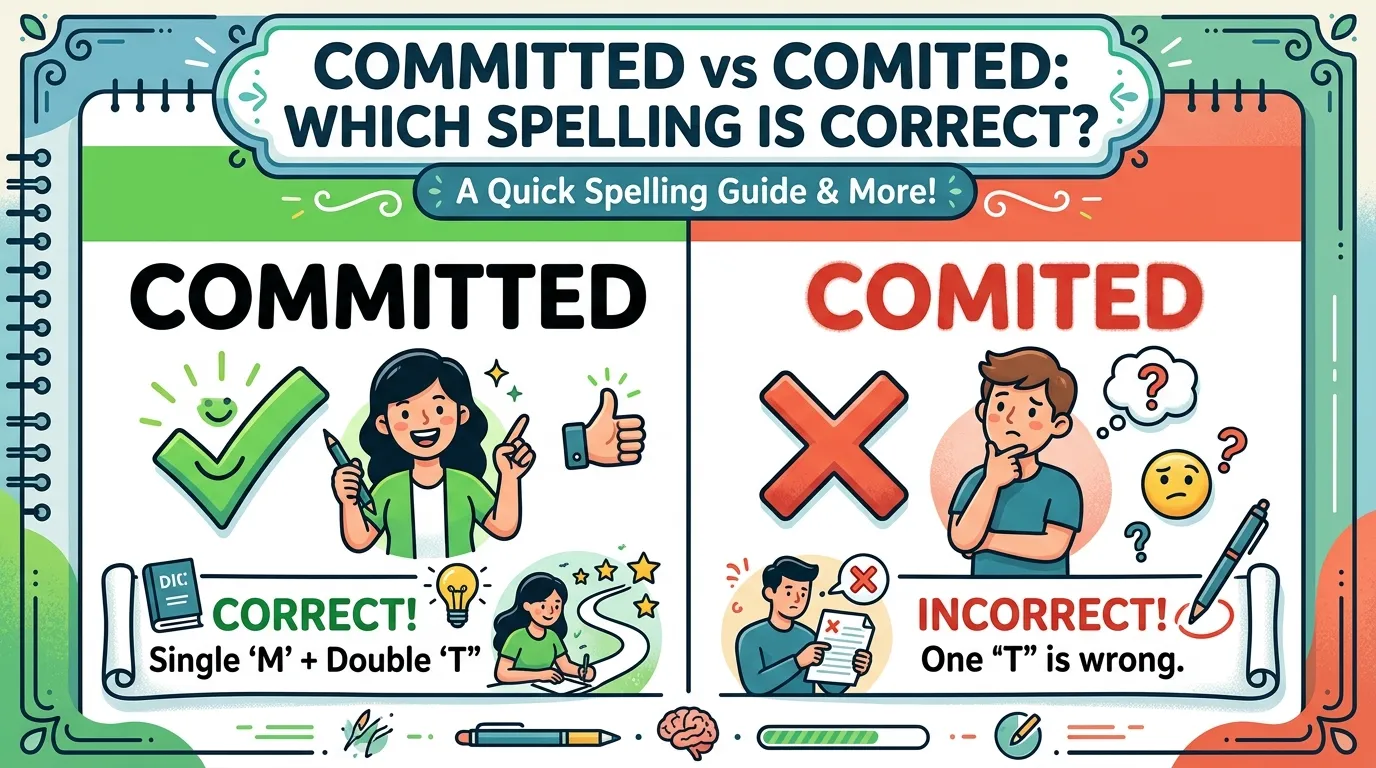
That is the first thing to know about committed: it is a word with two faces. One face is devotion. The other is obligation, and sometimes crime. The correct spelling is committed, with two m‘s and two t‘s. Comited, with one t, is a misspelling. And the reason the t doubles is a rule that governs a whole family of verbs — a rule that, once learned, makes the spelling feel automatic.
The Signature: What Committed Means
Committed is the past tense and past participle of the verb commit. Its most common meaning is dedication: to be devoted to something or someone. “She is committed to improving her English.” “He is committed to his family.” “The company is committed to customer service.” In this sense, the word is positive. A committed teacher, a committed athlete, a committed partner — these are people who keep their promises.
But commit has a second, darker meaning: to carry out an act, especially a wrong one. “The suspect committed a crime.” “He committed a serious mistake.” “The company committed an error in its report.” In this sense, the word is neutral or negative. You can commit a crime, commit fraud, commit a blunder, commit an offense. The same verb that describes devotion also describes wrongdoing, and the context tells you which one is meant.
There is a third meaning, quieter than the other two: to hand over or entrust. A court can commit someone to prison or to a hospital. A writer commits words to paper. A person commits money to an investment. In each case, the word means to deliver something into a new state — to place it where it will stay. The signature on the contract was this kind of commitment: money and time delivered into a binding arrangement.
Two M’s, Two T’s: The Doubling Rule
Now the spelling. The base verb is commit, with one m and one t at the end — c-o-m-m-i-t. Wait: look again. Commit already has two m‘s in the middle. It has one t at the end. When -ed is added, the final t doubles: commit → committed. The result has two m‘s and two t‘s. The misspelling comited drops one of the t‘s, and that is the entire error.
The doubling follows a rule that governs many English verbs. When a verb ends in a single consonant preceded by a single vowel, and the stress falls on the final syllable, the consonant doubles before a vowel suffix (-ed, -ing):
- stop → stopped, stopping
- plan → planned, planning
- admit → admitted, admitting
- permit → permitted, permitting
- submit → submitted, submitting
- commit → committed, committing
The rule is mechanical. Commit is stressed on the last syllable — com-MIT — and it ends in a single t preceded by a single vowel, i. So the t doubles. The same rule gives committing its double t, and commitment, the noun, keeps the base spelling with one t because the suffix -ment starts with a consonant, not a vowel.
The pronunciation confirms the spelling, in a way. Committed is pronounced “kuh-MIT-id” — three syllables, stress on the second. The double t does not make a longer t sound; it marks the short vowel before it, the way doubled consonants do throughout English. The spelling is a signal, not a sound.
The Family: Commitment, Committee, Commission
Commit belongs to a family of words built from the Latin committere, meaning to bring together or entrust. The family members look alike, and they are easy to confuse:
- Commitment — the noun for a promise or obligation. “Her commitment to the project never wavered.” One t, because -ment starts with a consonant.
- Committee — a group appointed to deal with something. “The committee meets on Tuesdays.” Double m, double t, double e — the most doubled word in the family, and a famous spelling trap in its own right.
- Commission — a fee, a task, or a body with authority. “She earns a commission on every sale.” Double m, double s.
- Committed — the past participle and adjective. Double m, double t.
The family is a minefield for spellers, because each member doubles different letters. Commitment has one t. Committee has two. Commission has two m‘s and two s‘s but one i. The only safe approach is to learn each word separately, and to remember that committed is the one with two m‘s and two t‘s.
The family also includes the adjective committed in specialized senses. A committed relationship is a long-term, exclusive partnership. A committed facility in finance is a credit line that a bank is obligated to provide. A committed patient is someone admitted to a hospital by court order. In each case, the word carries the signature sense: bound, obligated, locked in.
Committed in the Wild: Work, Love, and Law
The word’s three meanings map onto three domains of life. In work, committed is praise. A committed employee is loyal, focused, reliable. Job advertisements ask for “committed candidates.” Performance reviews celebrate “commitment to excellence.” The word signals that someone will stay when things get hard.
In love and friendship, committed is a status. A committed relationship is one in which both people have promised exclusivity and permanence. The phrase “commitment issues” names the reluctance to make that promise. The word’s weight here is emotional: to commit to a person is to choose them, day after day, over every alternative.
In law, committed is a verdict and a procedure. A person who commits a crime is charged. A person committed to prison is confined. A person committed to a psychiatric facility is held for treatment. The legal sense is the oldest: commit comes from the Latin for “to bring together,” and the law’s use preserves the idea of delivering someone into a new, constrained state.
The word’s opposites sharpen its meaning. The opposite of committed-in-devotion is uncommitted, detached, half-hearted. The opposite of committed-in-law is released, discharged, acquitted. The same word, two opposite directions — which is why context is everything with committed.
Committed in Medicine: The Committed Patient
The word’s legal sense has a medical branch that is worth knowing, because it appears in news reporting and in debates about mental health. To be committed to a psychiatric facility is to be admitted by court order, usually because a person is judged to be a danger to themselves or others. The older phrase, “committed to an asylum,” carries the history of a time when mental illness was treated by confinement. Modern law uses terms like “involuntary commitment” and “civil commitment,” and the procedures are governed by strict safeguards: hearings, time limits, rights of appeal.
The medical sense has generated its own vocabulary. A commitment hearing is the court proceeding that decides whether commitment is justified. A commitment order is the document that authorizes it. A voluntary commitment is a contradiction in terms — a person who admits themselves voluntarily is not committed in the legal sense — but the phrase is sometimes used loosely for a voluntary admission. The distinctions matter, because the legal consequences are serious: commitment restricts liberty, and the law treats it as a last resort.
The word’s history in medicine is a reminder of how language changes with attitudes. The asylum era used committed as a euphemism for confinement. Modern mental health law uses it as a precise legal term, with defined procedures and limits. The spelling never changed. The meaning narrowed, the safeguards grew, and the word that once meant “locked away” now means “admitted by a court, for a defined period, with rights of review.” The signature on the commitment order is still a commitment, but it is a different kind of commitment than the one the signer in the opening paragraph made.
The Two-Second Check
Before you send a sentence containing this word, look at the middle and the end. The middle should have two m‘s: comm-. The end should have two t‘s before the ed: -mitted. If either pair is single, the spelling is wrong. Comited fails the second check: one t, where two are required. Commited fails it too, with a single t in a different position. The correct form is committed: two and two.
A memory hook that works for many people: committed has two of everything that matters — two m‘s, two t‘s — because commitment itself is double: a promise made twice, once to yourself and once to the other person. The signer with the pen understood that. The signature was a double act: a decision and a declaration. The spelling, with its doubled letters, remembers both.










