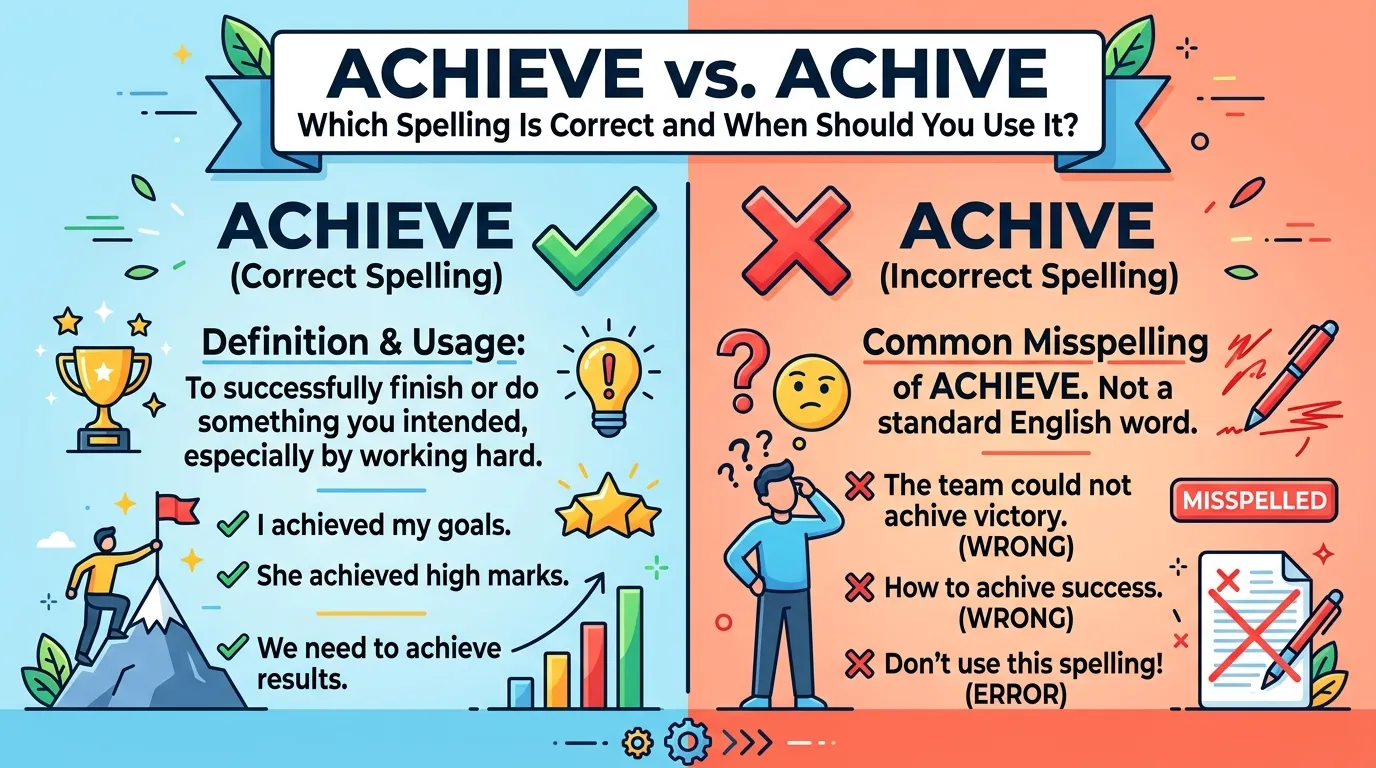
The marathon clock reads 3:59:41 as the runner crosses the finish line, and the volunteer handing out medals asks the question every finisher hears: “Did you achieve your goal?” The runner nods, too breathless to answer. Later, posting about the race, the runner types the word from the volunteer’s question — and drops a letter. “I hope to achive my goals.” The missing letter is an E, the second one, and its absence turns a real word into a misspelling. The runner achieved the finish. The post did not achieve the spelling.
Achieve is the only correct spelling. Achive is a misspelling. The error is one of the most common in English, because the second E is nearly silent in speech — and because the word’s spelling follows a pattern that only makes sense once you see the family it belongs to.
The Finish Line
Start with what the word means. Achieve is a verb meaning to successfully reach a goal or accomplish something through effort, skill, persistence, or determination. “She achieved her dream of becoming a doctor.” “They achieved excellent results.” “We achieved our sales target.” “He achieved success through hard work.” In every sentence, the word describes a goal that was set, pursued, and reached.
The word carries a sense of effort that its synonyms do not. Accomplish is about completion. Attain is about arrival. Reach is about distance. Achieve is about the work in between — the training, the studying, the trying. That is why the word appears so often in résumés, graduation speeches, and performance reviews: it names the kind of success that was earned.
The pronunciation is the source of the trouble. Achieve is pronounced uh-CHEEV. The second E is there in the spelling, but in speech it melts into the long EE sound, and the ear hears one vowel where the spelling has two letters. The hand, writing what the ear hears, writes achive — and the error is born.
The -ieve Family
The spelling makes sense once you see the family achieve belongs to. English has a group of words built on the same -ieve ending, and every member is spelled the same way: I-E-V-E. Believe. Relieve. Retrieve. Grieve. Thieve. Perceive, conceive, deceive, receive — the -ceive branch of the same family. In every one of them, the I comes before the E, and the E comes after the V.
The family has a history. Achieve comes from the Old French achever, meaning to finish or complete — from a- (to) + chef (head, end). To achieve was, literally, to bring something to its head, to its end. The French root explains the CH and the -ieve ending both: the word arrived in English with its French spelling nearly intact, and English kept it.
There is a useful proof in the noun form. The noun is achievement — and in achievement, the full -ieve spelling is on display: a-ch-ie-ve-ment. “Her greatest achievement was finishing the degree.” Say it slowly: uh-CHEEV-ment. The E is there, between the V and the M, and it is the same E that hides in the verb. The noun form shows the letter the verb form conceals.
Achieve vs Accomplish vs Attain
Achieve has close neighbors, and keeping them distinct sharpens a sentence. Accomplish emphasizes completion: “She accomplished the task.” A task can be accomplished without being a goal. Attain emphasizes arrival at a level: “He attained the rank of captain.” A rank is attained, not achieved, because it is a status rather than a project. Reach emphasizes distance covered: “They reached the summit.” Realize, in its older sense, means to make a goal real: “She realized her dream.”
The choice among them is a matter of shade. “She achieved the task” sounds slightly off — tasks are accomplished, goals are achieved. “He accomplished the rank of captain” sounds wrong — ranks are attained. “They achieved the summit” works, because a summit can be a goal, but “they reached the summit” is plainer. The words are neighbors, and the right one depends on whether the thing in question was completed, attained, reached, or earned.
The word also has a set of fixed collocations. Achieve a goal. Achieve success. Achieve a target. Achieve a balance. Achieve a breakthrough. Achieve consensus. In each phrase, the verb is doing the same job — naming success earned by effort — and the spelling is the same in all of them.
Achieve in the Wild
The word appears in every register, and its spelling matters in all of them. In business: “We achieved our quarterly targets.” In education: “Students who achieve high scores.” In sports: “She achieved a personal best.” In personal writing: “I hope to achieve my goals this year.” In each case, the word is doing the same job, and the second E is non-negotiable.
The word also has a grammatical point worth knowing. Achieve is a transitive verb — it takes a direct object. You achieve something: a goal, a result, a dream, a score. You do not “achieve” without an object in standard English. “She achieved” is incomplete. “She achieved her goal” is complete. The object is part of the verb’s construction, and without it the sentence hangs unfinished.
There is also a tone point. Achieve is a formal word, and overusing it drains it. A writer who says every completed task was “achieved” ends up sounding like a performance review. The word is at its best when the goal was real — a degree, a record, a target, a dream. Save it for the finish lines, not the errands.
The I-Before-E Trap
One more force pushes writers toward achive, and it is the most famous spelling rule in English: “I before E, except after C.” Generations of schoolchildren learned the rhyme, and it works for believe, field, piece, and chief. A writer who applies the rhyme to achieve gets the I-before-E order right — A-C-H-I-E-V-E — and then, paradoxically, doubts it. The doubt comes from the second E: the rhyme says nothing about what happens after the V, and the writer, unsure, drops the letter the rhyme does not mention.
The truth is that achieve follows the rhyme and then goes one step further. The I comes before the E, as the rhyme promises. Then a second E follows the V, because the word’s ending is -ieve, not -iev. The rhyme governs the vowel pair. The word’s history governs the ending. Both are needed, and neither alone produces the full spelling. Writers who remember only the rhyme get achive. Writers who remember the family get achieve.
There is also the pull of shorter words. Live, give, drive, arrive — all end in a single E after the V, and all of them are short, common words that the hand knows deeply. Achieve looks like it should belong with them. It does not. It belongs with the -ieve family, and the family is the proof: believe does not become belive, relieve does not become relive, and achieve does not become achive.
Achievable, Achiever, and the Family
Achieve brings a family with it, and the family confirms the spelling in every member. Achievement is the noun: the thing achieved. Achievable is the adjective: capable of being achieved. Achiever is the noun for a person who achieves. Unachievable is the negative: not capable of being achieved. In every member, the -ieve spelling holds — I before E, E after V, without exception.
The family also has a practical use. Achievable is the A in the SMART goals framework — goals should be Specific, Measurable, Achievable, Relevant, and Time-bound. The framework appears in management training, coaching, and education, and the word achievable is its most quoted member. A goal that is achievable is one that effort can reach. A goal that is unachievable is one that effort cannot. The distinction is the verb’s core sense in adjective form, and the spelling carries it.
And there is overachieve — to do better than expected, or to achieve more than is required. “She overachieved in every subject.” The prefix over- attaches to the whole verb, and the -ieve spelling survives the attachment intact. The word is a reminder that achieve is not just about reaching goals. It is about the scale of the reaching — and the spelling holds at every scale.
The -ieve Check
Back at the marathon, the runner’s medal says “Finisher,” and the post can be fixed with one keystroke. When achieve appears in your draft, run one check: does it end in -ieve? The family is the proof: believe, relieve, retrieve, grieve — every member ends in I-E-V-E, and achieve is a member in good standing.
And if you ever feel the pull toward achive, remember the noun. Achievement wears the full spelling openly, E and all. The verb hides the E in its pronunciation, but the noun shows it. The E was there all along — quiet in speech, essential in spelling, and the whole difference between the word and the mistake.