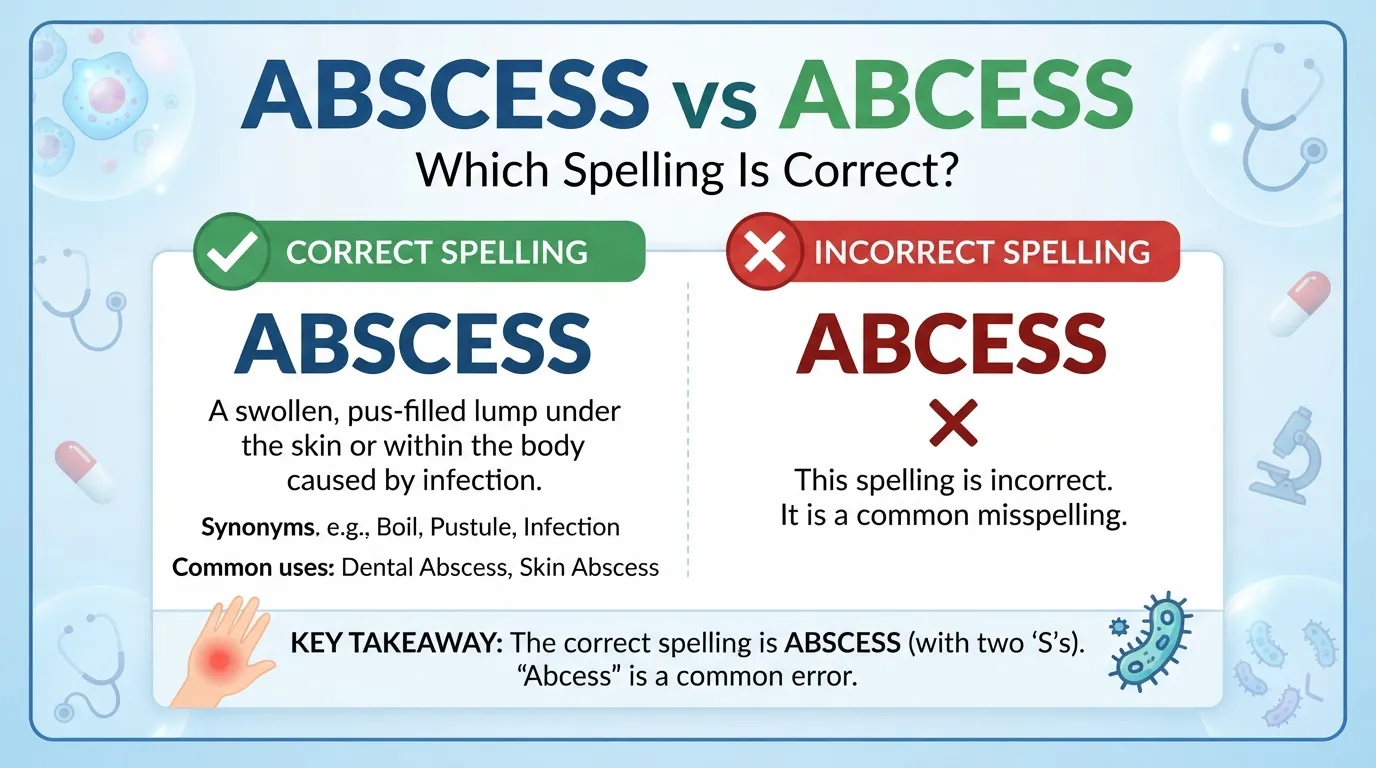
The patient sat in the dentist’s chair with one hand pressed to her jaw. “It started as a toothache,” she said. “Then the whole side of my face swelled up.” The dentist looked, nodded, and wrote two words on the chart: dental abscess. The patient stared at the second word. “How do you spell that?” she asked. “A-b-s-c-e-s-s,” said the dentist. “There’s an s after the b that you can’t hear.” That silent letter is the whole story of this word. The correct spelling is abscess. Abcess, without the first s, is a misspelling. And the reason the s goes missing is that in fast speech, it practically disappears.
The Toothache That Wouldn’t Wait
An abscess is a localized collection of pus within body tissue, usually caused by infection or inflammation. In plain language: it is a pocket of infected material that forms when the body’s immune system walls off an infection. It can develop under the skin, around a tooth, in an organ, or in other tissue. “She developed an abscess on her leg.” “The dentist found an abscess near the tooth.” “The patient was treated for a dental abscess.” “The swelling turned out to be an abscess.”
The word is primarily a medical noun, but it is common enough that people use it in everyday conversation about health. It appears in doctor’s offices, in pharmacy instructions, in health articles, and in the worried late-night searches of anyone who has ever had a swollen jaw. Knowing how to spell it matters in all of those places — but especially in medical writing, where a misspelling can confuse a reader who is already anxious.
What an Abscess Actually Is
To understand the word, it helps to understand the thing. When bacteria enter body tissue — through a cavity in a tooth, a cut in the skin, a blocked gland — the immune system responds by sending white blood cells to fight the infection. The battle produces pus: a mixture of dead cells, bacteria, and tissue fluid. The body walls off the area to contain the infection, and the result is a swollen, often painful pocket. That pocket is the abscess. It is the body’s way of quarantining trouble.
Abscesses come in many kinds, named by location. A dental abscess or tooth abscess forms around a tooth root. A skin abscess forms under the skin, often as a painful red lump. A brain abscess, a liver abscess, and a peritonsillar abscess — near the tonsils — are rarer and more serious. The treatment depends on the location and severity, but it usually involves draining the abscess, treating the infection with antibiotics, and addressing the underlying cause. A dental abscess may require a root canal or tooth extraction. A skin abscess may need to be lanced and drained. The word’s medical gravity is one reason its spelling matters: this is not a word for casual guessing.
Abs + Cess: A Going Away
The spelling makes sense once you know the word’s history. Abscess comes from the Latin abscessus, meaning “a going away” — from ab-, meaning “away,” and cedere, meaning “to go.” The ancient physicians who coined the term were describing what they saw: infected material that seemed to “go away” from healthy tissue and gather in one place. The word entered English through medical Latin, and it kept its Latin spelling, including the unusual bs in the middle.
That bs is the heart of the spelling problem. English has very few words with bs in the middle: absence, absolute, absorb, abstract, obscure. The combination is rare, and the ear struggles with it. In abscess, the b and the s sit next to each other, and in fast speech the b is barely pronounced. The word sounds like ab-sess, and writers hear abcess. But the spelling keeps both letters. A useful memory aid: think of the word as ABS + CESS. ABS — the same opening as absence and absolute — plus CESS, as in success and process. ABS + CESS = ABSCESS.
Types: Dental, Skin, and Beyond
The word’s most common appearances are worth knowing, because they show up in health writing constantly. The dental abscess is the one most people encounter: a painful, swollen area around a tooth, often caused by untreated decay or gum disease. Symptoms include throbbing tooth pain, sensitivity to hot and cold, swelling in the face or cheek, a bad taste in the mouth, and sometimes fever. The skin abscess appears as a red, swollen, painful lump, warm to the touch, sometimes with a visible head. The peritonsillar abscess, also called quinsy, forms near the tonsils and can make swallowing difficult. The brain abscess is rare but serious, requiring urgent medical care.
In all of these, the word behaves the same way grammatically. It is a countable noun: one abscess, two abscesses. The plural is abscesses, pronounced ab-sess-iz. The adjective form is abscessed: “an abscessed tooth.” The verb form is rare but exists: “The wound abscessed.” And the word appears in medical phrases like abscess drainage, abscess formation, and recurrent abscess.
Treatment Words You’ll Hear
Health writing about abscesses uses a small vocabulary of treatment words, and they are worth knowing because they appear alongside the word constantly. Drainage means removing the pus, either naturally or through a procedure. Incision and drainage, often abbreviated I&D, is the procedure for opening and draining an abscess. Antibiotics are drugs that fight bacterial infection. Root canal is the dental procedure that removes infected tissue from inside a tooth. Extraction is the removal of a tooth. Inflammation is the body’s response to injury or infection — redness, swelling, heat, pain. None of these words has the spelling trap that abscess does, but they all appear in the same sentences, which is another reason to get the anchor word right.
A note on tone: medical writing should be precise but not frightening. “The dentist drained the abscess and prescribed antibiotics” is clear and calm. “The abscess was a horrifying pocket of pus” is not medical writing; it is a horror story. The word itself is neutral. Let it stay neutral.
Abscess vs Boil vs Cyst: Three Lumps, Three Words
Three medical words describe lumps under the skin, and confusing them is as common as confusing the spelling. An abscess is a pocket of pus caused by infection. A boil, also called a furuncle, is a painful infected hair follicle — in effect, a small skin abscess with a specific cause. A cyst is a closed sac filled with fluid, air, or other material, and it is usually not caused by infection. A cyst can become infected and turn into an abscess, but a cyst on its own is not an abscess. The differences matter for treatment: abscesses usually need drainage, cysts are often simply monitored, and boils may resolve on their own with warm compresses.
The distinctions also matter for writing. A health article that calls every lump an abscess is imprecise. A patient who tells a doctor “I have an abscess” when they have a cyst may get the wrong advice. The words are neighbors, not twins. Abscess carries the infection meaning. Boil carries the hair-follicle meaning. Cyst carries the sac meaning. And one more neighbor: ulcer, an open sore on the skin or on a mucous membrane, which is a break in the surface rather than a pocket underneath it. Four words, four different lumps, one spelling rule for the one with the hidden s: abscess, ABS + CESS, every time.
When to See a Doctor: The Red Flags
Most abscesses need medical attention, and some need it urgently. The red flags are worth knowing, because health writing that lists symptoms without urgency does readers a disservice. See a doctor promptly if an abscess is large, growing, or very painful; if it is on the face, near the eye, or inside the mouth; if you have a fever; if red streaks spread outward from the lump; or if the area becomes hard and increasingly swollen. A dental abscess with facial swelling, difficulty opening the mouth, or trouble swallowing is an emergency — the infection can spread to the airway. Do not try to drain an abscess yourself. Home squeezing can push the infection deeper and make it worse.
The general advice is simple: warm compresses can ease discomfort while you wait for care, over-the-counter pain relief can help, and antibiotics alone rarely cure an abscess that needs drainage. The doctor’s job is to drain the pocket, treat the infection, and find the cause. The writer’s job is to describe all of that clearly, starting with the word itself: abscess, spelled with the s after the b, in every chart, every article, and every worried message.
The Spelling Lock-In
Before you write the word — on a chart, in an article, in a message to a friend with a swollen jaw — check the middle. If it reads abcess, with no s after the b, add one. The word is abscess: ABS + CESS. The s you cannot hear is the s you must write. The dentist was right. It is there, even when the ear misses it.










