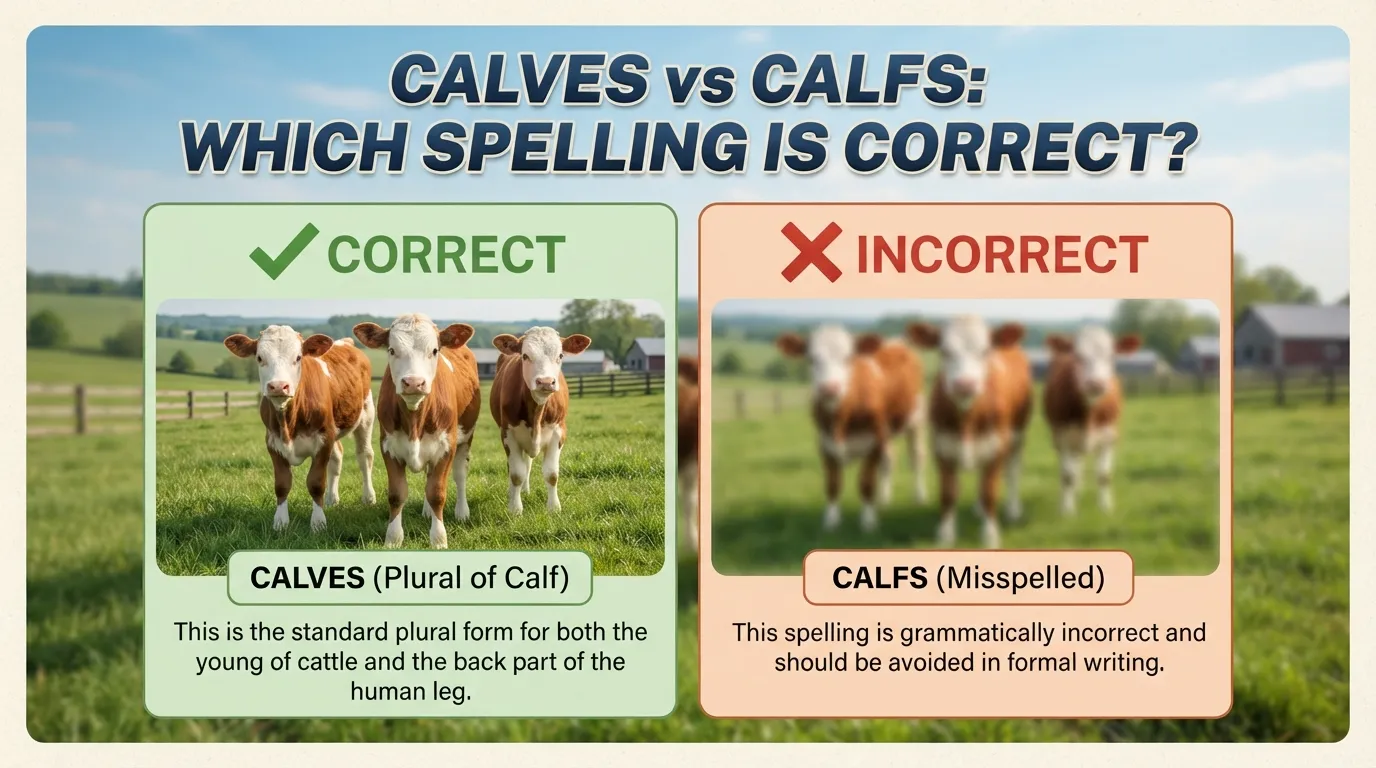
Some English words change their clothes when they become plural. Cat becomes cats — same word, one letter added. Child becomes children — a different ending entirely. And calf becomes calves — the f in the middle of the word turns into a v, as if the word itself shape-shifted. Calfs, with the f kept and an s added, is a misspelling in standard English. The f-to-v change is not a quirk. It is a survival from the oldest layer of English, and once you see the family it belongs to, the spelling stops feeling random.
The Word That Changes Its Skin
Calf has two common meanings, and both take the same plural. The first is a young animal: the young of cattle, and by extension the young of elephants, whales, giraffes, buffalo, and other large mammals. “The cow stayed close to her calf.” “The farmer has six calves.” “The cows are protecting their calves.” The second is the muscular area at the back of the lower leg, between the knee and the ankle. “I pulled a muscle in my left calf.” “Both of my calves hurt after the hike.” “My calves are sore after running.”
In both meanings, the plural is calves. The singular ends in f. The plural ends in ves. The f does not survive the plural. It becomes a v, and the plural ending is -es rather than -s. Calf to calves. That is the whole rule for this word, and it is worth learning as a single fact, because there is no way to derive it from the general rules of English plural spelling.
Calf, the Animal
The animal sense is the older one. Calf comes from Old English cealf, meaning a young cow. The word has kept its shape for more than a thousand years, and its plural has kept the f-to-v change for just as long. The reason is sound. In Old English, the f between two vowels was pronounced as v. The plural of cealf was cealfas, with the f sitting between vowels, so it sounded like v. Over centuries, the spelling caught up with the sound, and the plural became calves.
The animal sense appears in farming, in nature writing, and in idioms. Golden calf is an idol or false god, from the biblical story. To kill the fatted calf is to prepare a lavish celebration, from the parable of the prodigal son. Calf love is young, immature romantic affection. And calfskin is leather made from calf hide. In all of these, the base word is calf. The plural only appears when you are counting animals: “three calves,” “the calves in the next field.”
Calf, the Muscle
The leg sense is a separate word with a separate history that converged on the same spelling. It comes from Old Norse kalfi, meaning the calf of the leg. English adopted it, spelled it the same way as the animal word, and gave it the same plural. “My right calf hurts” becomes “both calves feel tight.” The two meanings share a plural because they share a spelling, and they share a spelling because of a historical coincidence. There is no logical connection between a baby cow and the back of your leg. The language simply filed them under the same word.
The muscle sense appears in sports, in medicine, and in fitness writing. Calf strain is a pulled muscle. Calf raise is an exercise that strengthens the calves. Calf cramp is a sudden, painful contraction. And calf pain is a symptom that sends people to doctors and physiotherapists. In all of these, the singular is calf and the plural is calves. A runner with sore legs has sore calves, not sore calfs.
The F-to-V Family
Calf is not alone. A small family of English nouns changes f to v in the plural. Learn the family and the pattern becomes familiar: calf to calves, half to halves, knife to knives, leaf to leaves, life to lives, wife to wives, wolf to wolves, loaf to loaves, thief to thieves, shelf to shelves. In each case, the f or fe at the end becomes ves. The pattern is old, and it is consistent within the family.
But the family has rebels, and the rebels are the trap. Some nouns ending in f simply add -s: roof to roofs, belief to beliefs, chief to chiefs, chef to chefs, cliff to cliffs, gulf to gulfs. And some accept both: dwarf to dwarfs or dwarves, hoof to hoofs or hooves, scarf to scarfs or scarves. There is no rule that predicts which family a word belongs to. You have to know each word. For calf, the answer is settled: calves. No alternative is accepted in standard English.
The Silent L
One more detail, because it causes its own confusion: the l in calf and calves is silent. In standard American English, calf sounds like “kaf,” with the vowel similar to the one in laugh for many speakers. Calves sounds like “kavz.” The l is written but never pronounced. The same is true of half, calm, walk, and talk — a small family of words where the l went quiet centuries ago and the spelling never caught up. Do not pronounce the l, and do not drop it from the spelling. It is silent, but it is not optional.
The pronunciation difference between the singular and the plural is the final consonant: calf ends with an f sound, calves ends with a v sound. That f-to-v shift in sound mirrors the f-to-v shift in spelling. The ear and the eye agree here, which is more than can be said for most English spelling. If you say kavz, write calves. If you say kaf, write calf.
Calves in Sport: The Runner’s Second Heart
Ask a runner about calves and you will hear a different story than the farmer’s. The calf muscles — the gastrocnemius, the large muscle that forms the visible bulge, and the soleus, the deeper muscle beneath it — do the work of every step. They lift the heel, push the body forward, and absorb the shock of landing. Physiologists call the calf muscles the “second heart” because their contractions help pump blood from the legs back toward the heart, fighting gravity on every stride. A runner with strong calves runs more efficiently. A runner with tight calves risks strains, cramps, and Achilles problems.
The training vocabulary is its own world. Calf raises — standing on the edge of a step and lifting the heels — are the basic strengthening exercise. Eccentric calf drops are the rehabilitation exercise for Achilles tendinopathy. Calf compression sleeves are tight garments that support the muscles during and after runs. Calf cramp is the sudden, painful contraction that wakes runners at 3 a.m. And calf strain, sometimes called tennis leg, is a tear in the muscle that can sideline an athlete for weeks. In all of this writing — in training plans, in medical articles, in forum posts from injured runners — the plural is calves. The runner’s second heart has two chambers, and both of them change their f to a v.
Calves in Language: Fatted Calves and Golden Calves
The animal sense of calf left two idioms in English that are still in use. To kill the fatted calf means to prepare a lavish celebration for someone’s return, from the parable of the prodigal son, in which a father slaughters a specially fattened calf to welcome home his wayward child. “When she came home from the hospital, her family killed the fatted calf.” The golden calf is an idol or false god, from the biblical story in which the Israelites, waiting for Moses, cast a calf from gold and worshipped it. “The startup’s founder warned against worshipping the golden calf of growth at any cost.” Both idioms use the singular calf, and both are worth knowing because they appear in writing far more often than the animal itself.
The leg sense has its own idiom, darker and more modern: to be all calves is not standard, but “calves like tree trunks” is a compliment for a cyclist or a dancer, and “calves of steel” praises endurance. And in fashion, calf-length describes a skirt or boot that reaches the calf — the leg, not the animal. The two meanings share the word, share the plural, and share the spelling rule. One calf, two calves, whether the calf is in the field, on the leg, or in the proverb.
The One-Word Rule
Before you write the plural, ask one question: does this word change its skin? For calf, the answer is yes. The f becomes a v, and the ending becomes -es. One calf, two calves. One leg muscle, two calves. The rule is old, the family is small, and the word is settled. Write calves, and the shape-shifter stays on your side.










