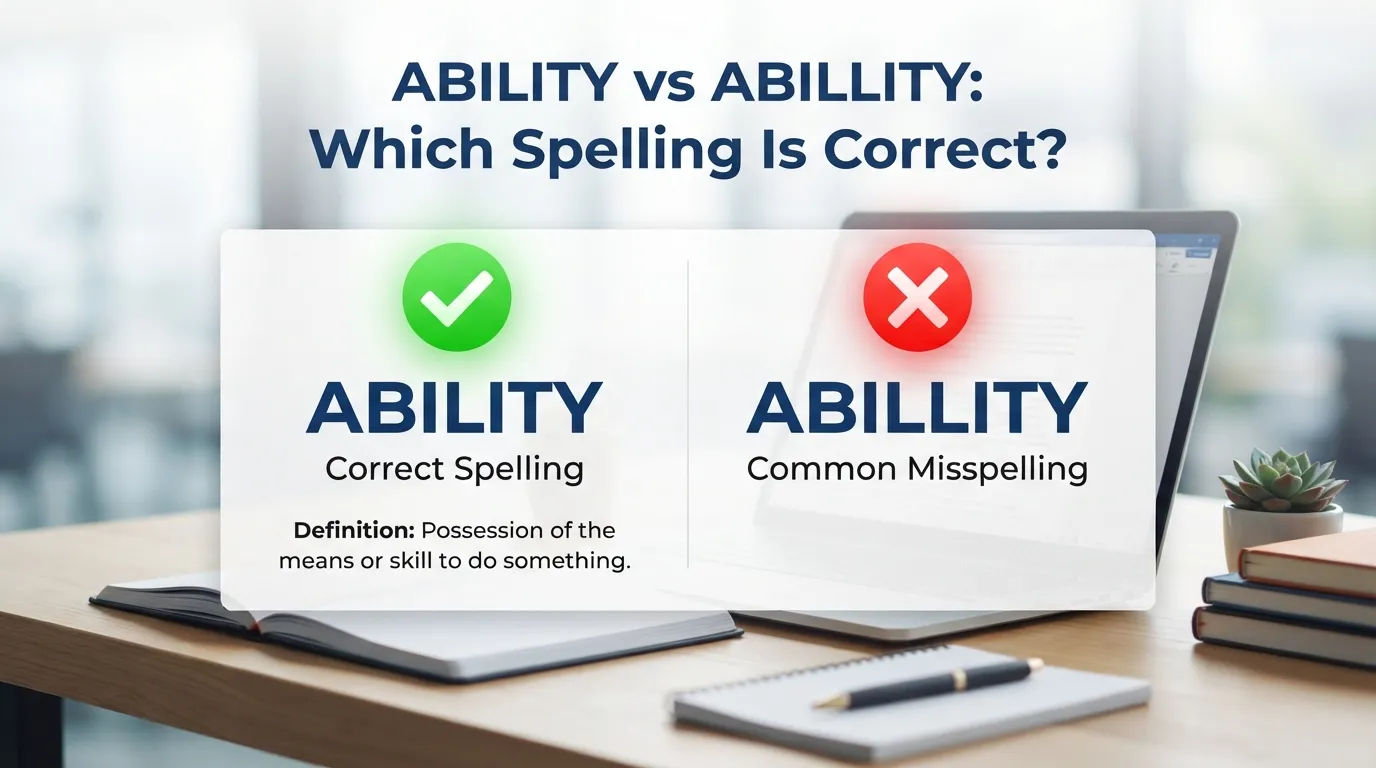
The coach stood at the edge of the track with a clipboard, watching two sprinters. One had the speed. The other had the form. “She’s got the ability,” he said, pointing at the second runner. “The other one’s got the talent. Ability is what you build. Talent is what you start with.” He was making a point about coaching, but he was also, accidentally, making a point about spelling. The correct spelling is ability, with one l after the i: a-b-i-l-i-t-y. Abillity, with two l‘s, is a misspelling. And the reason it is so common is that English is full of words that do double their consonants — which makes the single l in ability feel like an oversight.
Tryouts: The Coach’s Clipboard
Ability means the power, skill, capacity, or competence to do something. “She has the ability to solve difficult problems.” “Her writing ability has improved.” “The job requires strong communication abilities.” “The athlete demonstrated remarkable physical ability.” “Technology can increase our ability to communicate.” The word is broad. It covers a skill you learned, a capacity you were born with, and a machine’s power to perform a task. That breadth is why it appears everywhere: in education, in business, in sports, in science, in psychology, in everyday conversation.
The coach’s distinction is worth keeping. Ability is the general word for being able to do something. It does not say whether the power came from practice or from nature. “He has the ability to learn quickly” could mean he is naturally quick, or well trained, or both. The word stays neutral, which is why it is the default choice in job descriptions, school reports, and performance reviews. When a writer reaches for a more specific word, that is a style choice. When a writer reaches for ability, that is the safe choice — provided it is spelled with one l.
Able + ity: One L, One Rule
The spelling follows from the word’s construction. Ability is able + -ity: the adjective able plus the noun-forming suffix -ity. When the suffix attaches, the silent e in able drops, and the single l stays single. Able to ability. There is no doubling, because there is nothing to double. The l in able is single, and it stays single in the noun.
Writers add the second l for two reasons. First, English has many words with doubled consonants — skill, successful, different, accommodate, parallel, illegal, collect — and the pattern is so strong that it feels like ability should follow it. Second, the -ity family includes words where the base word does double: still to stillness is not an -ity word, but hostile to hostility shows the same single-l pattern as able to ability. The rule is simple: the l in the base word determines the l in the derived word. Able has one l. Ability has one l. The misspelling abillity invents a letter that was never there.
Ability vs Capability vs Skill vs Talent
Four words crowd the same territory, and choosing among them is a matter of precision. Ability is the general word: the power to do something. Capability is close, but it leans toward capacity and potential, especially for organizations and systems: “The company’s manufacturing capability.” “The software’s capability to handle large files.” Skill is learned and specific: “Her coding skills.” “His skill at negotiating.” Talent is natural and inborn: “She has a talent for music.” Competence is the level of ability needed to do a job properly: “He demonstrated professional competence.”
The opposites are just as useful. Inability is the lack of ability: “His inability to concentrate.” Disability is a physical or mental condition that limits activity — a word with its own spelling and its own dignity, and one that should never be used casually as a synonym for inability. And unable is the adjective form of the negative: “She was unable to attend.” All of them keep the single l. The family rule holds across the board.
The Plural and the Phrases
Ability has a regular plural: abilities. “The job requires strong communication abilities.” “Her abilities include coding, design, and project management.” The y changes to ies, as it does in city to cities and activity to activities. And the word appears in a set of fixed phrases that every fluent writer should know. Ability to plus a verb is the most common: “the ability to learn,” “the ability to adapt,” “the ability to lead.” To the best of one’s ability means as well as one can: “She performed to the best of her ability.” To the best of my knowledge is a different phrase — do not mix them. Natural ability is inborn talent. Physical ability is bodily power. Mental ability is cognitive power. Learning ability is the capacity to acquire new skills.
One grammar note: ability is a noun, and it is usually followed by to plus a verb, or by of plus a noun phrase. “The ability to swim.” “The ability of the team.” It is not usually followed by a bare verb or by for plus a verb. “Her ability for solving problems” is awkward; “her ability to solve problems” is natural.
Ability in Job Ads and School Reports
The word’s home turf is the world of evaluation: job ads, school reports, performance reviews, medical assessments. Job ads ask for “the ability to work independently,” “the ability to meet deadlines,” “the ability to communicate clearly.” School reports praise “strong mathematical ability” or note “reading ability below grade level.” Performance reviews measure “the ability to manage competing priorities.” In all of these, the word is doing quiet, professional work, and a misspelling stands out precisely because the context is formal. A résumé that writes abillity undermines the very competence it claims.
The word also appears in famous phrases. “With great power comes great responsibility” is the proverb; “ability” is the plainer cousin. In sports, “athletic ability” covers speed, strength, coordination, and endurance. In psychology, “cognitive ability” covers reasoning, memory, and problem-solving. In law, “the ability to stand trial” is a formal test of competence. The word travels everywhere, and it always takes the same spelling.
Ability in Science: Innate, Learned, and Measured
Psychology draws a sharp line that everyday speech blurs: the line between ability and achievement. An ability test measures what a person is capable of doing — reasoning, spatial thinking, verbal comprehension. An achievement test measures what a person has already learned — vocabulary, math facts, historical knowledge. The distinction matters in schools, where a student with high ability and low achievement may be bored, not struggling, and where a student with high achievement and average ability may be working extraordinarily hard. Teachers who confuse the two misread their students.
The growth-mindset research adds another layer. It suggests that people who believe ability is fixed — “I’m just not a math person” — perform worse than people who believe ability can grow with effort. The research does not claim that everyone has the same ability. It claims that ability is not a fixed quantity, and that practice, feedback, and persistence expand it. The coach on the clipboard would agree. Ability is what you build. And the belief that you can build it is part of the building. The word’s spelling, at least, is fixed: one l, no exceptions, in every test, every report, and every résumé.
Ability on the Field: The Scout’s Eye
Sports scouts talk about ability differently from teachers, and the difference is instructive. A scout watching a young footballer is not asking, “What has she learned?” The scout is asking, “What can she become?” The scout’s vocabulary reflects that: raw ability for undeveloped potential, natural ability for inborn talent, athletic ability for the physical package of speed, strength, and coordination. A player with high raw ability and poor coaching is a project. A player with modest ability and superb coaching is a finished product. The scout’s job is to tell the two apart.
The same lens applies to hiring. A hiring manager who asks for “the ability to learn quickly” is not asking for a skill the candidate already has. The manager is asking for a capacity — the power to acquire new skills on the job. That is why the phrase appears in almost every job ad: it is the one requirement that covers all the requirements that cannot be listed. And it is why the spelling matters in the ad itself. A job posting that writes abillity is asking candidates for a competence it has not demonstrated. The word is the test, and the test starts with the writer.
The Single-L Check
Before you send the application, the report, or the review, look at the word once. If it reads abillity — with two l‘s — delete one. The word is ability: able plus -ity, one l, one rule. The coach on the clipboard was right about the other thing, too. Ability is what you build. Spelling it correctly is part of the build.










