At the edge of the pool, a coach watches a swimmer finish a lap. “I have swam here before,” the swimmer says, toweling off. The coach smiles. “You have swum here before,” she says. “You swam here yesterday.” The swimmer blinks. Two words, one letter apart, and the difference is whether a helping verb is standing next to them. Welcome to one of the most persistent grammar traps in English — and one of the most musical.
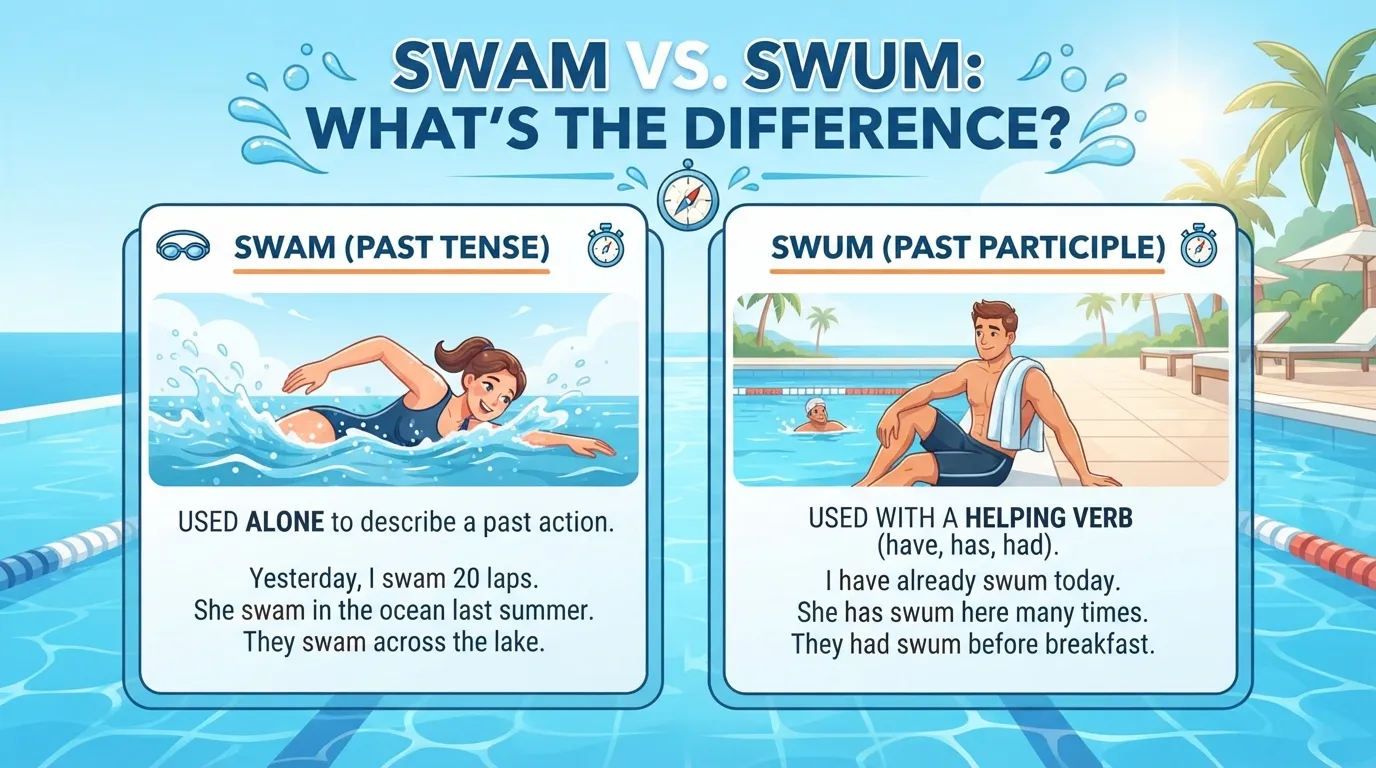
Swam and swum are both correct forms of the verb swim. They are not interchangeable. Swam is the simple past tense: a completed action in the past. Swum is the past participle: the form that appears after have, has, had, or be. The rule is simple. The reason it trips people up is that the two words sound so alike — and the pattern behind them is one of the oldest in the language.
The Vowel Journey: i → a → u
English has two kinds of verbs. Regular verbs form the past tense by adding -ed: walk → walked, talk → talked, jump → jumped. Irregular verbs do something else. And a large family of irregular verbs does something beautiful: they change their vowel. Swim → swam → swum. The vowel travels from I to A to U, like a swimmer moving through three strokes.
This vowel change has a name: ablaut, from a German word meaning “sound change.” It is one of the oldest patterns in the Germanic languages, older than English itself. Long before anyone wrote -ed on the end of a verb, speakers signaled the past tense by changing the vowel inside the word. The pattern survived in a handful of common verbs, and swim is one of them.
The journey is the memory hook. The vowel moves forward through the alphabet — I, then A, then U — as the verb moves forward through time: present, past, perfect. Swim is now. Swam is then. Swum is the completed action, the one that has been done. The vowel tells the time.

The Family That Changes Its Vowels
Swim is not alone. It belongs to a family of verbs that follow the same I–A–U pattern, and learning the family makes all of them easier at once:
- Sing → sang → sung. “She sang yesterday.” “She has sung that song before.”
- Drink → drank → drunk. “He drank water.” “He had drunk two glasses.”
- Begin → began → begun. “The race began.” “The race has begun.”
- Ring → rang → rung. “The bell rang.” “The bell has rung.”
- Shrink → shrank → shrunk. “The shirt shrank.” “The shirt has shrunk.”
- Stink → stank → stunk. “The fish stank.” “The fish has stunk up the kitchen.”
The pattern is the same in every member: I in the present, A in the simple past, U in the past participle. Once you see the family, swam and swum stop looking like random exceptions and start looking like what they are — members of a regular irregular family, following a rule older than the -ed ending.
There is a second family worth knowing, because it causes its own confusion: the I–O–I pattern, or rather the pattern where the past participle returns to a different vowel. Drive → drove → driven. Write → wrote → written. Ride → rode → ridden. These verbs do not follow the I–A–U pattern, and they should not be forced into it. Each irregular verb belongs to its own family, and the families do not mix.
The Helping-Verb Rule
The practical rule for swam and swum is about company. Swam stands alone. It is the simple past tense, and it does not need a helping verb. “I swam yesterday.” “She swam across the lake.” “We swam for an hour.” In each sentence, swam is the only verb, and the time is stated or understood: yesterday, last summer, for an hour.
Swum never stands alone. It is the past participle, and it needs a helping verb — have, has, had, or a form of be — to do its job. “I have swum in that lake before.” “She has swum competitively for years.” “They had swum for several hours before the storm arrived.” In each sentence, swum leans on its helper. Without the helper, the sentence collapses: “I swum yesterday” is wrong, the way a swimmer without water is wrong.
The test is simple. Look at the verb phrase. Is there a helping verb — have, has, had? If yes, the form is swum. If no, the form is swam. Yesterday → swam. Have/has/had → swum. Two words, one rule, no exceptions.

Swum in Passives
There is a less common use of swum that trips even confident writers: the passive voice. In a passive sentence, the past participle appears after a form of be. “The channel was swum by only a few athletes.” “The river had been swum before the race.” These sentences are grammatically correct, though they are rare in everyday speech. The passive puts the action first and the actor second, and swum does its participle job after was or been.
The passive is worth knowing about because it explains a sentence pattern that otherwise looks like an error. “The lake was swum in the morning” sounds odd, but it is correct — the lake is the thing that was swum, and swum is the participle after was. In practice, most writers avoid this construction and choose the active voice instead: “Athletes swam the lake in the morning.” The active version is clearer, shorter, and more natural. But the passive version is not wrong, and recognizing it prevents a false correction.
Swum Across the Channel: The Word in Sport
Nowhere does the swim-swam-swum family get more of a workout than in sport. Swimming is one of the few activities where the past tense is part of the daily conversation: coaches, commentators, and athletes talk constantly about what was swum, what has been swum, and what will be swum.
The English Channel is the word’s most famous stage. Since Matthew Webb first swam the Channel in 1875, hundreds of swimmers have swum it — in both directions, in relays, in record times. Every account of a Channel crossing uses the full family: “She swam the Channel in fourteen hours.” “She has swum the Channel three times.” The sentences are correct because the forms are correct: swam alone for the completed crossing, swum after has for the repeated achievement.
Olympic commentary is where the errors cluster. Live commentators, speaking fast and thinking faster, regularly say “she has swam a brilliant race” — and millions of listeners hear the error and absorb it. The mistake is understandable: in the heat of the moment, the simpler form wins. But the standard is clear, and the commentators who get it right — “she has swum a brilliant race” — are the ones whose grammar holds up under pressure, the way a swimmer’s stroke holds up in the final lap.
The lesson from sport is the same as the lesson from grammar: form matters under pressure. The swimmer who keeps her stroke in the last fifty meters wins the race. The speaker who keeps her verb forms in the last sentence wins the argument. Swim, swam, swum — three strokes, three forms, one finish.
Errors in the Wild
The most common error is using swam where swum belongs: “I have swam in that pool.” Sports commentary is full of it. So is casual speech. The error is so widespread that some speakers assume swum is the mistake and swam is correct everywhere. It is not. Swum is the standard participle, and it is required after have, has, and had.
The reverse error — “I swum yesterday” — is less common, because swum alone sounds unfinished to most ears. The ear expects a helper, and when it does not find one, it notices. The asymmetry is useful: if a sentence with swum sounds incomplete, it probably needs a helper. If a sentence with swam follows have, it probably needs swum.
Here is the drill the coach gives her swimmers. Three sentences, three forms, every morning: “I swim every morning.” “I swam yesterday.” “I have swum in this pool before.” Present, past, perfect. I, A, U. Swim, swam, swum. The vowel tells the time, the helper tells the form, and the water tells the rest.


That is the whole pattern, and it is worth keeping: I for now, A for then, U for the completed action. Swim, swam, swum. The vowel travels, the helper arrives, and the sentence lands exactly where it should — in the right tense, in the right form, in the right lane.










