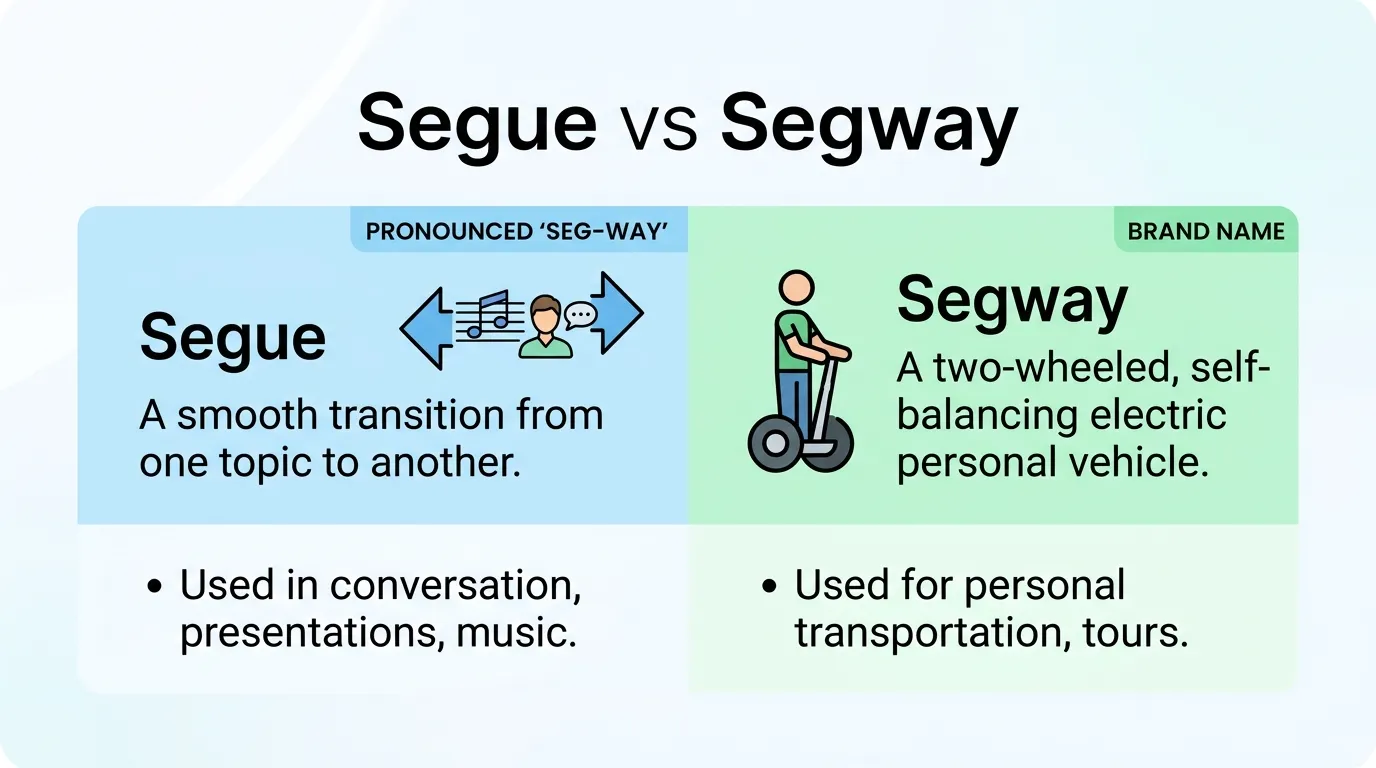
The DJ stood at the decks with one hand on the fader, and the room held its breath. The song that was playing — a slow, warm groove — was about to end. On the other deck, a faster track waited. The DJ slid the fader across, and for four bars the two songs lived together, the first one fading out as the second one faded in. Nobody in the room noticed the join. That is what a segue is: a transition so smooth that you cross from one thing to another without feeling the seam.
And then someone in the crowd said it out loud — “Great segway!” — and spelled it, in the group chat later, S-E-G-W-A-Y. The word they meant was segue. The word they wrote was a brand of personal transporter. The two words sound almost identical in American English, but they have nothing to do with each other. One is a musical term with a five-hundred-year history. The other is a trademark that happens to be a pun on the first.
The Crossfade: Where Segue Was Born
Segue comes from music. It entered English from Italian, where segue means “it follows” — from the verb seguire, to follow. In a musical score, the instruction segue tells the performers to continue into the next movement or section without a pause. The first piece ends and the second begins, and the audience hears one unbroken flow.
That is still the word’s home territory. A radio DJ segues from one song to another. A composer writes a segue between movements. A band segues from a ballad into a rock number in the middle of a set. In each case, the point is continuity: no silence, no gap, no announcement that something new is starting. The music simply continues, changed.
From music, the word spread into speech and writing. A speaker segues from one topic to the next. A paragraph segues into the next section of an essay. A meeting segues from budget updates into planning. In all of these, the meaning is the same as in the DJ booth: a smooth transition, one thing leading naturally into another. “That question provides a natural segue into our next topic.” “The conversation eventually segued into politics.” The word works as a noun (“a smooth segue”) and as a verb (“to segue into”).
The pronunciation is SEG-way — two syllables, stress on the first. The spelling is the trap. The word is pronounced like Segway, the brand, but spelled like the Italian word it is: s-e-g-u-e. There is no w in it. The gu does the work that a w would do in English, the way it does in guess and guest. If you remember that segue is Italian, the spelling stops being strange: Italian words do not need a w to make a w sound.
The Machine That Borrowed the Name
Now the other word. The Segway is a self-balancing personal transporter — a two-wheeled platform you stand on, leaning forward to go and back to stop — invented by Dean Kamen and unveiled in 2001. The name was chosen deliberately. Kamen’s company wanted a word that suggested smooth, effortless movement from one place to another. They took segue, the word for a smooth transition, and respelled it as Segway, swapping the Italian gu for the English gw and adding a capital S.
So the brand name is a pun: a Segway is a device that segues you from place to place. The spelling Segway is a trademark, owned by the company, and it refers to the vehicle and the brand. “The tourists explored the old town on Segways.” “The Segway tour leaves at ten.” It is always capitalized, because it is a proper noun, and it never means a transition. A speech cannot have a “Segway” into its next section unless the speaker is riding one onto the stage.
The brand’s fame is the reason the confusion is so common. When the Segway launched, it was one of the most publicized products of the decade — hyped as a revolution in transportation, featured on magazine covers, demonstrated on morning television. Millions of people learned the spelling S-E-G-W-A-Y before they ever encountered the Italian word. The brand taught the public a spelling, and the public applied it to the older word. That is how a trademark can bend a language: not by changing the meaning of the original word, but by outshouting it.
Two Words, One Sound, Zero Overlap
The two words are not interchangeable, and the test is simple. Ask what the sentence is about. If it is about a transition — between topics, songs, sections, ideas — the word is segue. If it is about the two-wheeled vehicle or the company that makes it, the word is Segway. There is no sentence in which both would be correct.
- “Her joke provided a natural segue into the serious part of the speech.” (Transition. Segue.)
- “The song segues into a slower instrumental section.” (Transition. Segue.)
- “He rode a Segway through the park.” (Vehicle. Segway.)
- “The Segway company redesigned its transporter.” (Brand. Segway.)
Notice that segue is lowercase in ordinary use, while Segway keeps its capital S even mid-sentence. That capital letter is a useful visual cue: if the word is capitalized and it is not at the start of a sentence, it is almost certainly the brand.
The confusion has a third layer worth knowing. Some people write segway (lowercase) for the transition, treating it as if the brand name had become a common word. Style guides and dictionaries do not accept this. The transition word is segue, full stop. The lowercase segway is a misspelling of segue, not a new word — though it is such a common misspelling that spellcheckers and search engines have learned to tolerate it, which only makes the error harder to spot.
Segue in the Wild: Meetings, Essays, and Conversations
The word’s real home, outside music, is in talk. Good speakers segue constantly, and the best ones do it invisibly. A conference talk that segues well feels like one long thought. A talk that segues badly feels like a stack of slides. The same is true of writing. An essay’s paragraphs should segue: each one growing out of the one before it, the way the second song grows out of the first in a DJ set.
A few patterns show up again and again. “A natural segue” is the most common pairing — a transition that feels unforced. “A smooth segue” and “a seamless segue” are close behind. On the negative side, writers complain about an “awkward segue” or a “clumsy segue,” a transition that draws attention to itself. The word also appears in stage directions and broadcasting: a radio host “segues into the news,” a TV segment “segues to a commercial break.” In every case, the word carries the musical idea forward: no gap, no jolt, just flow.
The verb forms are regular: segue, segues, segued, segueing. The past tense, segued, looks odd — the e and the d crowd together — but it is the standard form. “The speaker segued from marketing into sales.” Some writers prefer segueing for the participle; others write seguing, dropping the e. Both appear in print, though segueing is more common in dictionaries.
Attacca: Segue’s Classical Cousin
Classical music has its own word for the same idea: attacca, Italian for “attack” or “begin at once.” When a score says attacca, the orchestra moves into the next movement without pausing, exactly as segue instructs. Beethoven used the technique in his symphonies, linking movements so that the music never fully stops. Opera composers used it to keep dramatic momentum: one scene flows into the next, and the audience has no chance to applaud in between.
The two words overlap but are not identical. Attacca is a command: start the next thing immediately. Segue is a description: the transition itself. A conductor might say, “Attacca the finale,” meaning “go straight into it.” A critic might write, “The adagio segues into the finale,” meaning the transition was smooth. The first is an instruction; the second is a judgment. Both describe the same musical moment from opposite sides.
Film scores use segues constantly. A composer writing for a chase scene must segue from tension music to triumph music at the exact moment the hero escapes. The segue is timed to the frame. If it lands early, the triumph feels premature. If it lands late, the tension feels stale. Film composers talk about segues the way DJs do: as joins, as crossfades, as moments where two pieces of music become one. The DJ’s fader and the conductor’s baton are doing the same job.
The Pun That Ate the Original
There is a small irony in this story. The Segway was named after segue because the inventors wanted the smoothness of the transition word. But the product became so famous that its respelling began to replace the original in everyday writing. The tribute consumed the thing it was paying tribute to. Linguists call this kind of takeover genericization in reverse — not a brand name becoming a common word, but a brand spelling colonizing an older common word.
The fix is the same as the DJ’s technique: listen for the seam. When you write the word for a transition, pause and look at it. If it contains a w, you have written the vehicle. The transition word has no w — it is Italian, and Italian does not need one. Segue: the music continues, the topic changes, the conversation flows. Segway: two wheels, a platform, a helmet, and a tour guide. Keep the w on the machine, and the word will never steer you wrong.










