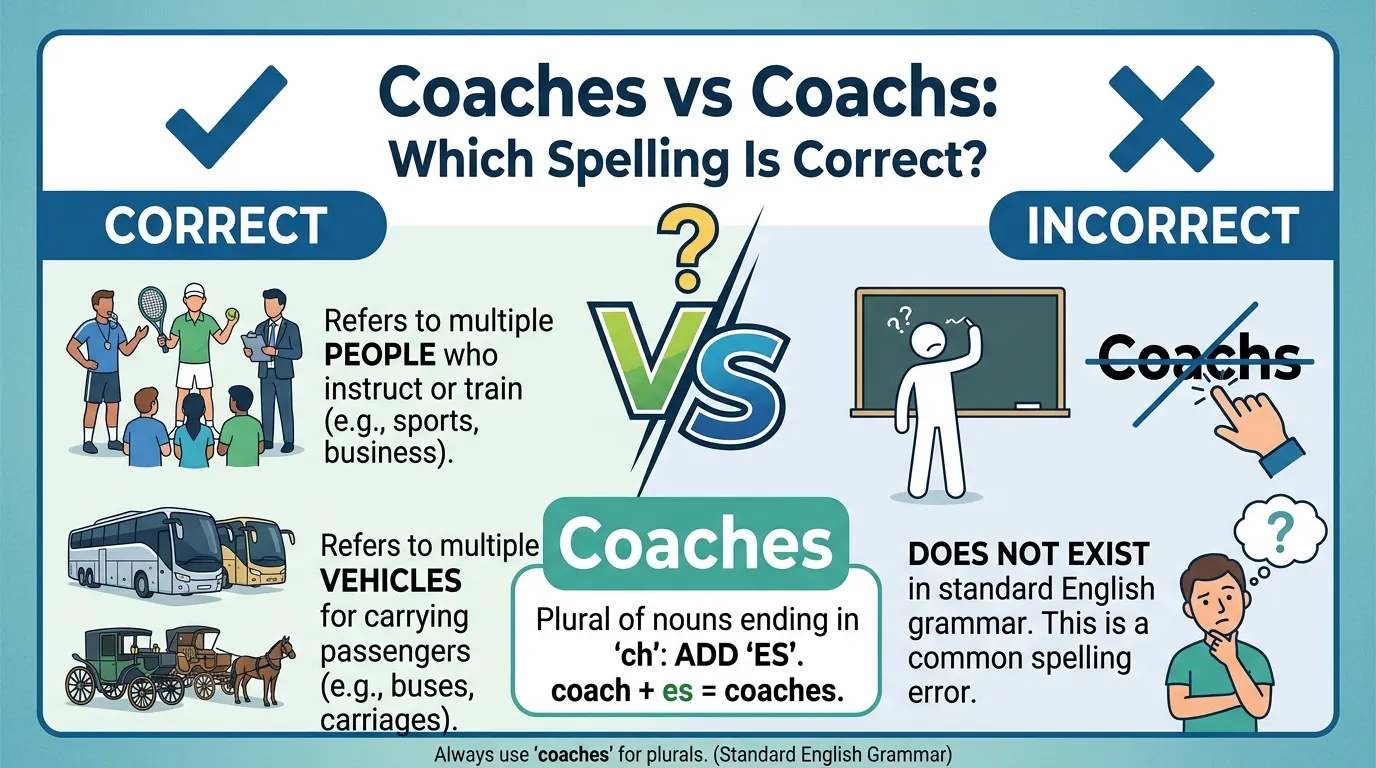
The youth club’s rulebook was twelve pages long, and it had one word wrong on nine of them. Every time the document mentioned the people who ran the teams, it said coachs. The club secretary had typed it that way for years, and nobody had ever questioned it — until a new volunteer, a retired English teacher, circled every instance in red ink and wrote in the margin: “This is not a word.” She was right. The correct spelling is coaches. Coachs is not standard English. And the reason is a rule that governs a whole family of words — a rule that, once you see it, makes the spelling feel inevitable.
The Rulebook’s Nine Mistakes
The rulebook’s sentences looked ordinary enough. “All coachs must attend the meeting.” “The coachs’ schedules are posted on Friday.” Each one contained the same error, and each one was easy to miss, because coachs looks plausible. It follows the most common plural pattern in English: add -s. One cat, two cats. One dog, two dogs. One coach, two coachs? It feels logical. It is also wrong.
English has a special rule for words that end in certain sounds. When a word ends in -ch, -sh, -s, -x, or -z, the plural is formed by adding -es, not just -s. The reason is pronunciation: try saying “coachs” out loud. Your mouth has to jam the ch sound and the s sound together, and the result is awkward. The e in -es adds a vowel that separates them, giving the word a second syllable: coach-es. The spelling follows the sound. That is the whole secret.
The -es Family
Coach is not alone. The -es rule covers a large and familiar family:
- church → churches
- branch → branches
- beach → beaches
- watch → watches
- sandwich → sandwiches
- match → matches
- dish → dishes
- box → boxes
- buzz → buzzes
- class → classes
Notice the pattern: every one of these words ends in a hissing or buzzing sound — ch, sh, s, x, z. Adding a bare -s would create an unpronounceable cluster, so English inserts the vowel. The rule is so consistent that it is one of the safest generalizations in English spelling. If a word ends in one of those five sounds, its plural takes -es. There are a few exceptions in words borrowed from other languages, but coach is not one of them.
The rule also explains why coachs looks wrong to a practiced reader even before they can say why. The eye expects the e. Its absence registers as a gap, the way a missing step registers on a staircase. The retired teacher who circled the rulebook did not need to consult a dictionary. Her eye had been trained by thousands of correctly spelled plurals, and coachs broke the pattern.
Coaches the Verb
Here is a twist that makes the word more interesting: coaches is not only a plural noun. It is also a verb form. “She coaches the team every Saturday.” “He coaches new managers through their first quarter.” In these sentences, coaches is the third-person singular present tense of the verb to coach — the form used with he, she, or it.
The verb follows the same -es rule. Just as the noun coach becomes coaches in the plural, the verb coach becomes coaches when the subject is singular and third-person. The logic is identical: the e separates the ch from the s. Compare teach → teaches, watch → watches, wash → washes. The verb and the noun obey the same rule, which is convenient: you only have to learn it once.
The verb coach has a full family of forms worth knowing. The base form is coach (“They coach together”). The past tense is coached (“She coached the team last season”). The present participle is coaching (“He is coaching the under-12s”). The noun for the activity is coaching as well (“Coaching is a skill, not just a job”). And the noun for a person who receives coaching is a coachee — a word that looks invented but is standard in professional coaching literature. None of these forms ever uses the spelling coachs.
Whose Whistle Is It? Possessives
The rulebook had a second problem hiding behind the first: the possessives. Once you fix coachs to coaches, you still have to decide where the apostrophe goes. English has three possessive forms for this word, and each means something different:
- Coach’s — belonging to one coach. “The coach’s office is upstairs.” “The coach’s decision stood.”
- Coaches’ — belonging to more than one coach. “The coaches’ meeting begins at noon.” “The coaches’ lounge is down the hall.”
- Coaches — no apostrophe, just the plural. “Two coaches are waiting outside.”
The rule is mechanical. Start with the plural, coaches. To make it possessive, add an apostrophe after the s: coaches’. To make the singular possessive, add apostrophe-s to the singular: coach’s. The most common error is writing coaches’ when you mean coach’s, or dropping the apostrophe entirely and writing coaches where a possessive is needed. The rulebook’s “The coachs’ schedules” was wrong twice over: wrong plural, and the apostrophe was attached to a word that did not exist.
A useful check: read the sentence aloud and ask how many coaches own the thing. One coach? Coach’s. More than one? Coaches’. No ownership at all, just more than one coach? Plain coaches, no apostrophe. The apostrophe is a small mark doing a large job, and it deserves the extra second of attention.
Coach, the Vehicle
There is one more coach that the rulebook never mentioned, and it is the oldest meaning of the word. Long before there were sports coaches, there were horse-drawn coaches — large, enclosed carriages. The word came into English in the 1500s from the Hungarian town of Kocs, where a particular style of carriage was made; the vehicle was a kocsi, which became coach in English. From the carriage, the word spread by metaphor: a coach in British English is still a long-distance bus (“We traveled by coach from London to Manchester”), and a railway coach is a passenger car.
The sports sense grew out of the vehicle sense. In the 1800s, at Oxford and Cambridge, a tutor who “carried” a student through an exam was called a coach, by analogy with a carriage carrying a passenger. The metaphor stuck, and by the late 1800s coach meant a sports trainer. The plural rule never changed through any of this history: carriages, buses, tutors, trainers — all of them become coaches in the plural.
The word also produces the adjective coachable, meaning willing to be taught: “She is talented and coachable, which is a rare combination.” And in American usage, coach class is the economy section of an airplane — a direct descendant of the carriage, still carrying passengers, still spelled the same way.
Coaches on the Sideline: A Whole Profession
The word coach covers a profession far wider than sports. A life coach helps clients set goals and change habits. A career coach helps people navigate job searches and promotions. An executive coach works with senior managers on leadership. A vocal coach trains singers and actors. A writing coach helps authors finish books. A financial coach helps families budget. Each of these is a coach in the original Oxford sense: someone who carries another person through a difficult passage.
The job titles produce their own vocabulary. Coaching is the activity. A coaching session is a single meeting. A coaching practice is a coach’s business. The International Coaching Federation, the largest professional body, certifies coaches and sets ethical standards. The profession has grown so fast that “coach” now appears in job titles that would have puzzled a Victorian: agile coach, wellness coach, dating coach, decluttering coach. In every title, the plural is coaches: “The conference brought together five hundred life coaches.”
The sports world has its own hierarchy. A head coach runs the team. Assistant coaches handle offense, defense, goalkeeping, or conditioning. A strength coach runs the gym. A skills coach runs drills. In American football, the coaching staff can number in the dozens. In a school, one coach may do every job. The possessives follow the same rules as everywhere else: “the head coach’s playbook” for one, “the coaches’ offices” for the staff.
The Locker-Room Check
Before you send anything containing this word, run one check. Look at the ending. If the word ends in -chs with no e — coachs — stop. The e is missing. The correct form is coaches, whether you mean several coaches or one person who coaches. Then check the apostrophe: one owner, coach’s; several owners, coaches’; no ownership, plain coaches.
The youth club fixed its rulebook. The secretary reprinted all twelve pages, the red circles disappeared, and the document now says coaches nine times without a single error. The retired teacher framed the corrected first page. It hangs in the club office, a small monument to a rule that is easy to learn and, once learned, impossible to unsee.










