The river was running high that spring, brown and fast after a week of rain, when the canoe tipped. The man in it went under, came up coughing, and went under again. On the bank, a woman who had been walking her dog kicked off her shoes, dove in, and got an arm around him. She held his head above the water until two other bystanders waded in to help drag them both out. By evening the local news was calling her a hero. A neighbor, posting the story online, called her something older and weightier: a savior.
That word carries more gravity than hero or rescuer. A hero can be brave; a savior is the person whose action stands between someone and disaster. It is a word we reach for when the stakes feel absolute. And when we write it, we face a small fork in the road: savior or saviour? Both are correct. The choice is not about right and wrong. It is about where your reader lives, which stylebook you follow, and — sometimes — whether you mean an everyday rescuer or the Saviour of Christian faith.
The Woman on the Bank, and the Word She Earned
Start with the everyday meaning, because it is the one most writers need. A savior is a person who saves someone from danger, difficulty, destruction, or suffering. The rescue can be literal, like the woman on the riverbank. It can also be figurative, and figurative uses are everywhere. A last-minute loan can be the savior of a small business. A substitute teacher who finally calms a chaotic classroom gets called a savior by Friday. A software patch can be the savior of a product launch that was hours from collapse.
Notice what all these uses share: the situation was genuinely bad, and the savior changed the outcome. That is why the word sounds inflated when it is applied to small conveniences. A coffee shop that opens an hour early is convenient, not a savior. A raincoat on a drizzly day is useful, not a savior. The word keeps its power only if it is saved for moments when something was truly at stake. When a writer calls every helpful thing a savior, the word goes flat, like a coin rubbed smooth by too much handling.
The word is a noun, and it travels with a small family of related forms. Someone can save; the act is salvation; the thing saved can be described as saved. You will also meet savior complex, a psychological term for a pattern of needing to rescue others, and savior sibling, a bioethics term for a child conceived partly to provide compatible tissue for a sick older sibling. Both show how far the word reaches beyond its religious home.
The Missing U, and the Family It Belongs To
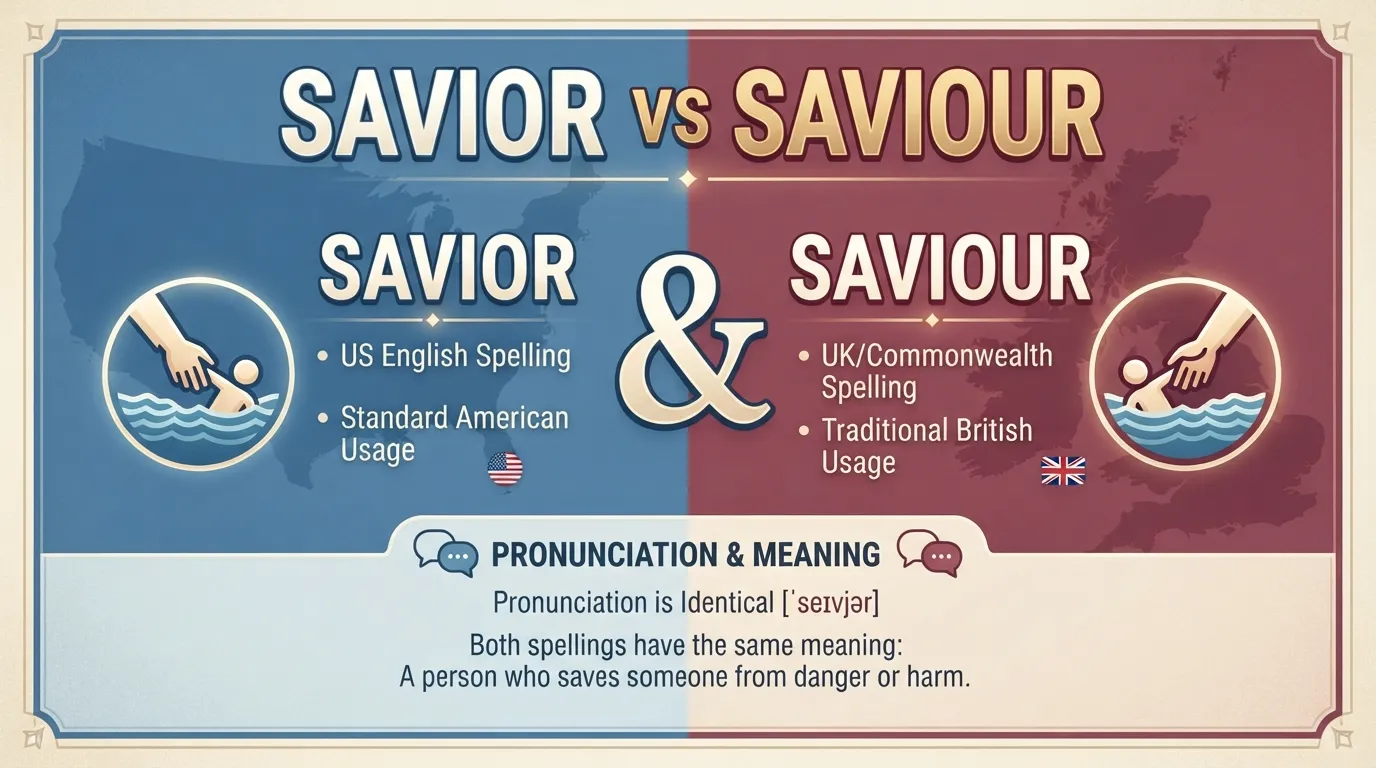
Now the spelling. American English writes savior; British English writes saviour. The difference is a single u, and it is not a quirk of this one word. It belongs to one of the most regular spelling families in English, the -or / -our family. American spelling dropped the u from a whole shelf of words that British spelling kept: color / colour, honor / honour, favor / favour, labor / labour, neighbor / neighbour, behavior / behaviour, humor / humour, rumor / rumour.
The split goes back to Noah Webster, the American lexicographer whose dictionaries in the early 1800s deliberately simplified spellings as part of building a distinct American identity. Webster argued that English spelling carried useless letters, and the u in -our words was one of his targets. Britain kept the older forms, and the rest of the English-speaking world mostly followed Britain — Canada sits in the middle, often accepting both, while Australia and New Zealand generally prefer saviour.
There is one wrinkle worth knowing. In British English, the -our ending is standard for this family, but the related verb endings differ: British English still writes save, not sa-ve-our, and the adjective saved is the same on both sides of the Atlantic. The u appears only in the noun’s ending. That is why saviour looks like a longer word but behaves exactly like savior in every sentence: same pronunciation, same grammar, same meaning.
When the Word Gets a Capital Letter
So far we have been talking about lowercase saviors: the firefighter, the donor, the timely patch. But the word has a second life, and it is the reason many people first meet it. In Christianity, the Saviour — usually capitalized — refers to Jesus Christ, understood as the one who saves humanity from sin. You will see it in hymns (“Saviour, like a shepherd lead us”), in Bible translations, and in church names. In this religious use, the capital letter does real work: it marks the word as a title, not a description.
Capitalization follows the same rule as other titles. Write the Saviour when you mean Jesus, and lowercase savior when you mean an ordinary rescuer. A sentence like “the paramedic was their saviour that night” keeps the lowercase, however dramatic the rescue. A sentence like “Christians believe Jesus is the Saviour” takes the capital. Mixing them up is one of the few genuine mistakes available with this word, and it is easy to avoid once you see the rule: capital for the title, lowercase for the job.
Which spelling does religion prefer? It follows the same regional rule. American hymnals and Bibles print Savior; British ones print Saviour. The King James Bible, published in 1611 before the spelling split hardened, uses Saviour, which is why the u form can feel older and more reverent to some readers. Modern American translations such as the ESV print Savior. Neither is more sacred; each is the local form of the same title.
Mapping the Choice to Your Reader
For ordinary writing, the decision is a matter of audience. If you write for an American audience — a US company blog, an American classroom, a US newspaper — use savior. If you write for a British, Australian, or New Zealand audience, use saviour. If you write for an international audience, pick one and stay consistent; readers on both sides understand both forms, and consistency matters far more than the choice itself. The one thing to avoid is switching mid-document: savior in paragraph two and saviour in paragraph five reads as carelessness, not cosmopolitanism.
Style guides line up behind the same rule. The Associated Press and Chicago Manual of Style prescribe savior for American writing. Oxford style prescribes saviour for British writing. If your publication has a house style, follow it; if it does not, follow your reader’s country. Canadian writers have the most freedom: both spellings are accepted, though saviour is more common in formal Canadian writing and savior appears often in business and media influenced by American usage.
Pronunciation does not change with the spelling. Both forms are pronounced the same — SAY-vyer — with the stress on the first syllable and a quick, almost swallowed second syllable. If you have ever heard someone stretch the word into three syllables (say-vee-or), that is a singing or preaching habit, not standard speech. In conversation, the word is two beats.
Phrases Where Savior Does Its Heaviest Work
The word earns its keep in a handful of fixed expressions. Savior complex describes someone who compulsively seeks out people to rescue, often at their own expense — a useful term, but a sharp one to apply to a real person, so use it carefully. Financial savior and political savior show up in news coverage whenever a company or country looks for one person to reverse a crisis. Sports writing loves the word too: a striker who scores twice in the last ten minutes becomes the team’s savior by Monday morning.
There are also phrases where the word hides inside other words. Save the day is the verb form of the same idea. Salvation is the abstract noun — the state of being saved — and it appears in both religious and secular contexts (“the new contract was the company’s salvation”). And in older literature you will meet saviour-faire nowhere — that is a joke, but it points to a real confusion: savoir-faire, the French phrase for social know-how, is an entirely different word, from savoir, to know. Do not let the similar shape fool you.
A Last Check Before You Choose
Here is a practical way to settle the question in any document. First, ask who will read it: American readers get savior, British and Commonwealth readers get saviour, and international readers get whichever you choose consistently. Second, ask whether you mean the religious title: if yes, capitalize. Third, read the sentence back and ask whether the stakes justify the word at all. If the answer is yes — if someone or something was genuinely rescued from real trouble — then savior or saviour is exactly the right word, and the only remaining question is that single letter u. The woman on the riverbank would probably shrug at the spelling debate. She did the saving; the rest of us just have to spell it.










