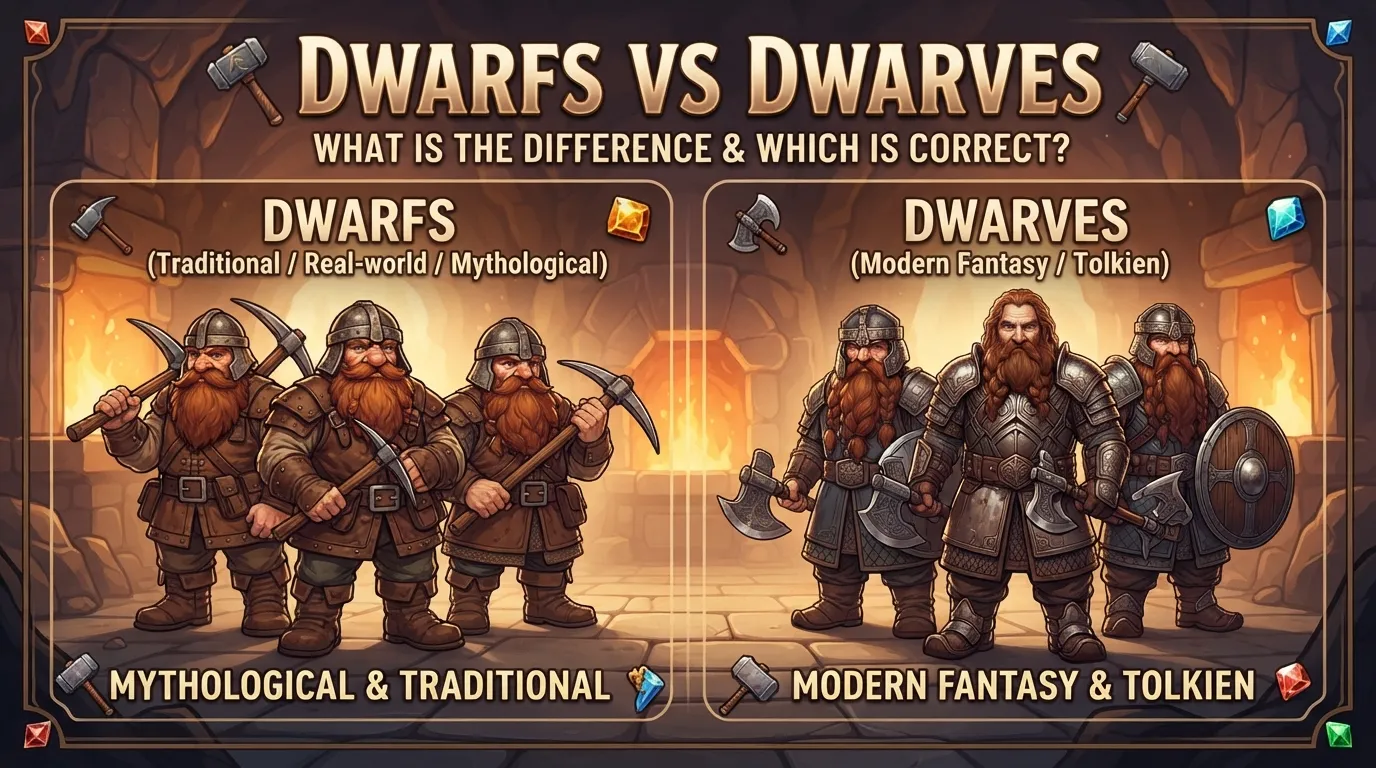
In 1937, a reader wrote to J. R. R. Tolkien to ask a question that sounds trivial until you try to answer it: why did he write dwarves instead of dwarfs? Tolkien replied that dwarves was, in his judgment, the historically better plural — the form the word would have taken if it had followed the same path as wolves and knives. He was making a deliberate choice, and it worked. Within a generation, dwarves belonged to fantasy the way elves belonged to it: the moment you read it, you picture bearded miners with axes and forges, not a medical textbook.
That letter is the best possible doorway into this pair, because it shows what is really going on. Dwarfs and dwarves are both correct plurals of dwarf. They are not a right answer and a wrong answer. They are two plurals with different homes: one in general English, one in fantasy and folklore. Choosing between them is a matter of context, register, and — when the word refers to real people — respect.
A Letter from Oxford, and a Plural Reborn
Tolkien’s reasoning was linguistic, not merely decorative. Old English had a class of nouns that changed their final consonant in the plural: wolf became wulfas, and over centuries the f softened into a v sound before the plural ending, giving modern wolves. The same voicing happened with knife / knives, wife / wives, life / lives, and leaf / leaves. Tolkien believed dwarf belonged to that family by history, and that dwarfs was a later leveling — the regular -s plural pushing out an older, more interesting form.
Whether or not modern linguists agree with every step of his argument, the effect is undeniable. The Hobbit (1937) and The Lord of the Rings (1954–55) made dwarves the standard plural in fantasy. Nearly every fantasy author since — and nearly every game, from Dungeons & Dragons to World of Warcraft — has followed him. In fantasy, dwarves signals a people: a culture with kings, mines, grudges, and songs. Dwarfs in a fantasy novel would read as a deliberate archaism or a mistake.
It is worth noting that Tolkien did the same thing with elf. The regular modern plural is elves, and Tolkien embraced it, but he also insisted on a distinction between his noble Elves and the smaller, mischievous elfs of fairy tales. For Tolkien, plurals were world-building. The ending of the word told you which world you were in.
The -f Family: Why Some Words Change and Others Don’t
English learners often want a rule for -f plurals, and the honest answer is that there is a pattern but not a law. A group of old, common, mostly one-syllable nouns voice the f to v before the plural: wolf → wolves, knife → knives, wife → wives, life → lives, leaf → leaves, half → halves, calf → calves, loaf → loaves, thief → thieves, shelf → shelves. These are words that have been in English a very long time, and their plurals preserve a sound change that happened centuries ago.
But a second, larger group keeps the f and simply adds -s: roof → roofs, chief → chiefs, proof → proofs, belief → beliefs, cliff → cliffs, grief → griefs, gulf → gulfs, safe → safes. And a third group accepts both: hoof → hoofs / hooves, scarf → scarfs / scarves, wharf → wharfs / wharves. Dwarf sits in that third group — both forms are established — but with a twist no other member has: the two forms have split by genre.
The practical rule for writers is therefore simple. If the word is dwarf, do not reach for a general -f rule. Reach for the context. Fantasy, folklore, and mythology take dwarves. Almost everything else takes dwarfs. And if you are ever unsure, dwarfs is the safer default in non-fantasy writing: no editor will mark it wrong.
Two Worlds, Two Plurals
Consider how the choice plays out in real sentences. In a museum catalog, you write: “The exhibition includes portraits of court dwarfs from seventeenth-century Spain.” In an astronomy paper, you write: “White dwarfs are the cooling remnants of stars like our sun.” In a gardening guide: “Dwarf varieties stay under two feet tall.” In each case, dwarfs is the natural, unmarked plural — the one that draws no attention to itself.
Now move to fantasy. “The dwarves of the Iron Hills marched at dawn.” “Thorin and his company of dwarves set out to reclaim the mountain.” Here dwarves is not just acceptable; it is expected. Using dwarfs in that sentence would feel like a typo to most fantasy readers, the way elfs would. The genre has claimed the spelling, and the claim is now stronger than any dictionary preference.
There is also a middle ground: folklore and fairy-tale retellings. Snow White’s companions are usually called the Seven Dwarfs — Disney’s 1937 film fixed that spelling in the public mind, and it remains standard for that story. But a modern fantasy retelling of the same tale might choose dwarves to signal a grittier, Tolkien-influenced world. The choice is a tone dial: dwarfs sounds documentary; dwarves sounds mythic.
The same tone dial operates in science writing, where the word is never about people at all. Astronomers write of white dwarfs and brown dwarfs, stellar objects that have burned through their fuel, and no astronomer has ever proposed dwarves for them. Botanists write of dwarf conifers and dwarf fruit trees — compact varieties bred for small gardens. In these technical uses, dwarfs is the only form that appears, because the fantasy signal would be absurd: a dwarf star is a physical object, not a character, and giving it the fantasy plural would confuse the reader about what kind of text they are reading.
When the Word Refers to Real People
Everything above concerns fictional beings, stars, and plants. When the word refers to people with dwarfism, different considerations apply, and they matter more than spelling. Dwarf has a long history as a medical and descriptive term, but many people with dwarfism find it reductive or offensive when used as a label, especially by strangers. The respectful default in everyday writing is person with dwarfism (person-first language), or little person, which is the term preferred by many in the community, including the advocacy organization Little People of America.
If you are writing about a specific person, use the language that person uses for themselves. If you are writing medically, use the precise clinical term for the condition (for example, achondroplasia, the most common cause of dwarfism) rather than the general label. And whatever you do, do not use the plural question as a joke: the dwarfs / dwarves distinction is a spelling choice, not a punchline about people’s bodies. Good writing about this topic keeps the fantasy grammar in the fantasy section and treats real people with the ordinary dignity they are owed.
One more usage note: the singular is always dwarf. There is no standard singular dwarve. You will occasionally see dwarve in old texts or fantasy role-playing material, but in modern English it reads as an error. The pair is dwarf / dwarfs or dwarf / dwarves, never dwarve / dwarves.
Dwarf the Verb: Small in a Different Way
There is one more member of this family that confuses people, and it is not a plural at all. Dwarf is also a verb, meaning to make something seem small by comparison: “The new skyscraper dwarfs the old church next door.” “Her achievement dwarfs everything else on her résumé.” In this use, the word has nothing to do with fantasy or medicine. It is a metaphor of scale, and it is common in journalism, architecture criticism, and sports writing — “the rookie’s debut dwarfed every other performance that weekend.”
The verb follows regular conjugation: dwarfs, dwarfed, dwarfing. Note that the third-person singular is always dwarfs — “the cathedral dwarfs the houses around it” — even in a fantasy novel. Nobody writes “the mountain dwarves the village.” The -ves form belongs to the noun plural only. If you see dwarves as a verb, it is a mistake.
The verb also carries a warning about tone. Because it compares sizes, it can sound dismissive when applied to people or their work: “his contribution dwarfed hers” may be accurate, but it can sting. In neutral comparisons of buildings, mountains, and budgets, it is unremarkable. Applied to people, use it with care.
Settling It in Your Own Writing
Here is the decision in one short sequence. First, ask what you are describing. If it is a fantasy people — Tolkien-style miners, folklore beings, a game race — write dwarves. If it is anything else — stars, plants, historical court figures, garden varieties — write dwarfs. If it is a real person with dwarfism, step back from the spelling question entirely and use person-first language. Second, check whether the word is a verb; if it is, the answer is always dwarfs. Third, be consistent within a single work: a novel that flips between dwarfs and dwarves for the same people will confuse readers who have learned to read the ending as a signal. Tolkien chose his plural on purpose, in a letter, with reasons. You can afford to choose yours on purpose too.










