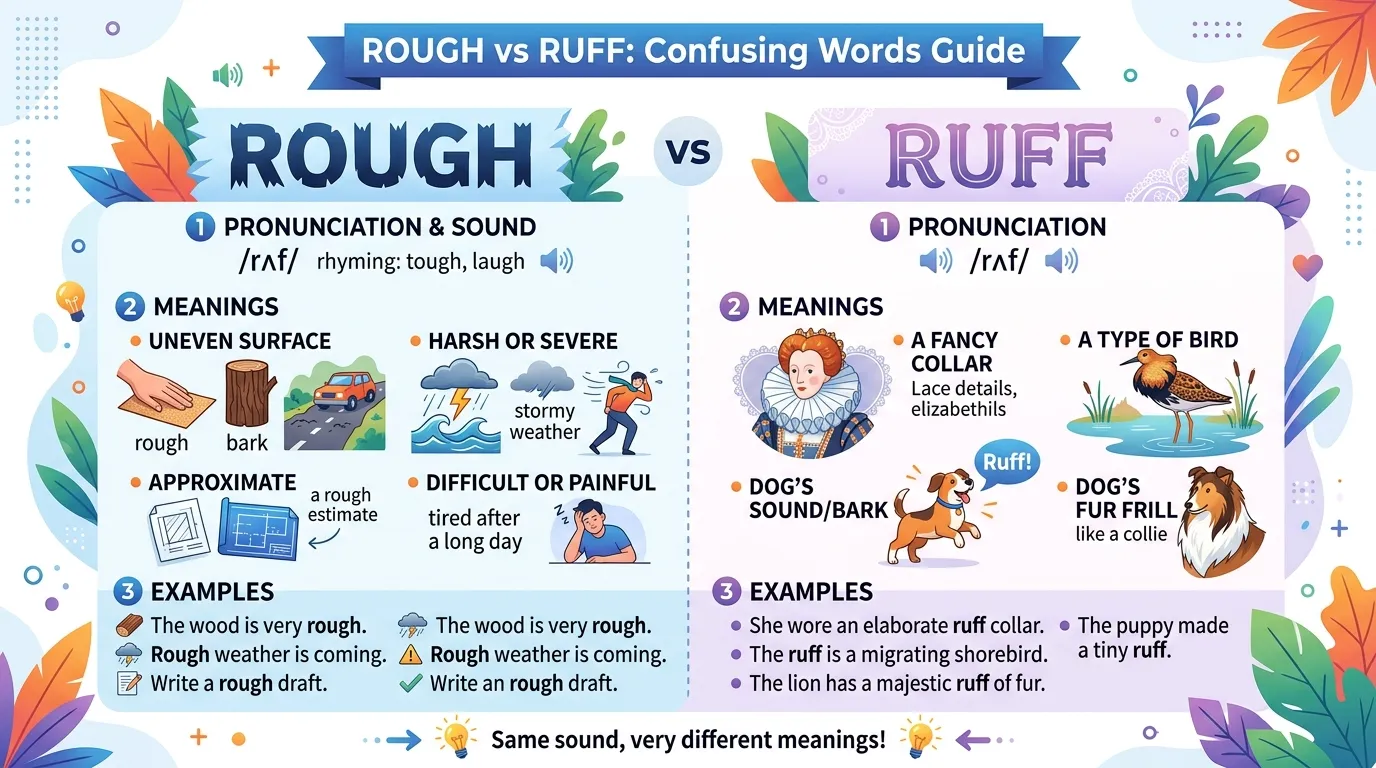
The museum of textures has three rooms, and the guide warns you before you enter the first one: “Touch everything.” In the first room, the walls are sandpaper, tree bark, gravel, and unfinished wood. In the second room, a mannequin wears a enormous pleated collar that stands up around its neck like a satellite dish. In the third room, a speaker plays a single sound on a loop: a dog barking, short and sharp. Three rooms, three experiences, one sound. The first room is rough. The second and third are ruff. The two words sound exactly alike. They share nothing else.
Room One: The Wall You Can Feel
Rough is one of the most versatile words in English, and it starts with the sense of touch. A rough surface is uneven, coarse, not smooth: rough wood, rough stone, rough fabric, rough skin. “The road is rough.” “The fabric feels rough.” “His hands were rough from years of manual labor.” In this sense, the word is the opposite of smooth, and it describes something you can feel with your fingers.
But rough does not stop at touch. It extends to difficulty: a rough day, a rough week, a rough start, a rough patch. It extends to harshness: rough language, rough treatment, rough justice. It extends to approximation: a rough estimate, a rough idea, a rough draft, a rough sketch. It extends to unfinished work: a rough cut of a film, a rough diamond, rough carpentry. And it extends to violence: a rough neighborhood, rough play, rough handling. In all of these, the core idea is the same: something that is not smooth, not polished, not finished, not easy. The word carries its tactile origin into every metaphor it touches.
Grammatically, rough is a shape-shifter. It is usually an adjective (“a rough road”), but it can be an adverb (“to play rough”), a noun (“the rough of a golf course,” “to take the rough with the smooth”), and a verb (“to rough it,” “to rough out a plan”). It appears in idioms that every fluent speaker knows: rough around the edges, rough and tumble, a rough diamond, roughing it, to sleep rough (to sleep outdoors). The word’s flexibility is part of why it is so common — it fits almost anywhere something is unfinished, difficult, or uneven.
Room Two: The Collar That Ate the Neck
Walk into the second room, and the word changes completely. A ruff is a stiff, pleated collar worn around the neck, fashionable in Europe in the sixteenth and seventeenth centuries. The mannequin in the museum wears one the size of a dinner plate: layers of starched linen, pleated and arranged in a circle, framing the face like a halo. In portraits by Holbein, Van Dyck, and Rembrandt, queens, merchants, and scholars all wear ruffs. The ruff was a status symbol: the bigger and whiter the ruff, the richer the wearer. It was also, by all accounts, deeply uncomfortable. Eating while wearing one required care. Turning your head required planning.
The word’s second meaning is biological. A ruff is a ring of feathers or fur around the neck of certain birds and animals. The ruffed grouse has a ruff of black feathers that it raises during mating displays. The male ruff (a wading bird, whose name is also ruff) grows an elaborate collar of feathers in breeding season. In both cases, the ruff is a display: a circle of feathers that makes the animal look bigger, more impressive, more worth noticing. The connection to the human collar is visual: both are circles around the neck, both are meant to be seen.
There is a third meaning, smaller and more specialized. In card games, ruff is a verb meaning to play a trump card: “He ruffed the trick.” In this sense, the word comes from a different root — probably from the French ronfle, a card game — and it has nothing to do with collars or feathers. It is a reminder that homophones can have separate histories: two words can sound alike without being related at all.
Room Three: The Bark
The third room is the smallest, and it holds the most familiar ruff of all. In comic strips, children’s books, and cartoons, a dog’s bark is written as “ruff ruff.” It is an onomatopoeia — a word that imitates the sound it names. “Ruff!” said the dog. The spelling is a convention, not a rule: different languages write a dog’s bark differently (French dogs say “ouaf,” German dogs say “wuff,” Japanese dogs say “wan”), but in English, the standard rendering is ruff or woof. The two are interchangeable in this context, and both are understood.
The bark sense of ruff is the one most English speakers encounter first, usually in childhood. It is also the one most likely to cause confusion, because it is the sense that sounds most like rough in everyday speech. A child who hears “ruff” in a storybook and “rough” in a conversation about a bad day has no way to tell from sound alone that they are different words. The spelling has to be learned separately, through reading and writing, not through hearing.
There is also a place where the two words meet in the wild: the phrase ruff and tumble does not exist, but rough and tumble does, and writers occasionally misspell it. The reverse error — writing rough for the collar — is rarer, because the collar is rare. The most common confusion is simple: a writer who means rough (difficult, uneven) writes ruff, because the sound is the same and the ruff spelling is shorter, simpler, and (to the ear) equally plausible.
Rough in Sports and Games
Sports gave rough some of its most durable idioms. In golf, the rough is the long grass bordering the fairway — the place your ball goes when your shot goes wrong. “He’s in the rough” means he is in trouble, and the metaphor needs no explanation: the rough is where the ground is uneven, the lie is bad, and the next shot is hard. In hockey, roughing is a penalty for unnecessarily rough play. In American football, roughing the passer is a foul for hitting the quarterback after the throw. In boxing, a rough fighter is one who bends the rules.
The word also names a specific kind of athlete: the rough-and-tumble player, the one who thrives in chaos, who is not polished but is impossible to ignore. Coaches use the phrase with affection: a rough-and-tumble player is not a dirty player, but a physical one, a player who does the hard work in the corners. And in card games, the ruff — the trump-card sense — has its own sports life: in bridge and whist, to ruff is to play a trump when you cannot follow suit. Two words, two games, and the spelling decides which game you are playing.
Two Histories, One Sound
The two words have completely different origins, which is why they share a sound but nothing else. Rough comes from Old English ruh, meaning hairy, shaggy, or coarse — a word about texture. Its relatives include rug (originally a coarse woolen blanket) and the German rau (rough). The word has been describing uneven surfaces for over a thousand years, and its spelling has stayed remarkably stable.
Ruff the collar comes from a different place: probably from ruff meaning a frill or a wrinkle, related to ruffle (a gathered strip of fabric) and rough only by coincidence. The bird sense comes from the collar sense, by visual analogy. The bark sense is onomatopoeia, invented by sound, not by history. Three meanings, three origins, one spelling — and none of them connected to rough.
The pronunciation is identical in standard American English: “ruff” — one syllable, rhyming with stuff, bluff, and gruff. In some British accents, rough can sound slightly different from ruff, but in most varieties of English, the two are perfect homophones. The ear cannot tell them apart. Only the context can: if the sentence is about a surface, a day, an estimate, or a difficulty, the word is rough. If it is about a collar, a bird’s neck, a trump card, or a dog’s bark, the word is ruff.
The Feel Test
Here is the memory hook, and it grows directly out of the museum. Rough is the word you can feel. It has a gh in it — two extra letters, rough and uneven, like the surface it describes. The spelling itself is rough: r-o-u-g-h, five letters with a silent gh at the end, awkward and bumpy on the page. Ruff is smooth by comparison: r-u-f-f, four letters, clean and simple, like a collar’s neat pleats or a bark’s short burst. The rough word has the rough spelling. The smooth word has the smooth spelling.
Another hook: rough shares its ough ending with tough, enough, and cough — words that all describe difficulty, effort, or discomfort. If the sentence is about something hard, difficult, or uneven, it probably needs the ough spelling. Ruff shares its uff ending with stuff, fluff, and puff — words about soft, light, airy things. If the sentence is about a collar, feathers, or a bark, it probably needs the uff spelling. The word families point the way.
Walk out of the museum and the three rooms stay with you. The wall you can feel: rough. The collar that ate the neck: ruff. The bark on the speaker: ruff. One sound, three rooms, and now you know which door each spelling opens.










