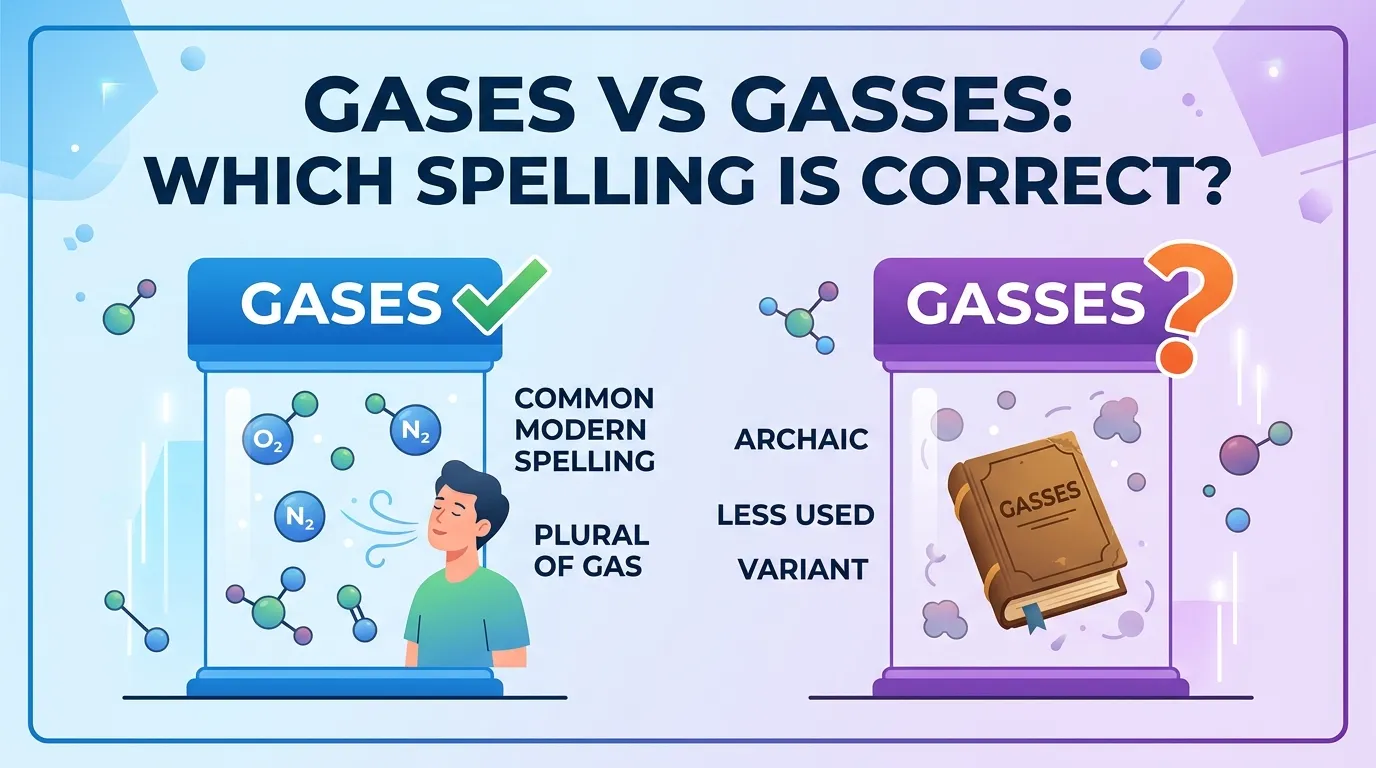
Look up on a clear night, and you are looking at gases. The air above you is mostly nitrogen and oxygen, with a pinch of argon and a trace of carbon dioxide, all of them gases — invisible, odorless, and utterly ordinary. Now look at a chemistry textbook, and you will find the same word, spelled the same way. But open a dictionary to the verb gass, and you will find a different spelling entirely: gasses. Two spellings, two jobs, one letter apart. The difference between gases and gasses is one of the cleanest examples in English of how a single letter can change a word’s entire identity.
The Air Above You
Gases is the plural of the noun gas. It names more than one gas: the gases in the atmosphere, the gases in a laboratory, the gases in a car’s exhaust. “Oxygen and nitrogen are gases.” “Some gases are invisible.” “Greenhouse gases affect Earth’s climate.” “The laboratory stores several chemical gases.” In every one of these sentences, gases is a plural noun, naming substances. The word’s job is counting: one gas, two gases, many gases.
The spelling follows a rule that governs a whole family of English nouns. When a noun ends in a hissing sound — s, x, z, ch, sh — the plural is formed by adding -es, not just -s. Bus becomes buses. Box becomes boxes. Watch becomes watches. Dish becomes dishes. Gas becomes gases. The extra e is there because gass would be hard to pronounce — the two s sounds would collapse into one. The e separates them and creates a second syllable: gas-iz. The rule is phonetic, not arbitrary. English adds the e so the plural can be heard.
That is the whole story of gases, and it is worth pausing on, because it explains why the spelling looks the way it does. The e is not decoration. It is the sound of the plural itself, written down. When you say “gases,” you say two syllables: gas and iz. The spelling records both of them.
The Verb That Talks Too Much
Gasses, with a double s, is a different word with a different job. It is the third-person singular form of the verb gass, an informal verb meaning to talk excessively, to chat at length, to go on and on. “He gasses on about his old college days.” “She gasses about her vacation for hours.” In these sentences, gasses is a verb, describing an action. It has nothing to do with chemistry. It has everything to do with conversation.
The verb gass is uncommon in modern English, and it is marked as informal or slang in most dictionaries. It belongs to the same family as gasbag (a person who talks too much) and gassing (talking at length). Its origin is probably the image of gas escaping — talk pouring out like air from a valve, unstoppable and slightly tiresome. The word is more common in British English than in American English, and even in Britain it is used sparingly. Most writers will go their whole careers without needing it. But when they do need it, the spelling matters, because gasses and gases are not interchangeable.
There is a second verb sense worth knowing. Gas itself can be a verb, meaning to supply with gas, to expose to gas, or (in older usage) to poison with gas. Its forms follow the doubling rule: gas → gassed → gassing. “The troops were gassed.” “The car was gassed up.” In the third-person singular, the verb gas becomes gasses: “The station gasses up a hundred cars a day.” This is the same spelling as the gass verb form, which is one reason the two words are so easy to confuse. The spelling gasses can be a verb in two different ways — and neither of them is the plural of gas.
The Sibilant Family
The gas/gases pattern is part of a larger system, and learning the system makes every member easier. English nouns that end in a hissing sound form their plurals with -es, and the pattern is completely regular:
- Class → classes (not “classs”)
- Boss → bosses
- Fox → foxes
- Church → churches
- Brush → brushes
- Gas → gases
Notice that in every case, the plural adds a syllable. Class (one syllable) becomes classes (two syllables). Gas (one syllable) becomes gases (two syllables). The added syllable is the -es ending, pronounced “iz.” If you say the plural aloud and hear two syllables, you need the e. If you hear one syllable, you do not. The ear is a reliable guide here, because the rule is built on sound.
Verbs follow a parallel rule. When a verb ends in a hissing sound, the third-person singular adds -es: pass → passes, watch → watches, fix → fixes. The verb gass follows the same pattern: gass → gasses. The double s in gasses is the result of the verb’s own double s (from gass) plus the -es ending. The spelling looks crowded, but it follows the rule exactly.
Where the Confusion Lives
The most common error with these words is writing gasses when you mean the plural of gas. It happens because writers remember the general rule — “add -es to words ending in s” — and then double the s for emphasis, or because they confuse the noun plural with the verb form. The error appears in student essays, in science writing, in online forums, and even in published work. It is one of those mistakes that survives proofreading, because gasses looks like a plausible English word — and it is a real word, just not the one the writer meant.
The reverse error — writing gases when you mean the verb — is rarer, because the verb gass is rare. But it does happen, usually when a writer is describing someone talking too much and reaches for the more familiar spelling. “He gases on about his car” is wrong; the verb needs the double s. The fix is the same in both directions: ask yourself whether the word is a noun or a verb. Noun (more than one gas) → gases, one s in the middle, one e before the final s. Verb (talking, or supplying gas) → gasses, double s.
A useful test: try replacing the word with liquids. If the sentence still makes sense, you need the noun: “Greenhouse liquids affect Earth’s climate” is odd but grammatical, so gases is correct. If the sentence needs a verb, try replacing it with talks: “He talks on about his old college days” works, so gasses is correct. The substitution test turns a spelling question into a grammar question, and grammar questions are easier to answer.
Gases in the News and the Lab
The word gases does heavy lifting in two domains where precision matters: climate science and medicine. In climate reporting, “greenhouse gases” is one of the most important phrases in the language — it names the carbon dioxide, methane, nitrous oxide, and fluorinated gases that trap heat in the atmosphere. The spelling matters here because the science matters: a report that writes “greenhouse gasses” has made an error in the first sentence, and careful readers notice. In medicine, gases are everywhere: the oxygen a patient breathes, the anesthetic gases in an operating room, the blood gases measured in an intensive-care unit. “Arterial blood gases” is a standard test, and its name is spelled with one s in the middle.
The verb gass shows up in a different kind of news: social commentary and memoir. A critic might write that a politician “gasses on about the past,” using the verb’s informal, slightly contemptuous tone. The word’s rarity is part of its effect — because readers do not encounter it often, it lands with a small shock. That is why writers who use it should spell it correctly: the double s is the only thing standing between the verb and the chemistry noun, and a reader who sees gases in a sentence about talking will pause, confused, wondering what chemistry has to do with conversation.
One Letter, Two Worlds
The memory hook for this pair is visual. Gases has one s in the middle, and it names things that spread out — gases fill a room, gases fill the sky, gases disperse. Gasses has two ss pressed together, and it names a verb about pressure — talk pouring out, gas being forced in. One s for the substance that expands. Two ss for the action that pushes. It is a coincidence, but it is the kind of coincidence that sticks.
Or, if you prefer a rule to an image: the plural of a noun ending in s never doubles the s. Classes, bosses, foxes, churches, gases — in every case, the base word keeps its single s and adds -es. Doubling happens only in verbs, where the base verb itself ends in a double consonant. If you see a doubled s in the middle of the word, you are looking at a verb. If you see a single s, you are looking at the plural noun.
The air above you is gases. The talk that fills a room can be gasses. One letter apart, two different worlds — and now you know which world each spelling belongs to.










