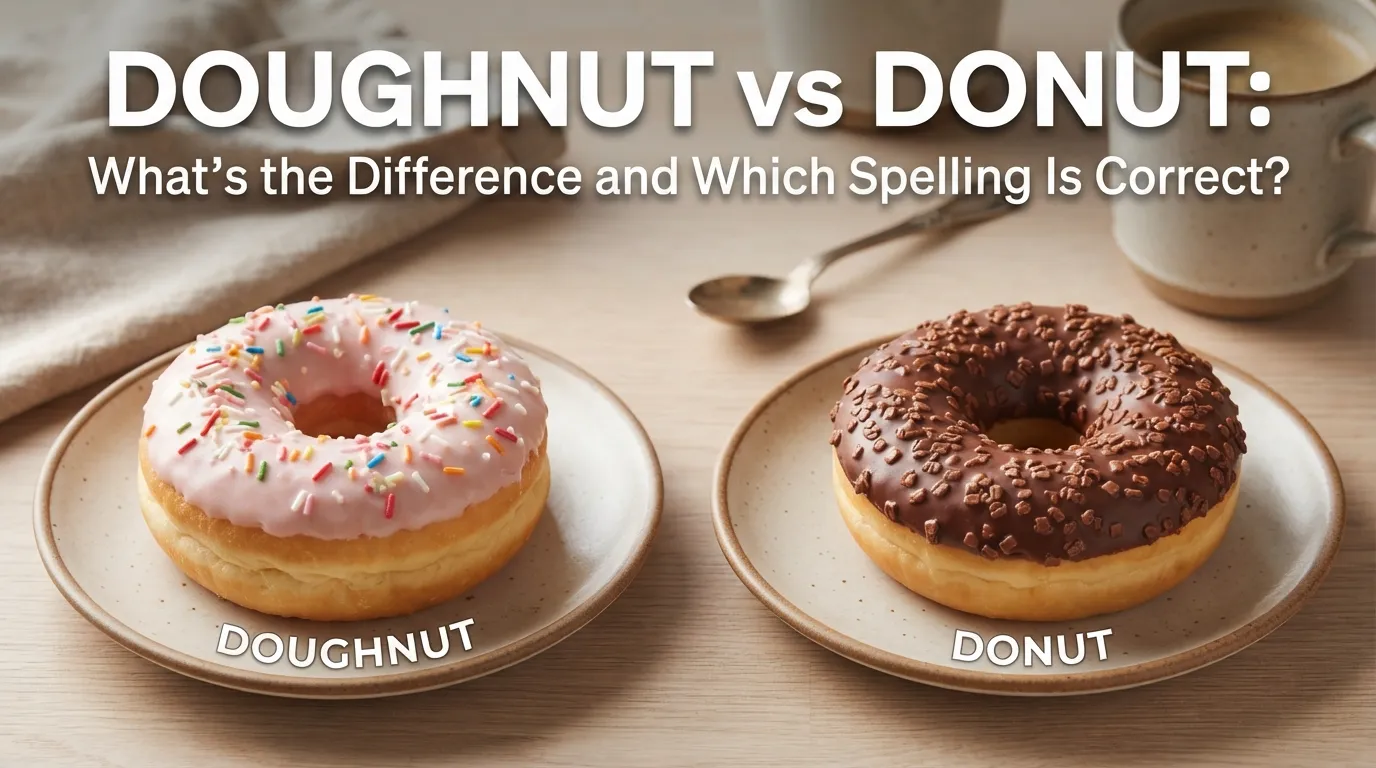
On a highway outside Boston there is a sign that has been visible for generations: a pink-and-orange logo, a coffee cup, and one word — Donuts. A few miles away, a bakery window says Fresh Doughnuts. Same food. Same street. Two spellings. Both are correct. Doughnut is the traditional spelling, older and more widely recognized around the world. Donut is the shorter spelling, born in American advertising and now the standard on shop signs across the United States. The question is not which one is right. It is which one fits your page, your audience, and your style guide.
The Sign on the Highway
The most famous donut sign in America belongs to a chain founded in 1950 in Quincy, Massachusetts. Its original name was Open Kettle. Its founder soon renamed it Dunkin’ Donuts — with the short spelling, right there in the name, on every sign, every cup, every box. That single branding decision did more for donut than any dictionary ever did. Millions of Americans learned the short spelling before they learned the long one, because they read it on their way to work.
The chain is not the only reason donut spread. American English has a long habit of simplifying spelling: color for colour, center for centre, check for cheque. Donut fits the pattern. It is shorter, faster to write, easier to fit on a sign. And because the food is casual — a breakfast treat, a coffee companion, a box brought to the office — the casual spelling felt natural. Nobody expects a doughnut shop to sound like a university press.
Dough + Nut: What’s Inside the Word
The traditional spelling tells the word’s story. Doughnut is dough + nut. The dough part is obvious: the food is fried dough. The nut part is the surprise. In the early 1800s, when the word first appeared, nut was used for any small round lump or cake. A doughnut was a small round cake of fried dough — a “dough nut.” The first doughnuts were not rings. They were solid balls of dough, sometimes with nuts or fruit in the middle. The hole came later, credited in American folklore to a sea captain named Hanson Gregory, who supposedly punched a hole in the middle so the dough would cook evenly.
That history explains the spelling. Doughnut preserves the two English words it was built from. Donut preserves the sound and drops the history. Neither is wrong. But when a reader sees doughnut, the word quietly teaches its own origin. When a reader sees donut, the word just names the food and moves on. Both jobs are legitimate. The writer chooses which job the word should do.
The Man Who Shortened It
The short spelling did not begin with the chain, but the chain made it famous. Donut appeared in American writing as early as the late nineteenth century, as a phonetic simplification. Spelling reformers liked it. Advertisers liked it more. A shorter word means a bigger sign, a cheaper label, a punchier headline. By the mid-twentieth century, donut was everywhere in American commercial writing: donut shops, donut makers, donut boxes, donut holes.
Dictionaries followed usage, as they do. Today, American dictionaries list doughnut as the main entry and donut as a variant — or list both without ranking them. British dictionaries list doughnut first and treat donut as an American variant. Style guides split. The Associated Press accepts both. The New York Times has used both. The practical rule is the one that governs all spelling variants: pick one and use it consistently through a single document. A menu that writes doughnuts in one line and donuts in the next looks careless, even though both spellings are correct.
Doughnut in Britain, Donut in America
Regional preference is the clearest guide for most writers. In British English, doughnut dominates. British bakeries, newspapers, and cookbooks overwhelmingly use the long spelling, and donut reads as an American import. In American English, both spellings are common, but donut dominates in commercial and casual contexts — shops, menus, advertising, social media — while doughnut holds its ground in formal, literary, and traditional writing.
Pronunciation offers no help and no confusion: both spellings are pronounced exactly the same, DOH-nut. The plural forms follow the spelling you chose: doughnuts or donuts. And the derived terms follow too: doughnut hole or donut hole, doughnut shop or donut shop, doughnut glaze or donut glaze. Consistency, again, is the only rule that matters.
The Doughnut Family: Holes, Fillings, and Phrases
The word has grown a family of compounds and idioms, and they all follow the spelling you choose. The doughnut hole is both the literal hole in the middle and the small ball of dough sold as a snack. The doughnut as spare tire is slang: “the car’s spare is a doughnut” means a small temporary tire. “Doughnut” as a shape describes anything ring-like: a doughnut magnet, a doughnut chart. In sports, “donut” appears in “a donut” for a zero score, especially in cricket and in American slang for a shutout.
The fillings and toppings have their own vocabulary: glazed, frosted, filled, jelly, custard, Boston cream, cruller, bear claw, fritter. A cruller is a twisted, ridged doughnut. A fritter is a chunky fried cake with fruit. A bear claw is a large, almond-topped Danish-style pastry often sold beside doughnuts. None of these terms change with the spelling question, but they all appear in the same menus and articles, which is another reason to settle the spelling early and stop thinking about it.
The Doughnut in Culture: Cops, Offices, and a Yellow Cartoon Family
No food has a richer pop-culture life than the doughnut. The association with police officers began in the mid-twentieth century, when doughnut shops were among the few places open late at night, and officers on night shifts stopped for coffee and a doughnut. The stereotype stuck, and it has been joked about, resented, and embraced ever since. The office doughnut box is another institution: the person who brings doughnuts to a morning meeting is buying goodwill by the dozen. And then there is Homer Simpson, whose love of doughnuts — “Mmm, doughnuts” — became one of the most quoted lines in television history.
The doughnut also has its own holiday. National Doughnut Day, celebrated on the first Friday of June in the United States, dates back to 1938, when the Salvation Army honored the women who served doughnuts to soldiers during World War I. Those women, known as Doughnut Lassies, fried doughnuts in soldiers’ helmets on the front lines in France. The holiday began as a fundraiser during the Great Depression and survived as a celebration of the food and the women who served it. Today, shops give away free doughnuts on the day, and the spelling on the signs is usually the short one — donut — because the celebration is commercial, casual, and American. The history behind it, though, is anything but casual, and it is a reminder that the simplest foods often carry the longest stories.
The Hole Truth: Why the Ring Shape Stuck
The ring shape that defines the modern doughnut was not inevitable. Early doughnuts were solid balls, and the hole was a practical fix: the center of a solid ball cooked slower than the outside, leaving a raw middle. Punching a hole let hot oil reach every part of the dough, so the ring cooked evenly. The fix became the identity. Today, the ring is the default shape, and the solid ball survives as the “doughnut hole” — the small sphere of dough that the ring leaves behind, sold as a snack in its own right. Filled doughnuts took a different path: no hole, but a pocket of jelly, custard, or cream injected after frying. The three forms — ring, hole, filled — cover nearly every doughnut on earth, and they all answer the same engineering problem: how to get heat into the middle of fried dough.
Picking One and Sticking With It
So which should you use? Use doughnut when you are writing formal, traditional, academic, or international English; when your audience is primarily British; or when your style guide prefers the traditional form. Use donut when you are writing American commercial, casual, or advertising copy; when you are naming a shop or product that uses the short spelling; or when your style guide accepts it. And in every case, use the same spelling throughout a single document. The highway sign and the bakery window can disagree. Your article should not.
One last practical tip: if you write for a publication, check its house style before you start. A quick search of the publication’s archive for doughnut versus donut will tell you which form its editors prefer, and following the house style saves everyone a round of corrections. If you write for yourself, pick the form that fits your voice — traditional or modern, long or short — and then forget about it. The doughnut, by either spelling, tastes the same.










