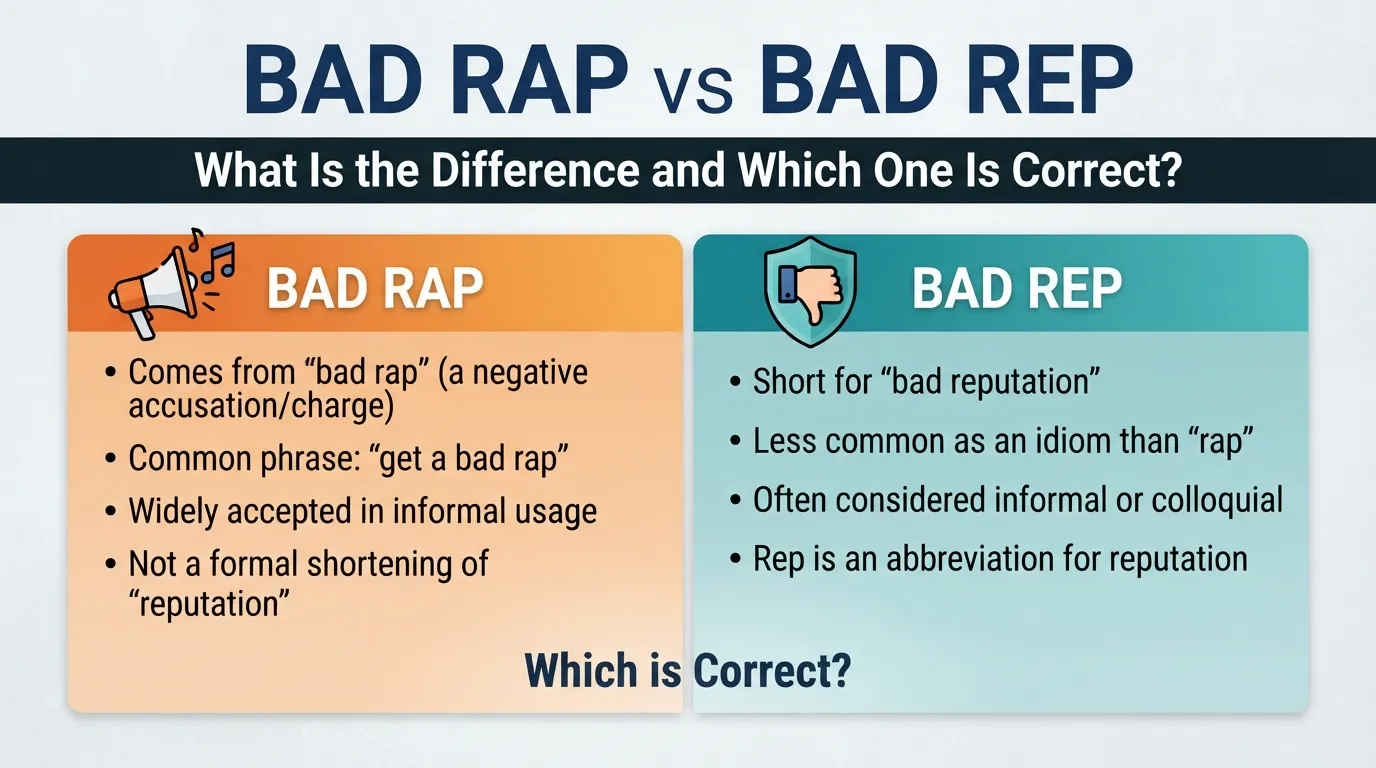
Two coworkers were talking about the new restaurant across the street. “It gets a bad rap,” said one. “It’s got a bad rep,” said the other. They agreed about the restaurant. They disagreed about nothing. And yet they used two different expressions, because bad rap and bad rep are both correct — and they are not quite the same thing. One says the criticism is unfair. The other just says the reputation is poor. The difference is small, but it is real, and it comes from the two different words hiding inside the phrases.
Two Sentences in the Same Break Room
Put the two phrases side by side and the distinction appears. “That neighborhood gets a bad rap” suggests the neighborhood is judged more harshly than it deserves. The speaker is defending it, or at least questioning the judgment. “That neighborhood has a bad rep” simply reports that people think poorly of it. The speaker may agree with the judgment or not; the phrase does not say. One phrase carries an opinion about fairness. The other carries a fact about reputation.
This is why the two expressions are not interchangeable in every sentence, even though they overlap heavily. “Introverts sometimes get a bad rap” works because it implies the judgment is undeserved. “The hotel has a bad rep because customers keep complaining about the rooms” works because it describes a reputation built on repeated complaints, fairly earned. Swap them and the sentences still make sense, but the shading changes. The first speaker sounds sympathetic. The second sounds neutral. In casual conversation the difference barely registers. In careful writing, it is the whole point.
Rap: The Charge Sheet
Bad rap comes from rap in its older sense: a charge, a criticism, a criminal accusation. A “rap sheet” is a record of criminal charges. To “take the rap” is to take the blame for something. To “beat the rap” is to escape a charge. In this family, rap is about being accused or blamed. So a “bad rap” is literally a bad charge against someone — an unfavorable judgment, a negative verdict, a criticism that lands on a person or thing.
That history explains the unfairness coloring. A charge can be false. A verdict can be wrong. When you say something “gets a bad rap,” you are borrowing the language of accusation, and accusations carry the possibility of innocence. The phrase took hold in American English in the twentieth century, and it spread because it filled a gap: English needed a quick way to say “people judge this more harshly than it deserves.” Consider the examples: “Teachers sometimes get a bad rap.” “Reality television gets a bad rap.” “He got a bad rap for something he did not actually cause.” In each case, the speaker is pushing back against the judgment, not just reporting it.
Rap also lives in fixed phrases worth knowing. “A bum rap” is an unjust accusation or punishment: “He got a bum rap from the committee.” “To take the rap” is to accept blame: “She took the rap for the team’s mistake.” And of course there is the musical sense, which is a different word with a different history — more on that below.
Rep: The Shortened Reputation
Bad rep is simpler. Rep is short for reputation, clipped the way info is short for information and demo is short for demonstration. A “bad rep” is a bad reputation, nothing more and nothing less. “That brand has a bad rep among younger customers.” “He has a bad rep at work.” “The school has a bad rep in the local community.” “The website has a bad rep for poor customer service.” In each case, you could replace bad rep with bad reputation and lose nothing but a syllable.
Because rep is an abbreviation, the phrase is more casual than bad reputation. It belongs in speech, in texts, in informal writing. You would not write “the company has a bad rep” in a legal filing or a formal report; you would write “the company has a bad reputation.” But in a meeting, in an email to a colleague, in a review, bad rep is perfectly natural. Note also that rep has another life as a clipping of representative — a sales rep, a union rep — which is why context matters. “He’s a bad rep” could mean he has a bad reputation, or, in a sales office, that he is a poor representative. The sentence around it settles which.
The Unfairness Test
Here is the practical test that separates the two phrases. Ask: am I saying the judgment is unfair, or am I just reporting the reputation? If unfair, use bad rap. If just reporting, use bad rep or bad reputation. “That movie gets a bad rap” — you think the movie is better than its reputation. “That restaurant has a bad rep” — you are noting that people think poorly of it, fairly or not.
The test also explains why bad rap is the more common choice when people defend something. Defending requires the unfairness idea. “Opossums get a bad rap” is a defense of opossums. “The new policy gets a bad rap” is a defense of the policy. Nobody writes “the new policy has a bad rep” when they are defending it, because bad rep concedes the reputation without challenging it. The two phrases are close cousins, but they point in different directions: one pushes back, one reports.
Rap’s Other Lives
One confusion deserves clearing up, because it misleads a lot of writers: rap the music has nothing to do with bad rap. Rap music comes from a different sense of rap — to talk, to chat, to strike — and it developed its own history in the 1970s. The phrase bad rap predates rap music’s mainstream fame and draws on the charge-and-blame sense, not the musical one. Nobody who says “the city gets a bad rap” is comparing the city to a song.
There is also a third phrase that sometimes gets tangled in: bad wrap. That one is simply wrong in this context. Wrap means to cover or enclose — gift wrap, a wrap sandwich. It has no connection to reputation or blame. “A bad wrap” for a restaurant is a misspelling born of sound-alike confusion. If you mean reputation, write rap or rep. If you mean a sandwich, write wrap.
Choosing in Speech and in Writing
Register decides which form fits. In casual speech, use either, and let the unfairness test pick. In informal writing — texts, social posts, blog comments, internal emails — both are fine. In formal writing — reports, academic papers, professional articles, press releases — avoid both and use bad reputation, or rephrase entirely: “The neighborhood is unfairly criticized” instead of “the neighborhood gets a bad rap,” or “the company’s reputation has suffered” instead of “the company has a bad rep.” Formal writing prefers the full word to the clipping and the plain statement to the idiom.
Regionally, both phrases are strongest in American English. British English uses them too, but bad reputation and bad press are more common in British writing. And for the plural or possessive forms, the phrases behave like ordinary noun phrases: “bad raps” is rare; writers usually keep the singular. “The restaurant’s bad rep” works; “the restaurant’s bad rap” works too, though the possessive is less common than the verb construction “gets a bad rap.”
Bad Rap in Pop Culture and Headlines
The phrase’s unfairness coloring is why it thrives in headlines and pop culture. Headline writers love it because it compresses a defense into three words. “Opossums Get a Bad Rap” tells the reader the article will defend opossums. “Carbs Get a Bad Rap” promises a defense of carbohydrates. “Millennials Get a Bad Rap” signals that the writer thinks the generation is judged too harshly. In each case, the headline does double duty: it names the subject and announces the writer’s stance. A headline that read “Millennials Have a Bad Rep” would sound like a report, not a defense, and it would attract a different reader.
The phrase also appears in song lyrics, stand-up comedy, and television dialogue, usually at the moment a character defends something unfashionable. A comedian says, “Airports get a bad rap,” and the audience knows a defense is coming. A food writer says, “Frozen vegetables get a bad rap,” and the reader knows the next paragraph will praise them. The phrase has become a signal: what follows will be a case for the defense. That is a lot of work for three small words, and it is why the phrase has survived while so many other slang expressions have faded. It fills a gap that no single word fills. There is no one-word synonym for “unfairly criticized.” Maligned comes close, but it is formal. Bad rap is the everyday version, and it is not going anywhere.
The One-Question Check
Before you write either phrase, ask one question: do I think the criticism is unfair? Yes — bad rap. No, or I’m not saying — bad rep. And if the writing is formal, skip both and write bad reputation. Two coworkers, one restaurant, two phrases, one question. That is the whole difference.










