
Three scenes, one word. A farmer in Iowa looks over a wheat field and says the crop will yield forty bushels an acre. A driver approaching a roundabout sees a red-and-white triangle and yields to the traffic already circling. A negotiator, after three hours of argument, yields a single point and saves the deal. Same word, three different lives — and one spelling question that trips up thousands of writers: is it yield or yeild? The answer is yield, spelled y-i-e-l-d. Yeild is a misspelling. And the irony of this particular mistake is that the word people get wrong is one of the few that actually follows the rule they are afraid of.
Scene One: The Harvest
The oldest sense of yield is the farm sense: to produce, to give back something from effort and land. “The farm yields two harvests a year.” “These bonds yield about five percent annually.” “Her efforts finally yielded results.” “The apple trees yield fruit every fall.” In each sentence, something is produced — grain, interest, results, fruit — as the outcome of a process.

As a noun, yield names the amount produced: “The wheat crop had a record yield this year.” “Milk yield per cow has improved on this farm.” This is the sense behind one of the most common phrases in agriculture and manufacturing — crop yield, grain yield, high yield — and behind the verb’s most productive family: produce a yield, improve the yield, increase yield, measure yield. When you read that a factory “yielded” a thousand units, or an orchard “yields” a heavy crop, you are in the harvest sense, and the spelling is y-i-e-l-d in every form: yields, yielded, yielding.
Scene Two: The Intersection
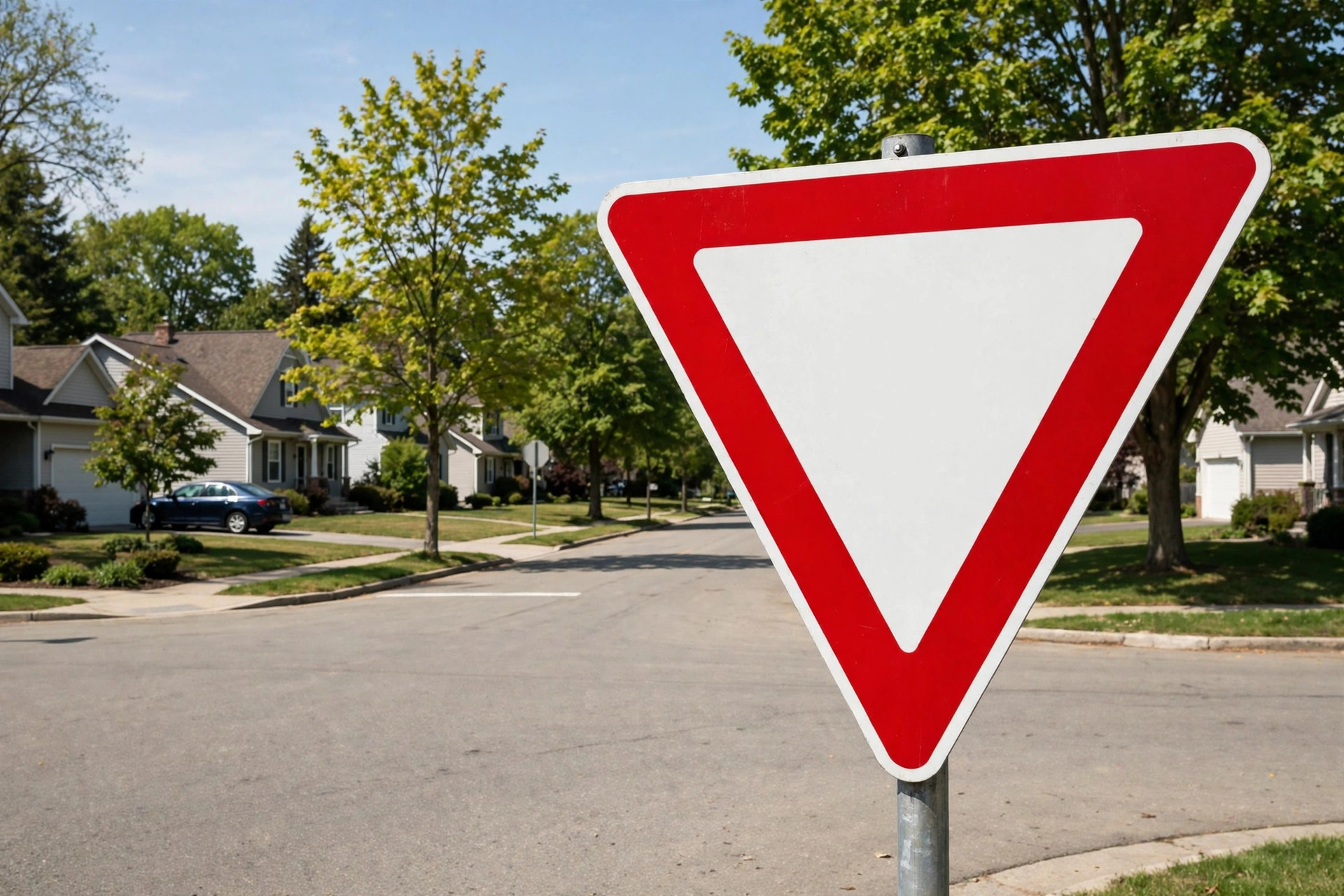
The second life of yield is the one every driver knows: to give way. “Yield to oncoming traffic.” “Please yield the right of way to pedestrians.” “The bus yielded to let the ambulance pass.” Here the word means stepping aside so someone or something else can go first. It is the verb on the road sign, and it is also a noun when it names the sign itself: “The yield sign at the intersection was new.”
This sense is worth pausing on, because it explains one of the word’s most useful memory tricks. To yield is to let something go before you. In the spelling, the i goes before the e — the i is yielded the first position, the e follows. It is a small poetic coincidence, but it is exactly the kind of hook that makes a spelling stick.
The give-way sense extends far beyond traffic. In meetings, a speaker “yields the floor” to let a colleague speak. In debate, you “yield a point” to concede it. In a crowded hallway, you yield the doorway. In every case the meaning is the same: you step aside, deliberately, and let the other thing pass.
Scene Three: The Negotiation
The third life is the hardest: to surrender, to submit, to stop resisting. “She refused to yield to pressure.” “The troops yielded after a long siege.” “He would not yield an inch in the negotiation.” “They finally yielded to their children’s requests.”

Notice that this sense is not the same as giving up. Give up often means abandoning an effort altogether. Yield as surrender means giving in to a force, pressure, or authority — and it can be strategic rather than defeatist. “She gave up the diet” means she quit. “She yielded to pressure from the committee” means she conceded a point, not that she quit entirely. A general who yields a hill may be saving an army. A negotiator who yields a clause may be winning the contract. The word carries dignity that “give up” does not.
That dignity is why the opposites of this sense are words of resistance: resist, defy, persist, hold out, stand firm, withstand, oppose. “The defenders refused to yield” becomes “The defenders held out.” For the produce sense, the opposites are different: consume, waste, lose. A bad investment consumes your savings; a good one yields returns. Matching the opposite to the sense is what separates careful writing from careless writing.
The ie/ei Tangle
So why does anyone write yeild? Because of the most famous spelling rhyme in English: “i before e, except after c.” Most writers learn it in school, and then English immediately undermines it with rule-breakers like weird, seize, either, neither, leisure, protein, and heist. After seeing so many exceptions, writers lose confidence in the order. Is it ie or ei? Faced with a word that sounds like “yeeld,” many people guess wrong.
Here is the twist: yield is not an exception. It follows the rule perfectly — “i before e.” The word that trips people up is actually one of the well-behaved words. That is the irony of the yeild mistake: people break the rule on a word that obeys it.
There is a second reason the mistake persists. The long “ee” sound can be spelled both ways in English — believe, receive, deceive, grief, field — so when writers sound the word out, they are never sure which pattern applies. Unlike receive, which really does follow “except after c,” yield is a simple “i before e” word. And there is a rhyme that settles it: yield rhymes with field, and field is also spelled with ie. If you can spell field, you can spell yield the same way. The full rule, honestly stated: i before e (believe, field, yield, friend, thief, piece), except after c (receive, deceive, conceive, ceiling), with a short list of real exceptions — and yield is not on it.
Yield in Finance: A Word That Pays
If the harvest sense is the oldest, the finance sense is the one that pays the most attention to spelling, because it appears in documents where errors cost money. A bond’s yield is the return it pays: “The bonds yield five percent.” A stock’s dividend yield tells investors what income the shares produce. A yield curve plots returns across time. High-yield bonds pay a higher return because they carry more risk; high-yield crops produce more per acre.

In finance writing, the natural synonym for yield is return: “The bonds yield five percent” becomes “The bonds return five percent.” In a traffic context, the natural synonym is give way. In a negotiation, it is concede or relent. Choosing the synonym that matches the sense keeps the writing precise — and it keeps the spelling anchored, because every one of those synonyms pairs with the same y-i-e-l-d word.
The word also grows a useful adjective: yielding, meaning flexible or compliant. “A yielding negotiator” is one who bends. “Yielding soil” is ground that gives underfoot. It is a small word family, but it covers a surprising amount of ground: farms, roads, boardrooms, and markets.
Yield in the News and in Everyday Speech
Turn on the news and yield appears in all three of its lives, sometimes in a single broadcast. A farming report: “Wheat yields are up this season.” A traffic report: “Drivers should yield to emergency vehicles.” A political report: “The senator yielded the floor after two hours.” A markets report: “Bond yields fell after the announcement.” The word is a workhorse of journalism precisely because it is compact: one syllable that can mean produce, give way, or concede, depending on the sentence around it.
Everyday speech adds more. “Yield to temptation” means to give in to something tempting: “She finally yielded to temptation and bought the cake.” “Yield the right of way” is the traffic rule every driver learns. “Yield the floor” belongs to formal meetings and legislatures. In sports commentary, a team “yields” a goal when it concedes one, and a boxer “yields” the center of the ring when he steps back. In science, materials “yield” under pressure — the point at which metal bends rather than springs back is called the yield point, and the strength at that moment is the yield strength. Engineers use the word daily, and they spell it the same way: y-i-e-l-d.
The word also appears in a phrase that confuses many writers: “yield to” versus “yield up.” “Yield to” means give way to someone or something: “Yield to the faster runner.” “Yield up” is rarer and means to hand something over: “The safe yielded up its secrets.” Both use the same spelling. And in all of these uses — news, sport, science, speech — the misspelling yeild shows up too, usually typed in a hurry. The fix is the same everywhere: field, yield, ie.
Putting It Together
Three scenes, one spelling. The farm yields a crop. The driver yields the road. The negotiator yields a point. The investor watches the yield. In every case the word is y-i-e-l-d, and the misspelling yeild appears in every one of those contexts too — in farm reports, in traffic tickets, in contracts, in prospectuses. The fix is the same in all of them: remember that yield rhymes with field, that it follows the rule instead of breaking it, and that the i yields the first position to no one — it goes first, and the e follows, exactly as the word itself describes.
One last check before you send anything containing this word. Say it: YEELD, one syllable, rhyming with field and sealed. Now write it: y-i-e-l-d. If the letters in your draft read yeild, swap the first two vowels. The word that means giving way should never have to give way to a misspelling.










