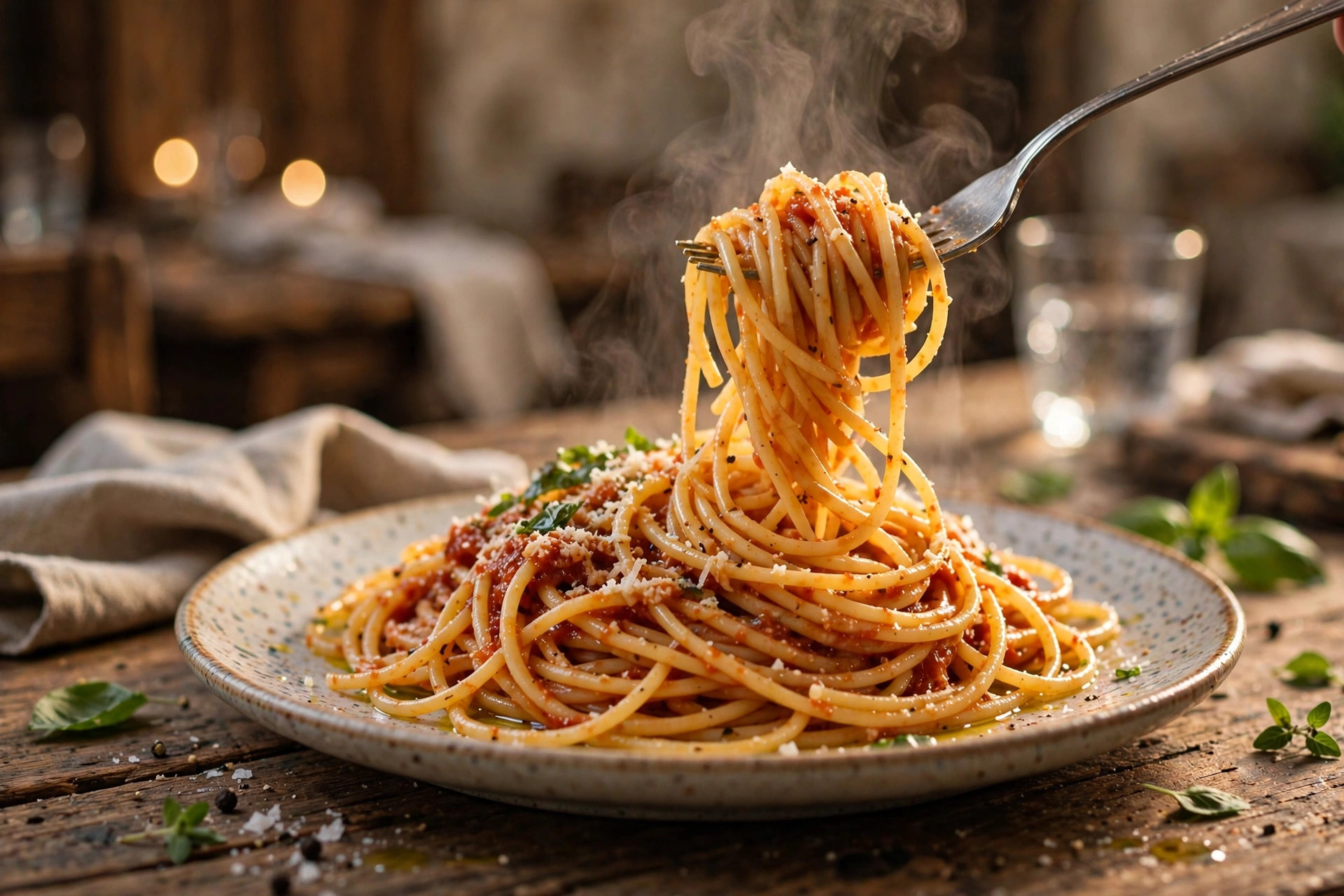
The menu said spagetti bolognese. The restaurant was good — the kind of place with fresh pasta and a wood-fired oven — but the menu had a typo, and one of the diners at my table noticed it before the waiter finished pouring water. The correct spelling is spaghetti. Spagetti, with one T, is a misspelling. It is a small error with a long explanation, because the word is not English at all. It is Italian, and its spelling follows Italian rules that English never bothered to translate.
Little Strings
Spaghetti is the plural of spaghetto, an Italian word meaning “thin string” or “thin cord.” Spaghetto itself is a diminutive form of spago, the Italian word for “string” or “twine.” So the literal meaning of spaghetti is: thin little strings. Hold that image, because it explains both the food and the spelling.

Now the letters, one at a time: s-p-a-g-h-e-t-t-i. Notice the double T in the middle. That double T is the part most people get wrong when they write spagetti. The single-T version is not accepted in any dictionary, style guide, or standard form of English. It does not have its own separate meaning. When someone writes spagetti, they almost always intend to write spaghetti. The standard spelling ends in -etti, contains a double T, and has only one G.
In its main sense, spaghetti is a type of long, thin, round pasta made from wheat flour and water. It is one of the most widely recognized foods in the world and a staple of Italian cooking. “She served spaghetti with tomato sauce.” “The kids love spaghetti and meatballs.” “We bought fresh spaghetti from the Italian market.” “He twirled the spaghetti around his fork.”
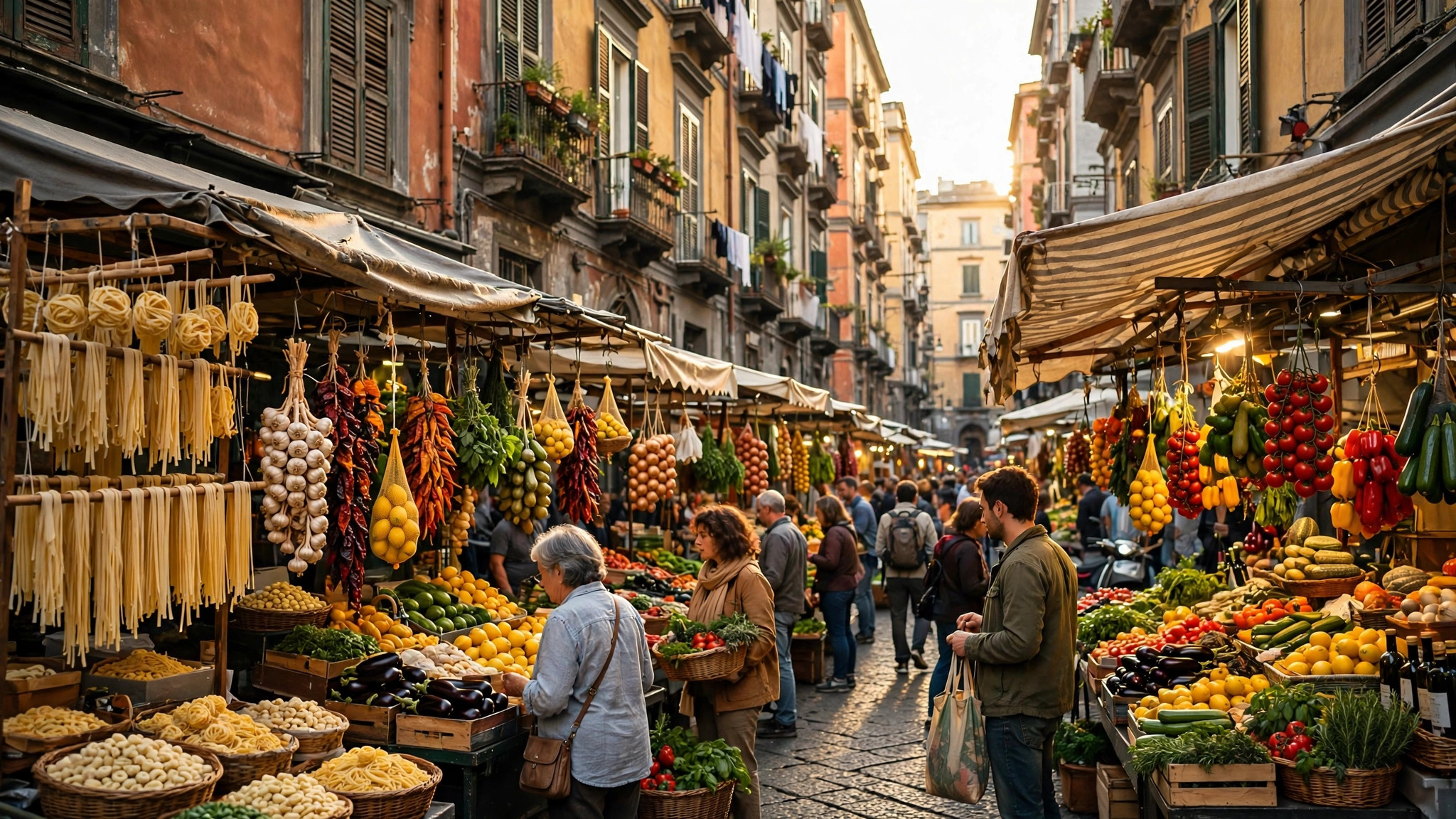
From Naples to Your Table
The word entered English in the nineteenth century as Italian food became known outside Italy. It arrived with the food itself — with immigrants, with restaurants, with cookbooks — and English adopted it wholesale, spelling and all. That is the crucial point: English did not translate the word. It borrowed it, unchanged, including the double T and the silent GH.
Italian spelling has clear rules about doubled consonants. In Italian, a double consonant like TT is pronounced with a slightly longer hold, and it changes how the word sounds and sometimes its meaning. Many Italian food words keep their doubled consonants in English: mozzarella (double Z), cappuccino (double P, double C), pizza (double Z), tagliatelle (double T), fettuccine (double T, double C), risotto (double T), prosciutto (double T), bruschetta (double T), spaghetti (double T). Notice the pattern. Italian words borrowed into English often keep their double consonants, especially double T and double Z. English speakers who learn this pattern find it easier to remember that spaghetti needs two Ts.
The GH in spaghetti is silent in English. It comes from the Italian spelling, where GH is used to keep the G hard before an E or I. Without the H, “spageti” would suggest a soft G sound in Italian. The H is a spelling device, not a sound. This is the same reason English has spaghetti and not spagetti. The original Italian word simply has a double T, and English borrowed the whole word unchanged.
The Double T Rule of Italian Borrowings
So why do people write spagetti? The mistake is very common, and the reasons are easy to understand. First, English speakers do not naturally double consonants unless they know the word’s history. In English, the double T in spaghetti does not change the sound in an obvious way, so many writers assume one T is enough. Second, English has no word-final -etti pattern of its own. Spaghetti comes from Italian, and Italian spelling rules are different from English ones. A writer who has never seen the Italian pattern may simplify the ending.
Third, pronunciation gives no clear hint. Most English speakers say spaghetti with a quick T sound, which sounds the same whether the word has one T or two. There is no audible difference between spagetti and spaghetti in normal speech, so spellers guess. Fourth, the double T sits between two weak vowel sounds. When the word is spoken quickly, the doubled consonant is easy to miss. Finally, there is the autocorrect problem. Once a person writes spagetti once, their brain remembers that version, and the mistake becomes a habit. Many people have seen spagetti in text messages, social media posts, and restaurant menus, which makes it feel more normal than it is.
The pronunciation, for the record: in American English, spaghetti is pronounced spuh-GET-ee. Broken into syllables: spuh / get / ee. The stress falls on the second syllable: GET. The first syllable is weak (“spuh,” rhyming with the start of “suppose”). The second syllable carries the stress (“GET,” rhyming with “net”). The final syllable sounds like “ee” (rhyming with “see”). The double T does not make a longer sound. It is the same T sound as in a single T. No matter how quickly or slowly you say the word, the correct spelling is always spaghetti, never spagetti.
Spaghetti Beyond the Plate
The word escaped the kitchen long ago, and its figurative meanings are where the spelling error spreads fastest — because people write them quickly, in slang, in code reviews, in headlines. In software development, “spaghetti code” describes computer code that is tangled, disorganized, and hard to follow. The name comes from the image of a plate of noodles twisted together in every direction. “The old program is full of spaghetti code.” “Nobody wants to maintain that spaghetti code.” “The team refactored the spaghetti code into clean modules.”

A “spaghetti junction” is a complicated, tangled road interchange where many highways cross over each other. The term is used in the United Kingdom and elsewhere to describe confusing highway interchanges. “Drivers hate navigating that spaghetti junction during rush hour.” A “spaghetti western” is a Western film made by Italian filmmakers, especially in the 1960s and 1970s. The nickname comes from the films’ Italian origin. “Spaghetti westerns changed the way Westerns were filmed.” “Spaghetti straps” are the very thin shoulder straps on dresses and tops, called that because they look like thin strands of pasta. “She wore a dress with spaghetti straps.” “Spaghetti squash” is a type of squash whose cooked flesh separates into thin strands that look like pasta. “We baked spaghetti squash for dinner.” And in business and manufacturing, a “spaghetti diagram” is a visual map that traces the movement of people or materials through a process. The tangled lines look like a plate of spaghetti. “The spaghetti diagram showed how inefficient the layout was.” Every one of these compounds uses the same spelling. The word never changes.
Counting What Can’t Be Counted
Grammatically, spaghetti is a noun, and it is usually an uncountable noun. Uncountable nouns are not counted as individual items. You do not say “one spaghetti, two spaghettis” when talking about the food. Correct: “We ate spaghetti for dinner.” “She bought some spaghetti.” “How much spaghetti do we need?” Incorrect: “We ate a spaghetti for dinner.” “She bought three spaghettis.” Instead, use amounts or containers: a plate of spaghetti, a bowl of spaghetti, a box of spaghetti, a bag of spaghetti, two pounds of spaghetti, some spaghetti, a serving of spaghetti.
Spaghetti can also modify other nouns, functioning like an adjective in phrases such as spaghetti dinner, spaghetti sauce, spaghetti recipe, spaghetti night, spaghetti bowl, spaghetti factory, spaghetti dinner fundraiser. “Our church is hosting a spaghetti dinner on Saturday.” “This spaghetti sauce recipe is a family favorite.” “We had a spaghetti night with friends.” And it appears in many compounds — spaghetti code, spaghetti western, spaghetti junction, spaghetti straps, spaghetti squash, spaghetti diagram, spaghetti bolognese — written as separate words or with hyphens depending on the term, but the word spaghetti itself is always spelled the same way.
A Menu of Mistakes to Skip
English has borrowed many Italian food words, and knowing them helps you spell spaghetti correctly, because you start to recognize the double-consonant pattern: mozzarella (cheese with double Z), cappuccino (coffee with double P and double C), pizza (double Z), espresso (double S, not “expresso”), lasagna, ravioli, tortellini, risotto (rice dish with double T), prosciutto (cured ham with double T), bruschetta (toasted bread with double T), fettuccine (wide pasta with double T and double C), tagliatelle (ribbon pasta with double T), gnocchi (potato dumplings with double C), tiramisu, gelato, pesto, parmesan, marinara, alfredo, bolognese. Each of these words keeps its Italian spelling in English. Spaghetti follows the same rule.

For the pasta itself, the near-synonyms depend on context: pasta (the broad category), noodles (a more general word, often used for Asian noodles), linguine, fettuccine, tagliatelle, angel hair, vermicelli (related pastas, thinner or flatter), pasta strands (descriptive phrase). In American English, pasta usually means Italian-style pasta made from wheat, while noodles is broader and often suggests Asian noodles like ramen or udon. Many Americans call spaghetti “noodles” in casual speech, especially when talking to children, but in recipes and food writing, spaghetti is called pasta. And for “spaghetti code,” the opposites are clean code, structured code, or well-organized code — which is, fittingly, the same standard this spelling deserves. Two Ts. One G. Every time, on every menu, in every codebase, in every sentence.










