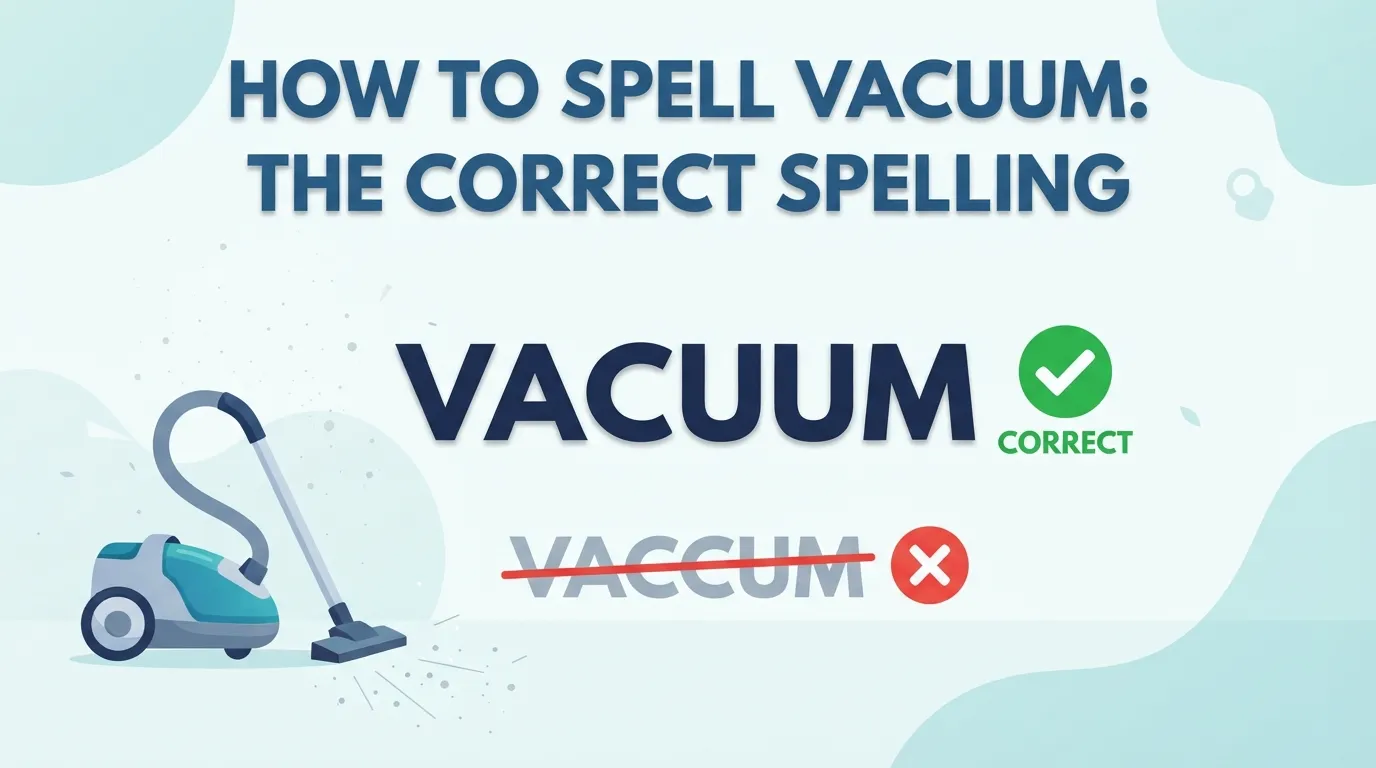
English has a favorite set of double letters. SS shows up everywhere: class, pass, boss. EE is a regular: feel, need, keep. TT, LL, OO — all common, all comfortable. And then there is UU. The double U is so rare in English that most people can name only one word that contains it. That word is vacuum, and its rarity is the reason it gets misspelled so often.
The correct spelling is vacuum: V-A-C-U-U-M. One C, two U’s, one M. If you have been writing “vaccum,” “vaccuum,” or “vacume,” those are misspellings. The double U is not a mistake. It is the whole point of the word.
The Rarest Double Letter in English
Think of the doubled letters in English as a popularity contest. SS, EE, TT, LL, OO, FF, ZZ, MM, NN, PP, RR — all of them appear in dozens of everyday words. UU barely shows up at all. Outside of vacuum, the only common examples are “continuum” and a handful of borrowings like “muumuu.” A writer’s brain, which has spent a lifetime seeing doubled letters in familiar pairs, looks at UU and quietly decides it must be a typo. The hand then “fixes” it by dropping one U, producing vaccum or vacum.
That instinct is understandable and wrong. The double U is doing real work: it produces the long “oo” sound in the second syllable. Say the word slowly — “VAK-yoom.” The “yoom” at the end is the two U’s, working together. One U would give you a different sound, and the word would feel unfinished. The spelling is not decorative; it is the sound, written down.
The C causes the opposite problem. English has many words with a double C — accept, occur, recommend, success — so writers guess that vacuum might have one too. That guess produces vaccuum, with two C’s and two U’s. But vacuum has only one C. The doubled letter is the U, not the C. A short chant covers it: “Double U, single C, single M.” Say it while you write the word, and the letters fall into place.
There is one more error, the ending. In everyday speech, the end of vacuum can sound like “ume,” which leads people to write vacume, with a silent E. The actual ending is “-uum,” with the second U carrying the long “oo” sound. No silent E. The word ends the way it sounds when you say it slowly: VAK-yoom.

The Appliance That Became a Verb
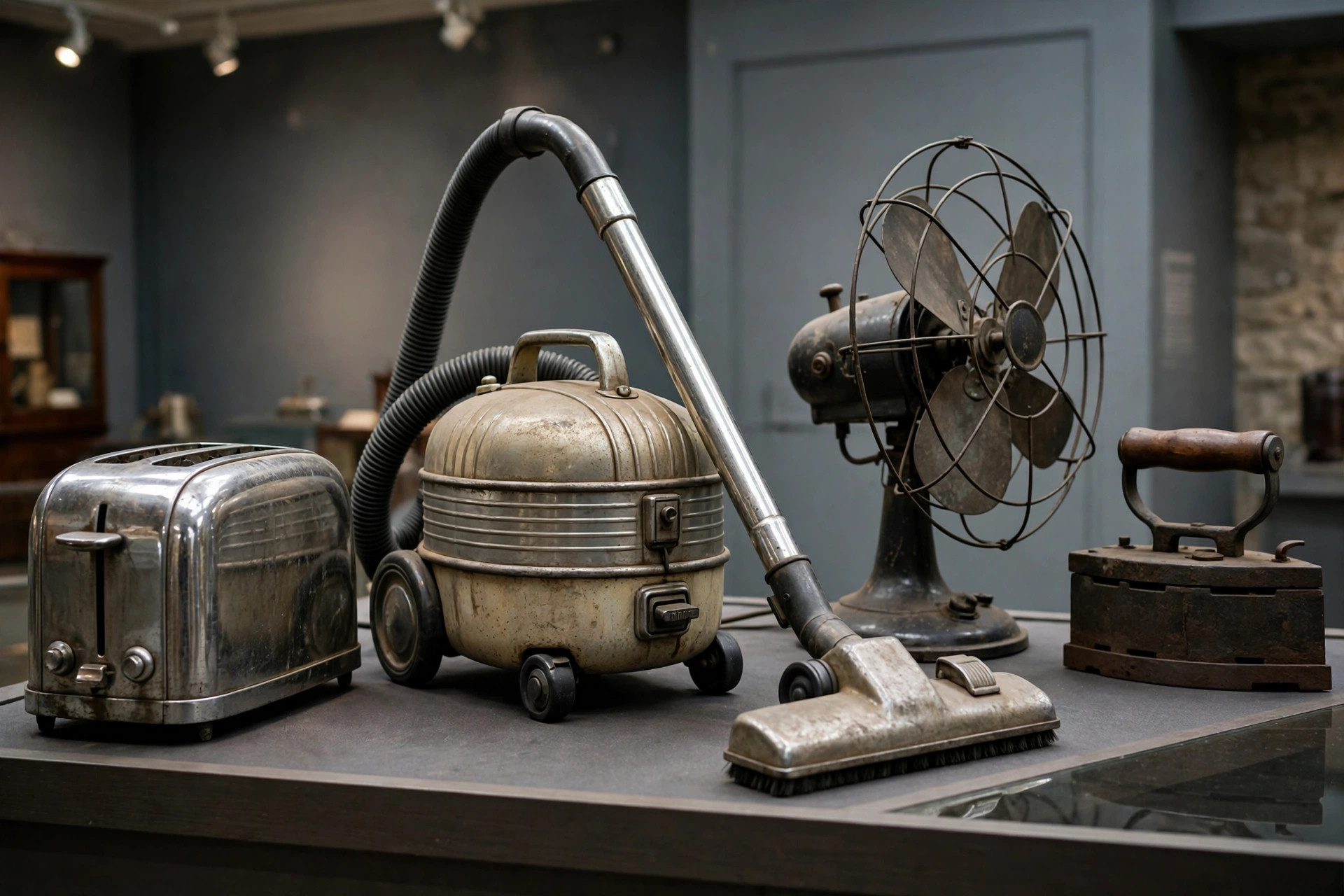
Most people meet vacuum in its everyday sense: the household appliance. “The vacuum is in the hall closet.” “The vacuum cleaner stopped working.” In this sense, vacuum is simply short for “vacuum cleaner,” and it is the meaning you will hear most often at home.
What makes the word interesting is what happened next. The appliance gave its name to an action, and the noun became a verb. “I need to vacuum the car.” “They vacuumed the whole house in under an hour.” “He vacuums the office every Friday.” This is a fully standard verb, used in casual and formal writing alike, and it follows normal verb patterns: vacuums, vacuumed, vacuuming. All of them keep the same V-A-C-U-U-M base.
The verb has also produced a family of compound words that show up in kitchens and factories: vacuum-sealed (packaging with the air removed, so food lasts longer), vacuum-packed (the same idea, as a product label), and vacuum flask (a thermos, which uses a vacuum layer as insulation). Each one carries the double U with it. Misspell the base and every compound inherits the error, which is why “vaccum-sealed” appears so often on homemade labels and small-business packaging.
There is a small piece of brand history here too. For decades, many people called any vacuum cleaner a “Hoover,” after the dominant manufacturer — the way some people call any tissue a “Kleenex.” The brand name faded as the market diversified, but the verb survived: to vacuum is now the generic action, regardless of which machine you push. The word outgrew the brand.
Nothing to See: The Science
Vacuum has a second, older meaning, and it is the reason the word exists at all. In science, a vacuum is a space with no matter in it — no air, no gas, nothing. Outer space is the most famous example. A perfect vacuum does not occur naturally very often, so scientists create partial vacuums in laboratories to run experiments: “Light travels through the vacuum of space.” “The chamber was pumped down to a near-vacuum.”
The word comes from the Latin adjective vacuus, meaning “empty.” The Romans used it for empty spaces and empty rooms. English borrowed it in the 1500s, first for empty space, and much later for the cleaning machine — which works by creating a partial vacuum inside itself, so that air rushes in and carries dirt with it. The appliance is named after the physics. Every time you vacuum a carpet, you are operating a small, portable piece of 17th-century science.
That science has a famous moment. In the 1640s, the Italian physicist Evangelista Torricelli invented the barometer and demonstrated that a vacuum could exist at the top of a tube of mercury — a result that shocked philosophers who had believed “nature abhors a vacuum.” Torricelli was right, and the vacuum went from a philosophical impossibility to a laboratory tool. Three centuries later, vacuum tubes — glass bulbs with the air removed — became the electronic heart of early radios, televisions, and computers, before transistors replaced them. The word has been at the center of technology for a long time, and it still is: vacuum chambers are used to manufacture computer chips today.
The plural is worth one line. The standard plural is vacuums. A Latin-based plural, “vacua,” exists in specialized scientific writing, but “vacuums” is what you should use in ordinary English — for the machines, the empty spaces, and the verbs alike.
The C Mix-Up
Let us settle the C question once, because it causes the most stubborn errors. Vacuum has one C. The words that tempt you toward two C’s — accept, occur, recommend, success — all have their own reasons for the doubling, and none of them apply here. The doubled letter in vacuum is the U. If you remember one sentence about this word, make it this one: the U is doubled, the C is not.
A practical test helps. Write the word and look at it. Does it have two U’s in a row? It should. Does it have two C’s in a row? It should not. Does it end in -uum, not -ume? It should. Three checks, five seconds, and the word is safe.
One final habit: when you type vacuum, slow down at the middle. Most typos happen because the fingers rush through the part the brain finds odd — the double U. Type V-A-C, pause, type U-U, pause, type M. It feels deliberate the first few times. After a week, the pattern lives in your hands, and the rarest double letter in English stops being rare to you. It becomes the one double letter you never get wrong.
Vacuum in Everyday Phrases
Vacuum has escaped the laboratory and the living room into the language of politics, business, and daily life. The most famous phrase is “nature abhors a vacuum.” Aristotle is credited with the idea: empty spaces, he believed, must be filled. Modern physics disagrees — vacuums exist quite happily — but the phrase survives as a metaphor. In politics, a power vacuum describes what happens when a leader falls and no successor is ready: rival factions rush in to fill the empty space, just as air rushes into a vacuum chamber. In business, a leadership vacuum means a team with no one making decisions, and the result is usually the same: someone fills it, whether or not they are the right person.
Another common phrase is “in a vacuum.” “You can’t make this decision in a vacuum” means you cannot decide without context — without knowing the market, the history, the people involved. The phrase treats isolation as emptiness: a choice made in a vacuum is a choice made in the absence of the air it needs. It is a neat piece of imagery, and it is used constantly in offices, newsrooms, and classrooms.
The vacuum flask deserves a mention of its own. Invented by the Scottish scientist James Dewar in 1892, it uses a vacuum layer between two glass walls to insulate its contents — the vacuum stops heat from traveling, so hot drinks stay hot and cold drinks stay cold. The household thermos is a vacuum flask with a brand name. Every time you pour coffee from a thermos on a winter morning, you are using the same physics as a space scientist.
The word also appears in phrases about silence and absence. “A vacuum of information” describes a situation where nobody knows what is happening — and, as with a power vacuum, rumor rushes in to fill it. “The room fell into a vacuum of silence” is a writer’s way of describing a quiet so complete it feels physical. In each case, the word borrows the physics: an absence that pulls something in to fill it.
These phrases are worth knowing because they show how far a scientific word can travel. Vacuum began as Latin for “empty,” became a laboratory concept, became an appliance, and became a metaphor for every kind of emptiness that demands to be filled. The spelling travels with it everywhere: V-A-C-U-U-M, double U, single C, in every register from physics papers to political speeches.