Picture a rainy office at six in the evening. Two colleagues, Priya and Marcus, are the last ones left. Priya is about to leave when she notices an umbrella by the door — black, wooden handle, not hers. “Is this yours?” she asks. Marcus shakes his head. “Must be someone else’s,” he says. Priya nods, leaves it there, and walks out into the rain without one.
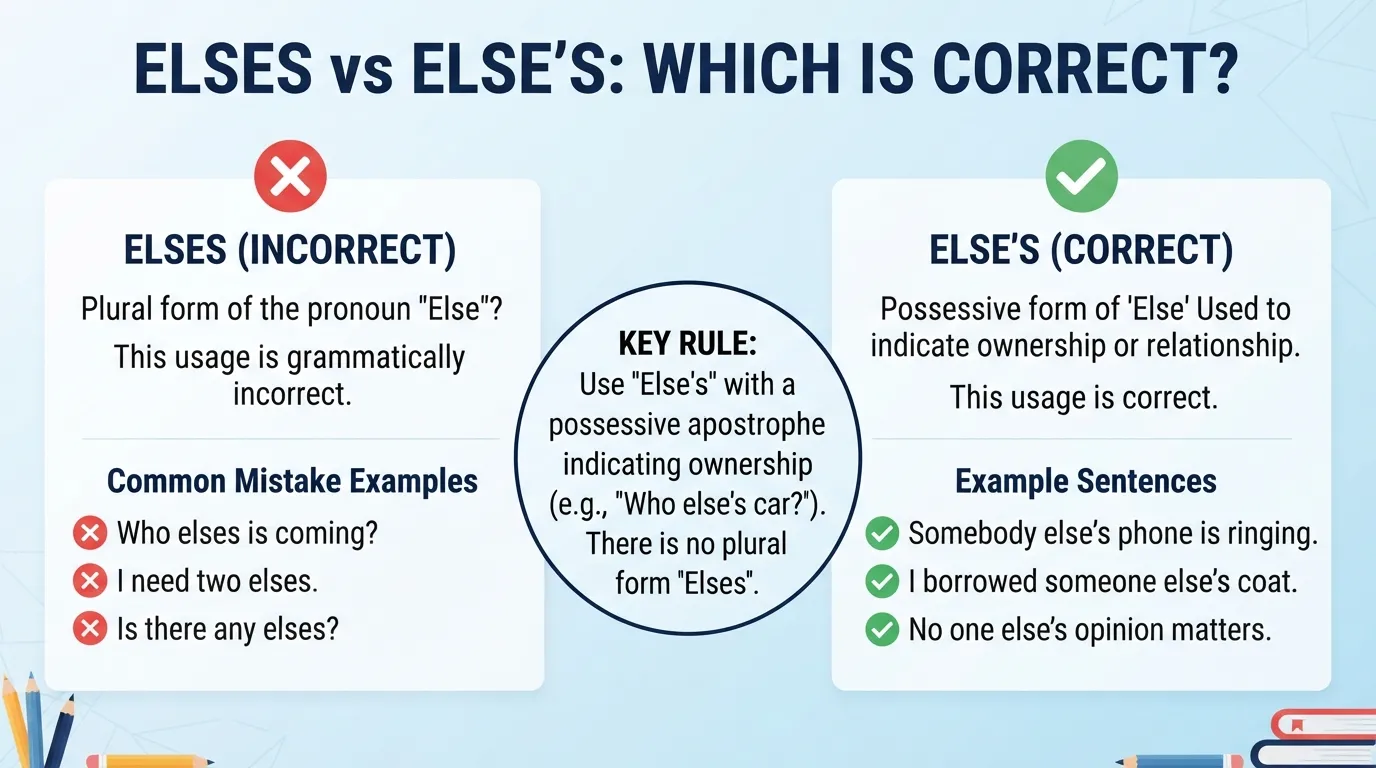
Nothing in that scene is remarkable except one thing: the word Marcus used. Someone else’s. It is a small phrase, but it hides one of English’s oddest grammatical maneuvers — an apostrophe attached to a word that is not even a noun. And it is the reason so many people freeze when they have to write it, and end up typing elses instead. Elses is not the standard form. Else’s, with the apostrophe, is. Understanding why means understanding what else actually is — and why English forces it to do a job it was never designed for.
Whose Umbrella? The Problem in One Sentence
The confusion always arrives in the same shape: a writer needs to say that something belongs to a different person, and the sentence comes out as “someone elses car” or “anybody elses idea.” The instinct is understandable. In English, possession is usually shown by adding ‘s to the owner: Maria’s car, the dog’s bowl. So when the owner is “someone else,” the writer adds s to the last word and stops. The result, elses, looks like it should work. It does not, because English possession needs the apostrophe — and because else is doing something stranger than being an owner.
The correct form is someone else’s car, anybody else’s idea, everyone else’s opinion. The apostrophe-s attaches to else, even though else is not the owner — someone is. English has decided, in effect, to hang the possessive marker on the last word of the whole phrase, wherever that happens to land. It is the same logic that lets us write the Queen of England’s crown: the crown belongs to the Queen, but the ‘s lands on England, the last word of the phrase. Someone else’s is that same trick, in miniature.
This is the single most important fact about this pair. Elses, without an apostrophe, is not a word in standard English. It is a misspelling of else’s. If your spell checker flags elses, it is right. Add the apostrophe, and the sentence is fixed.
Else Is an Adverb Wearing a Disguise
Why does this feel so unnatural? Because else is not a noun. It is an adverb meaning “in addition,” “otherwise,” or “other than the person or thing already mentioned.” It almost never stands alone. It follows indefinite pronouns — someone else, anybody else, nobody else, everyone else — and question words — what else, who else, where else, how else. In each case it points away from the thing already named, toward something additional or different.
Consider the range: “Is there anything else you need?” (something additional). “Who else is coming?” (another person). “Let’s go somewhere else.” (another place). “What else could we do?” (another option). In every case, else leans on the word before it. It cannot stand up as a subject or an object on its own. You cannot say “Else is coming” or “I saw else.” The word needs a partner.
That dependence is exactly why the possessive feels strange. Possession normally belongs to nouns and pronouns — Maria’s, his, theirs. But in someone else’s jacket, the phrase as a whole names the owner (“someone other than the person we meant”), and English puts the possessive ending on the phrase’s final word. Else carries the apostrophe because it happens to be last in line, not because it owns anything. Once you see that, the spelling stops feeling arbitrary. It is the language applying one consistent rule — ‘s goes at the end of the owner phrase — to an unusual owner phrase.
The Apostrophe Does the Real Work
Because the apostrophe carries the entire meaning, dropping it changes the sentence from “belonging to another person” to nonsense. “I borrowed someone elses charger” leaves the reader hunting for a word that does not exist. “I borrowed someone else’s charger” is instantly clear. The apostrophe is not decoration; it is the only thing distinguishing possession from a typo.
There are three ways writers get the apostrophe wrong, and each has a different fix. The first is omitting it entirely (elses) — fix by adding ‘s. The second is putting the apostrophe after the s (elses’) — this is the plural-possessive pattern (“the dogs’ bowls”), but it does not apply here, because else has no plural to possess. The third is doubling up (else’s’s), which sometimes appears when a writer senses that something is off and overcorrects. One apostrophe, one s: else’s. That is the whole formula.
A useful test: replace the phrase with a simple name. “I borrowed Marcus’s charger” works the same way as “I borrowed someone else’s charger.” If the name version takes ‘s, the else version does too. The test works because the two phrases play the same role in the sentence — owner — even though one is a name and the other is a pronoun plus else.
The Whole Family: Someone, Anyone, Everyone, Nobody
The pattern is not limited to someone else’s. It runs through the entire family of else phrases, and it is worth seeing the full set, because writers who learn only one member of the family often stumble on the others:
- Someone else’s — “That is someone else’s laptop; please don’t move it.”
- Somebody else’s — “We ended up using somebody else’s slides.”
- Anyone else’s — “I don’t want anyone else’s opinion on this; I want yours.”
- Anybody else’s — “Is this anybody else’s coat?”
- Everyone else’s — “Her presentation was shorter than everyone else’s.”
- Everybody else’s — “Everybody else’s code passed the review.”
- Nobody else’s — “The decision was nobody else’s to make.”
- Somewhere else’s — rare, but possible: “The recipe is somewhere else’s version, not ours.”
Notice that the last one is awkward, and that awkwardness is informative. Somewhere else’s is grammatically possible but stylistically clumsy, because places do not own things the way people do. Native speakers usually rephrase: “The recipe comes from somewhere else.” The fact that the construction strains at the edges shows how tightly it is tied to people and their possessions.
The same pattern extends to question words, though less often: “Whose else’s…?” is not standard — you would say “Who else’s…?” (“Who else’s turn is it?”). Here the possessive lands on else after who, and it is perfectly correct, if a little formal-sounding. In casual speech, people often rephrase to “Whose turn is it next?” — which is a reminder that the else’s construction, while correct, is not always the most natural choice.
Is There a Plural of Else?
One question that drives a lot of elses misspellings is the plural question: if one person is “someone else,” are two people “someone elses”? The answer is no, and the reason is that else never becomes plural. The plural lives in the pronoun, not in else. “Someone else” refers to one other person; “other people” or “everyone else” refers to several. There is no situation in standard English where elses is the plural of anything.
This is worth stating plainly because the elses spelling looks so much like a normal plural. English trains us to add -s for “more than one”: cat / cats, idea / ideas. But else is not a noun, so it has no plural, just as very and quickly have no plurals. You would never write “verys” or “quicklies.” Elses belongs in the same category: a plural ending on a word that cannot take one.
There is one apparent exception, and it proves the rule. In linguistics and grammar discussions, you may see elses used as a mention rather than a use — as in “this sentence contains two elses.” That is the word being quoted as an object of discussion, and even there it is usually written with quotation marks or italics: “two elses.” It is not a license to use elses in ordinary writing.
Rephrasing Your Way Out
Sometimes the cleanest fix for an else’s sentence is not to fix the apostrophe but to rephrase. The construction is correct, but it can grow heavy in formal writing, especially with longer owner phrases. “The committee’s decision, and not anyone else’s, will stand” is correct but clunky. Alternatives include: “The committee alone will decide.” “No one else’s approval is needed” can become “No further approval is needed.” “Someone else’s responsibility” can become “another person’s responsibility” or simply “someone else’s job” — shorter owner phrases read better.
In casual writing, the construction is completely natural and needs no rephrasing. “Mind your own business, not someone else’s” is idiomatic. “Don’t judge everyone else’s choices” is idiomatic. The place to rephrase is formal or legal writing, where long chains of possessives (“the contractor’s subcontractor’s someone else’s…”) become unreadable. There, recasting the sentence is a style choice, not a grammar fix.
And a final note on pronunciation: else’s is pronounced exactly like else plus a z sound — EL-siz. It sounds identical to the misspelling elses, which is why the error survives: in speech, there is no difference to hear. The apostrophe is a purely written signal, and writing is where it must be supplied. The umbrella by the office door belonged to someone else — and the apostrophe that says so belongs in the sentence, every time.










