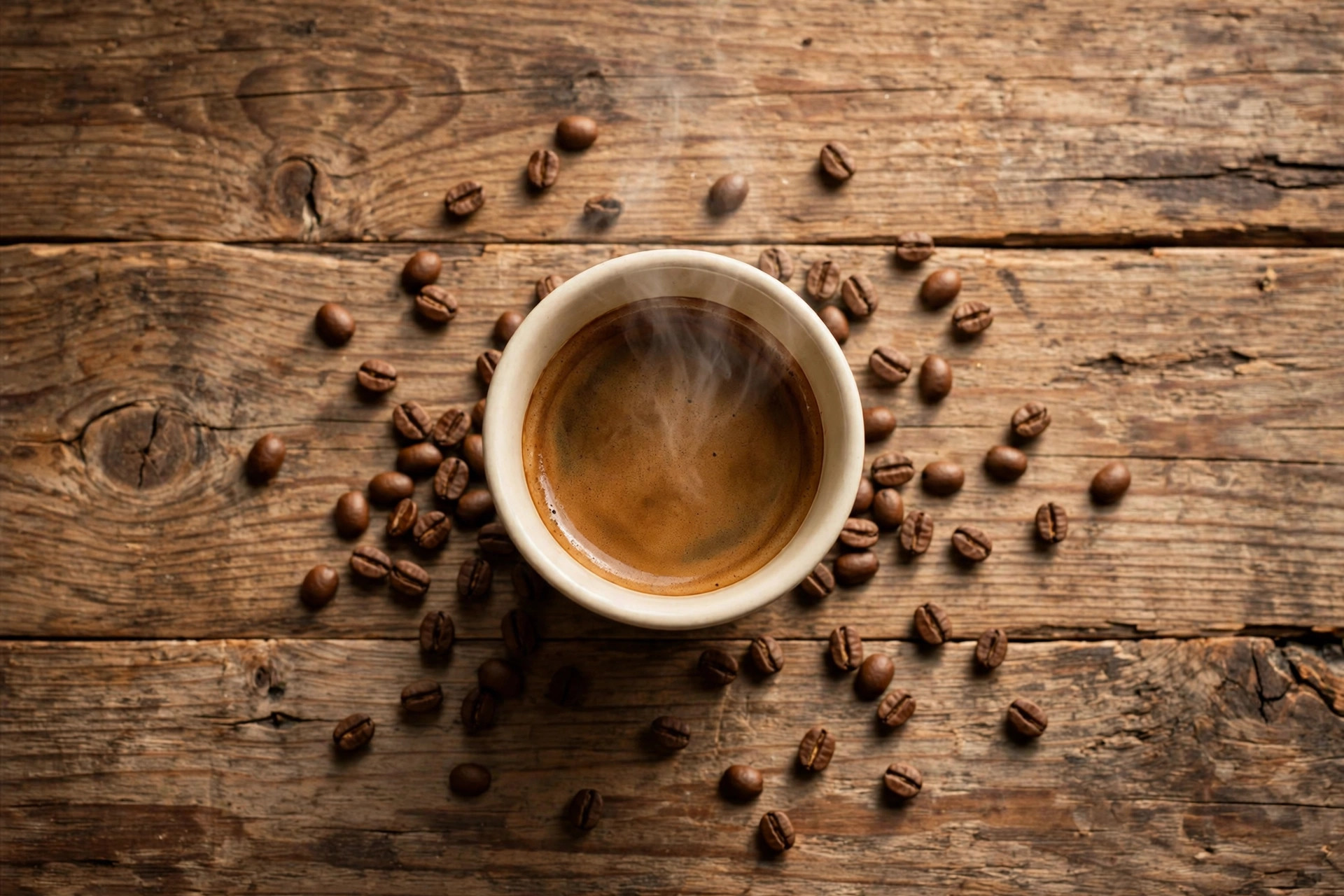
It is 6:00 in the morning. Somewhere, a coffee plant’s red cherry has been picked, dried, roasted, ground, and brewed. The dark liquid in your cup contains a molecule that is about to go on a journey through your body — and that molecule’s name is one of the most misspelled words in English.
The word is caffeine. The misspelling is caffine. The difference is two letters in the middle, and the reason people get it wrong has everything to do with how the word sounds, where it came from, and what its letters look like next to familiar words. Follow the molecule, and the spelling follows.
6:00 a.m.: The Bean Wakes Up

Caffeine begins as a defense mechanism. Coffee plants, tea bushes, cacao trees, and a few dozen other species produce it as a natural pesticide — bitter enough to deter insects, in doses that happen to be pleasant for humans. A single coffee bean contains roughly one to two percent caffeine by weight. A tea leaf contains more by dry weight, though a cup of tea usually delivers less, because less leaf is used and the brewing is gentler.
Humans discovered this molecule early and enthusiastically. Coffeehouses in the Middle East were serving it by the 1400s. Tea had been drunk in China for far longer. Chocolate arrived in Europe in the 1500s and brought caffeine with it. By the time the word caffeine entered English in the 1820s — chemists isolated the compound in 1819 and named it after coffee, from the French café — the substance was already a daily habit for millions of people.
That history matters for the spelling, because the word’s middle — the ei that everyone drops — is a souvenir of its French origin. English did not invent the word from scratch; it borrowed it, letters and all, from caféine. The ei is the French fingerprint.
The Molecule’s Commute to Your Brain

Once you drink it, caffeine moves fast. It is absorbed through the stomach and small intestine and reaches peak concentration in the blood within about 45 minutes. From there it crosses into the brain, where it does its famous trick: it blocks adenosine, the neurotransmitter that signals sleepiness. With adenosine’s parking spaces occupied, the brain feels more alert — not because it has gained energy, but because the “tired” signal has been muted.
The effect lasts several hours. Caffeine’s half-life — the time for half of it to be cleared — is roughly five hours in most adults, which is why a 4 p.m. espresso can still be echoing at bedtime. The body clears it through the liver, and the rate varies with genetics, pregnancy, medication, and even smoking.
None of this is why the word is hard to spell. But it explains why the word is everywhere — on labels, in articles, in medical advice, in casual conversation — and therefore why its misspelling is so visible. A word you write once a year can be misspelled quietly. A word you write every day cannot.
Why Caffine Looks So Convincing

Caffine is a persuasive misspelling, and it persuades for three reasons. First, pronunciation hides the truth. Say “caffeine” out loud: ka-FEEN. The middle vowel sounds collapse into a single long “ee,” and the ear reports nothing about whether the letters are ei, ie, or just i. Spelling by ear produces caffine naturally.
Second, the word’s shape invites a familiar pattern. English has a large family of words with double f followed by i: affinity, affirm, affection, afflict, offer. The brain sees caff- and expects an i to follow, because that is what usually follows. Caffine fits the neighborhood. Caffeine, with its ei, looks like the odd one out — even though it is the correct form.
Third, the schoolroom rule “i before e except after c” actively misleads here. People who half-remember the rule try to apply it and produce caffine, believing they are following the pattern. But the rule does not govern this word. The ei in caffeine is not an “i before e” situation at all; it is a French borrowing whose letters were fixed by its origin, not by an English sound rule. The rhyme, famously unreliable, fails again.
The correct shape is worth staring at once: c-a-f-f-e-i-n-e. Double f, then e-i, then n-e. Say it as “caff-e-i-ne” and the middle stops being invisible.
A French Passport: Where the ei Came From
The German chemist Friedlieb Runge isolated caffeine in 1819 at the request of the poet Goethe, who had heard about the young chemist’s work and wanted to know what made coffee stimulating. Runge named the compound Koffein in German; French chemists rendered it caféine; English took the French form and dropped the accent, leaving caffeine.
The French éi represented a long “ay” sound that English speakers heard as “ee.” English kept the letters and changed the sound — a common outcome for borrowings. The same process gave us protein (from Greek via German) and codeine (from Greek kodeia). In fact, the -eine / -ine ending is a small family of chemistry words: caffeine, codeine, protein, nicotine. If you know one of them, the ending of the others follows the same shape.
Knowing the origin does more than satisfy curiosity. It gives the spelling a reason. Caffeine is not spelled with ei because of a rule; it is spelled that way because of a journey — from a German laboratory, through French chemistry, into English. Words carry their histories in their letters, and this word’s history is written right in its middle.
Caffeine by the Numbers
A few figures make the word concrete — and give you natural sentences to practice it in:
- Brewed coffee (8 oz): roughly 95 mg of caffeine.
- Espresso (1 oz): roughly 63 mg — less per shot, but far more concentrated.
- Black tea (8 oz): roughly 45–50 mg.
- Dark chocolate (1 oz): roughly 20 mg.
- Cola (12 oz): roughly 30–40 mg.
Most health authorities put the general daily ceiling for healthy adults around 400 mg — about four cups of brewed coffee. The numbers vary by source and by bean, which is exactly why the word appears in so many articles, labels, and arguments. “How much caffeine is in this?” is one of the most asked nutrition questions in English, and every answer has to spell the word.
Notice how naturally the word fits into these sentences. It is a noun, naming a substance. It rarely appears as anything else — there is no verb “to caffeine,” no adjective “caffeinated” in the sense of a quality (though “caffeinated” exists as a participle: “caffeinated coffee”). The word’s grammatical life is simple. Its spelling is the only hard part.
Decaf, Withdrawal, and the Afternoon Cliff
Caffeine’s story has a few sequels worth knowing, because they explain why the word shows up in so many health conversations. The first is decaf. Decaffeinated coffee is not caffeine-free — it typically retains 2–7 mg per cup — because the decaffeination process removes most but not all of the molecule. The Swiss Water method, the most common chemical-free process, soaks the beans in hot water and filters the caffeine out with activated carbon. The result tastes close to regular coffee, and for people who love the ritual but not the buzz, it is a compromise that works.
The second sequel is withdrawal. People who drink caffeine daily and stop abruptly often get headaches, fatigue, irritability, and difficulty concentrating for a day or two. The mechanism is straightforward: the brain, accustomed to blocked adenosine receptors, has grown extra receptors to compensate. When the caffeine vanishes, adenosine floods the expanded receptor network, and the tiredness signal hits harder than usual. The headache is real, the mechanism is understood, and the cure is usually time — or a small, tapered dose.
The third is the afternoon cliff. Caffeine’s half-life means that a morning dose is still half-present at mid-afternoon, and a mid-afternoon dose is still half-present at bedtime. This is why sleep specialists advise a “caffeine curfew” — no coffee after 2 p.m. for sensitive sleepers — and why the “caffeine nap” (drink coffee, then nap for twenty minutes, waking as the caffeine kicks in) works for some people. The nap clears adenosine while the caffeine blocks its return. It sounds like a trick, but the pharmacology is sound.
None of this makes caffeine dangerous for most adults in normal amounts. It makes it a substance worth understanding — which is why the word appears in medical guidance, on labels, and in a thousand articles. And every one of those appearances has to spell it caffeine, with the ei that its French passport gave it.
Writing It Right, Every Time
Three habits settle the spelling permanently. First, link it to its French origin: café plus -ine gives caffeine, and the é of café survives as the e of ei. If you can spell café, you can spell caffeine — just add ine after the fe, and remember the double f that coffee also has.
Second, distrust the affinity pattern. Yes, affinity and affirm use ffi. Caffeine does not. It is the exception in its own neighborhood, and exceptions are exactly what memory hooks are for.
Third, say the letters when you write them: “caff-e-i-ne.” Two seconds of deliberate spelling, a few times, builds the motor habit. After that, the hand knows the word even when the ear does not.
Tomorrow morning, the molecule will make its commute again — from bean to cup to brain. The word will be on the bag, on the menu, in the article you read while you drink. Now it will be spelled right.










